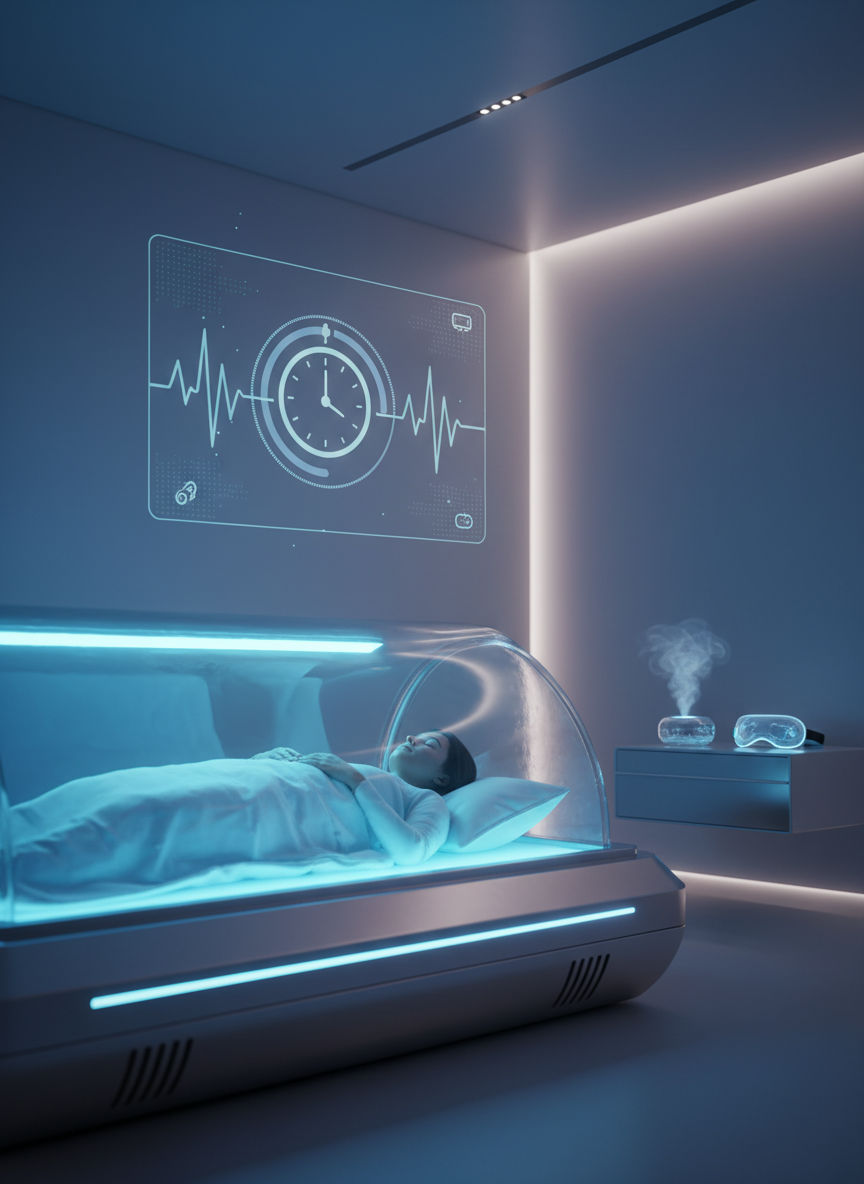
Why are you spending a third of your life unconscious?
Prompted by NerdSip Explorer #6598
Understand how sleep rebuilds your brain and body.
Have you ever noticed how your phone starts acting glitchy when it hasn't been turned off in a while? Your body and brain work the exact same way. When you sleep, you aren't just 'turning off' for the night—you are running a critical system update.
During the day, your brain builds up chemical waste just from thinking and moving. When you finally close your eyes, your brain acts like a nighttime cleaning crew. It flushes out the day's waste, files away your memories, and repairs your muscles.
Without this nightly reboot, that chemical 'junk' stays in your brain. This is why you feel foggy, irritable, or clumsy after a bad night's rest. Sleep isn't a luxury or a sign of weakness; it is the most powerful biological reset button you possess.
By prioritizing sleep, you are literally giving your brain a daily bath and keeping your mental engine running smoothly!
Key Takeaway
Sleep is an active, vital process where your brain cleans and repairs itself.
Test Your Knowledge
What happens to your brain while you sleep?
Imagine your sleep as a dishwasher with different cycles. To get everything perfectly clean, it has to run through the heavy wash and then the delicate cycle. Your brain does this by alternating between two main 'gears' during the night.
The first gear is Deep Sleep. Think of this as the physical repair shop. Your breathing slows down, your muscles relax, and your body pumps out hormones to heal physical wear and tear. If you wake up feeling physically refreshed, you had good deep sleep.
The second gear is REM Sleep (Rapid Eye Movement). This is the mental and emotional sorting phase. Your brain becomes highly active, and this is when you have your most vivid dreams. REM sleep takes the raw information from your day and organizes it into long-term memories.
Throughout the night, you bounce back and forth between these two gears. You need both the physical repair and the mental sorting to wake up feeling like your best self!
Key Takeaway
Your sleep cycles between physical repair (Deep Sleep) and mental sorting (REM Sleep).
Test Your Knowledge
Which phase of sleep is primarily responsible for mental and emotional sorting?
Have you ever wondered how your body knows when to feel tired and when to wake up? You actually have a 24-hour internal timer running in the background of your brain, known as the circadian rhythm.
Think of this rhythm as a master conductor directing an orchestra. It sends signals to every cell in your body, telling them what time it is. The most important tool this conductor uses to keep time is light.
When sunlight hits your eyes in the morning, it sends a loud 'wake up!' message to your brain, making you feel alert. As the sun goes down and darkness falls, your brain releases a sleepy hormone called melatonin. This hormone is like a quiet lullaby, preparing your body for rest.
When we travel across time zones, our internal clock gets out of sync with the sun, which is exactly why we experience jet lag!
Key Takeaway
Your circadian rhythm is an internal clock that uses light and darkness to regulate your sleep.
Test Your Knowledge
What is the primary signal your internal clock uses to know what time it is?
Even if you want to sleep, modern life is filled with sneaky 'sleep thieves' that trick your brain into staying awake. Understanding these culprits is the first step to beating them.
The most common thief is caffeine. When you drink coffee, the caffeine acts like a piece of tape over your brain's 'tired' sensors. Even though your body needs rest, the brain can't feel the sleepy signals. Because caffeine stays in your system for hours, an afternoon coffee can easily ruin your bedtime.
Another major thief is blue light from phones, tablets, and TVs. Remember how our internal clock uses light to know it's daytime? The bright light from your phone mimics the sun. Looking at screens late at night tricks your brain into thinking it's noon, stopping the release of your sleep hormone.
Finally, stress acts like a false alarm in your body. It triggers a 'fight or flight' response, making your brain think there is danger nearby, keeping you tossing and turning.
Key Takeaway
Caffeine, blue light from screens, and stress can artificially block your body's natural sleep signals.
Test Your Knowledge
Why does looking at a phone screen at night make it hard to sleep?
Now that you know how sleep works, how do you actually get more of it? The secret is treating your bedroom like a cozy, prehistoric sleep cave. Our ancestors slept best in environments that were cool, dark, and quiet, and our modern biology craves the exact same thing.
First, cool it down. Your body temperature naturally drops when you sleep. Keeping your room slightly chilly acts as a signal to your brain that it's time to rest.
Next, block the light. Remember the blue light sleep thief? Try to make your room as pitch-black as possible using blackout curtains or an eye mask.
Finally, establish a wind-down routine. Just like a pilot gently descends an airplane before landing, you need to gently bring your day to a close. Reading a physical book, taking a warm shower, or doing gentle stretching signals to your brain that it is safe to finally shut down.
Key Takeaway
You can drastically improve your sleep by making your bedroom cool, dark, and building a relaxing bedtime routine.
Test Your Knowledge
Which bedroom environment is best suited for quality sleep?
Track your progress, earn XP, and compete on leaderboards. Download NerdSip to start learning.