Why does your Xbox use a GPU, but Google's AI uses a TPU?
Prompted by A NerdSip Learner
Confident grasp of AI hardware architectures.
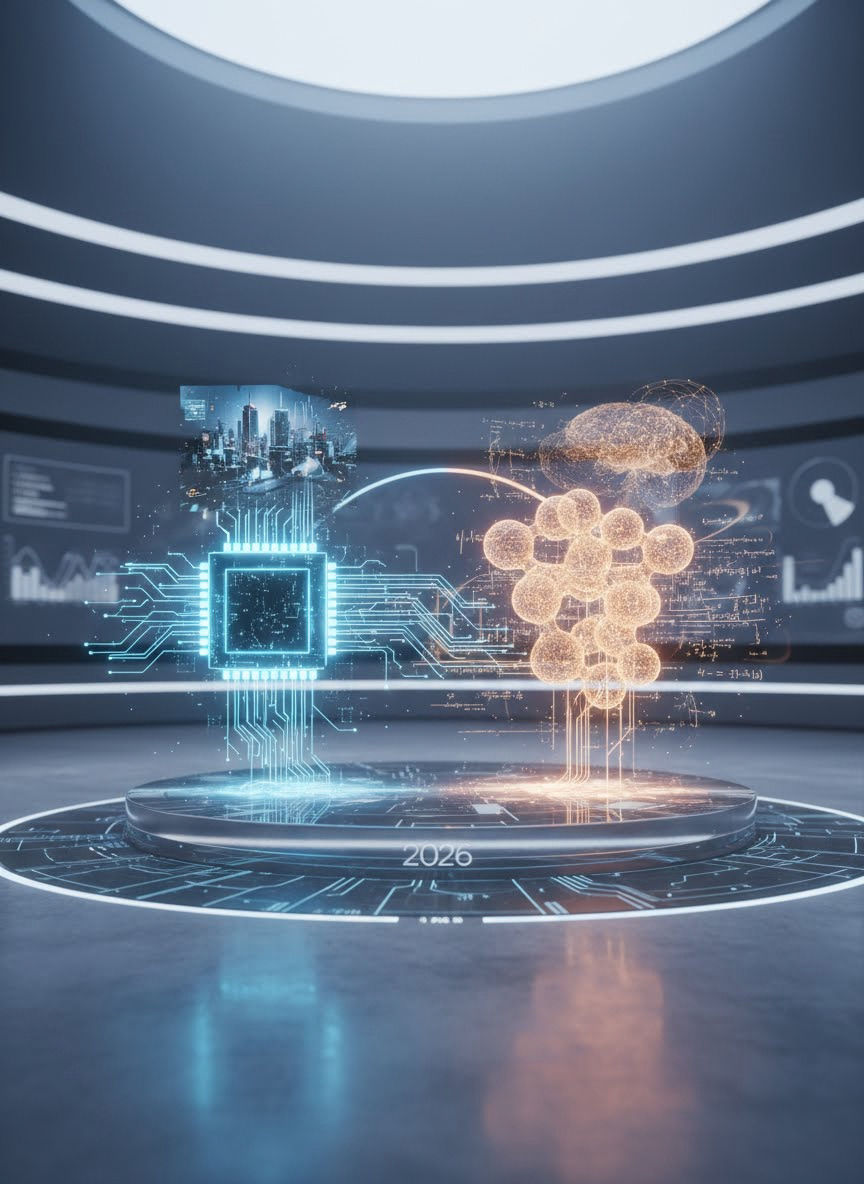
Welcome to the engine room of the AI revolution! To understand the difference between a GPU (Graphics Processing Unit) and a TPU (Tensor Processing Unit), we need to look at what they were born to do. Imagine a GPU as a Swiss Army Knife. It was originally designed for video games—rendering millions of pixels to make explosions look cool. Because of this, it’s incredibly versatile. It can handle graphics, physics simulations, and yes, AI math.
Now, meet the TPU. This is the Scalpel—a laser-focused tool created by Google specifically for one job: machine learning. It doesn't care about video games or rendering graphics. In 2026, while GPUs are still the jack-of-all-trades powering your PC and generic AI tasks, TPUs are the specialized heavy lifters running inside massive data centers to train the world's largest models.
Think of it this way: If you needed to commute to work, you’d drive a car (GPU). But if you needed to move 500 tons of cargo across the country, you’d build a freight train (TPU). Both move things, but their design philosophy is completely different.
Key Takeaway
GPUs are versatile multi-purpose chips, while TPUs are specialized hardware built solely for AI math.
Test Your Knowledge
Which analogy best describes the GPU?
Let’s pop the hood and look at the architecture. A GPU achieves speed by using thousands of small, efficient cores. It breaks a big problem down into thousands of tiny pieces and solves them all at once—this is called *parallel processing*. It's like having a stadium full of people each solving one math problem on a notepad simultaneously.
A TPU, however, uses something called a Systolic Array. Instead of writing data back and forth to memory constantly (which is slow), the TPU feeds data through a massive grid of calculators in a flowing wave. The output of one calculation flows directly into the next without stopping.
In 2026, this efficiency is crucial. The TPU acts like a highly tuned assembly line. It might not be able to change tasks as quickly as the crowd of people (GPU), but once it's set up to do matrix multiplication (the math of AI), it churns out results with incredible speed and lower electricity usage.
Key Takeaway
GPUs use thousands of cores for parallel tasks, while TPUs use systolic arrays to flow data like an assembly line.
Test Your Knowledge
Why is the TPU's 'Systolic Array' architecture efficient?
Here is where it gets a bit technical, but stick with me! Computers think in numbers, and the 'precision' of those numbers matters. A classic CPU or GPU often likes to calculate with high precision (like 64-bit or 32-bit numbers), ensuring the answer is exact to many decimal places. This is great for scientific simulations where being off by 0.00001 matters.
But here's the secret of AI in 2026: AI doesn't need to be perfect; it just needs to be close enough.
TPUs are aggressive about using lower precision formats, like bfloat16 (Brain Floating Point). They chop off the unnecessary decimal places to calculate faster. Imagine trying to multiply $45.12345 by $10.98765 versus just multiplying $45 by $11. The second one is lightning fast! TPUs sacrifice a tiny bit of microscopic accuracy for a massive boost in speed, which is exactly what neural networks need to learn efficiently.
Key Takeaway
TPUs gain speed by prioritizing 'good enough' lower-precision math (bfloat16) over the high precision required for other computing tasks.
Test Your Knowledge
What trade-off do TPUs make to gain speed?
If TPUs are so fast, why doesn't everyone use them? The answer lies in the ecosystem.
GPUs (dominated by Nvidia) utilize a software platform called CUDA. It is incredibly mature and flexible. In 2026, almost every AI researcher, student, and startup starts on GPUs because they work with every piece of software out of the box. You can buy a GPU, stick it in your home PC, and start coding.
TPUs (created by Google) are mostly available only through Google’s Cloud. You can't buy a TPU at your local electronics store. To use them, you typically need to use specific software frameworks (like JAX or TensorFlow) that are optimized for that hardware.
It’s the classic trade-off: The GPU is the ultimate flexible tool you can own and use anywhere. The TPU is the rentable super-weapon that requires you to play by Google's rules, but rewards you with unmatched efficiency at scale.
Key Takeaway
GPUs offer flexibility and ownership, while TPUs are cloud-based powerhouses tied to Google's ecosystem.
Test Your Knowledge
What is a major limitation of TPUs for the average user?
So, who wins the battle in 2026? The truth is, they have called a truce and divided the territory.
GPUs have retained the crown for training diverse models and for consumer applications. If you are generating images on your laptop, playing a VR game, or a researcher testing a weird new architecture, you are using a GPU. Their versatility makes them safe and powerful.
TPUs rule the land of massive scale. When a tech giant needs to train a model with trillions of parameters (like the successors to GPT-4), they turn to TPU pods (thousands of TPUs connected together) because they use less power and run faster for that specific math.
For you, the user? You'll likely own a GPU, but the smart assistant you talk to on your phone was probably trained on a TPU. It’s a symbiotic relationship driving our AI future!
Key Takeaway
GPUs dominate consumer tech and research flexibility, while TPUs dominate massive-scale cloud training.
Test Your Knowledge
If you were a researcher trying a brand new, experimental AI method, which chip would you likely choose?
Track your progress, earn XP, and compete on leaderboards. Download NerdSip to start learning.