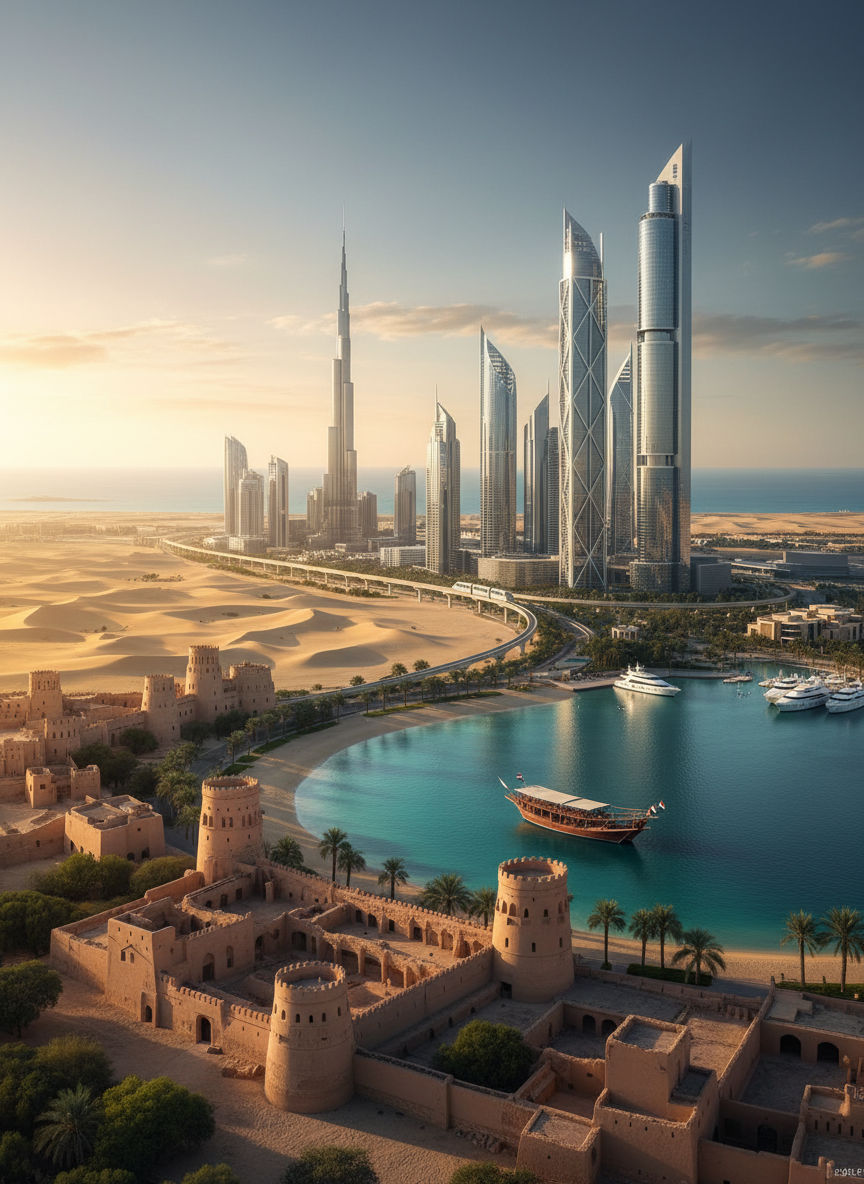
How did Bedouin tribes architect the world's most modern megacities?
Prompted by A NerdSip Learner
Master the intricate history and power dynamics of the UAE’s ruling families.
To grasp the UAE's political landscape, we must look back to the 18th century. The foundation of modern power lies in the Bani Yas tribal confederation, a complex network of Bedouin tribes originally settled in the fertile Liwa Oasis on the edge of the Empty Quarter desert.
The confederation was led by the Al Bu Falah branch, from which the current ruling family of Abu Dhabi, the Al Nahyan, emerged. Driven by droughts and the strategic potential of the pearl trade, these tribes began migrating to the coast around 1793, eventually moving their seat of power to Abu Dhabi island.
This migration marked the birth of systematic state-building. The Bani Yas established a thriving territory held together by shrewd marriage alliances and Bedouin diplomacy. Their dominance along the coast laid the essential groundwork for Abu Dhabi’s future territorial expansion.
Key Takeaway
The UAE’s modern power structure is rooted in the historic Bani Yas tribal confederation from the Liwa Oasis.
Test Your Knowledge
Which branch of the Bani Yas historically provided the leadership and is the lineage of the Al Nahyan?
Despite the strength of the Bani Yas, internal tensions eventually surfaced. In 1833, a pivotal political rift occurred: approximately 800 members of the Al Bu Falasah branch broke away from Al Nahyan rule in Abu Dhabi.
Led by Maktoum bin Butti, they journeyed north along the coast and settled at the mouth of the Dubai Creek. This migration signaled the birth of modern Dubai and the founding of the Al Maktoum ruling dynasty.
Remarkably, this secession was largely peaceful, with Abu Dhabi de facto accepting Dubai’s independence. This 1833 event established the bipolar power structure that defines the UAE today: the vast Abu Dhabi in the south and the rising, trade-focused Dubai in the north.
Key Takeaway
The peaceful 1833 secession of the Al Maktoum created the dual power centers that still define the region today.
Test Your Knowledge
Which ruling family established Dubai after the secession of 1833?
In the early 19th century, the Persian Gulf became a theater for imperial interests. The British saw their vital sea routes to India threatened by maritime raids from local tribes—most notably the Qawasim—and labeled the region the 'Pirate Coast.'
To secure their trade routes, Britain enforced a General Treaty in 1820 and, eventually, the 1853 'Perpetual Maritime Truce.' Consequently, the Pirate Coast was renamed the 'Trucial States.'
By 1892, an Exclusive Agreement placed the sheikhdoms’ foreign and defense policies under British control. In exchange, the British guaranteed protection against the Ottoman Empire and France. These treaties effectively froze territorial borders and provided international legitimacy to the reigning sheikhs.
Key Takeaway
British protectorate treaties in the 19th century ended maritime conflict and solidified the rule of regional dynasties.
Test Your Knowledge
What was the main British geopolitical goal when signing treaties with the Gulf sheikhdoms?
Long before oil was discovered, the economic survival of the Trucial States depended on a single resource: natural pearls. During the late 19th and early 20th centuries, the Gulf experienced an enormous boom, with nearly 80% of the male coastal population employed in the industry.
However, disaster struck in the late 1920s. Japan’s Kokichi Mikimoto perfected the creation of cultured pearls, which were cheaper and more uniform. This, combined with the 1929 Great Depression, caused global demand for luxury goods to vanish.
The collapse of the pearl market plunged Dubai and Abu Dhabi into extreme poverty. This traumatic crisis left a deep psychological scar on the ruling families, shaping their future obsession with economic diversification and long-term stability.
Key Takeaway
The destruction of the pearl industry by Japanese cultured pearls in the 1930s taught the Sheikhs the dangers of a monoculture.
Test Your Knowledge
What event triggered the economic ruin of the Gulf region in the 1930s?
Poverty ended abruptly when oil was discovered in the late 1950s. However, fate distributed this new-found wealth asymmetrically. In 1958, massive reserves were found off the coast of Abu Dhabi at Umm Shaif.
Abu Dhabi suddenly controlled over 90% of the region’s total oil resources, transforming it into one of the wealthiest territories on earth. Dubai, by contrast, did not find oil until 1966 in the Fateh field—and in much smaller quantities.
This disparity forced Sheikh Rashid bin Saeed Al Maktoum of Dubai to pursue a radically different economic path. While Abu Dhabi could rely on immense rentier state income, Dubai knew its oil would run dry quickly, necessitating a focus on trade and services.
Key Takeaway
Abu Dhabi’s massive oil wealth versus Dubai’s limited reserves defined the diverging development paths of the two emirates.
Test Your Knowledge
How did the oil discoveries in Abu Dhabi and Dubai differ?
As oil billions began flowing into Abu Dhabi, the ruler at the time, Sheikh Shakhbut, refused to spend the money. Deeply suspicious of sudden modernity, he literally hoarded the revenue, effectively blocking the emirate’s progress.
The Al Nahyan family and the British government grew concerned that this stagnation would destabilize the region. In August 1966, a bloodless palace coup took place: Shakhbut was deposed, and his younger brother, Sheikh Zayed bin Sultan Al Nahyan, took power.
Sheikh Zayed was a true visionary. He immediately opened the state coffers, investing heavily in schools, hospitals, and infrastructure. He also shared wealth with poorer neighboring emirates, becoming the essential catalyst for the future formation of the UAE.
Key Takeaway
Sheikh Zayed’s 1966 takeover ended fiscal conservatism and launched the radical modernization of Abu Dhabi.
Test Your Knowledge
Why was Sheikh Shakhbut deposed by his family and the British in 1966?
While Abu Dhabi was swimming in oil, Sheikh Rashid bin Saeed Al Maktoum demonstrated mercantile genius in Dubai. He realized early on that Dubai’s only chance for survival lay in free trade and logistics.
In the late 1950s, he took out massive loans to dredge the Dubai Creek, allowing larger merchant ships to dock. He introduced an extremely liberal customs policy, creating a zero-tax environment that attracted merchants from all over the world.
He used Dubai’s modest oil revenues not for consumption, but for massive infrastructure projects like the World Trade Center and the Jebel Ali port. This strategy successfully transformed Dubai from a small trading post into the premier logistical hub of the Middle East.
Key Takeaway
Sheikh Rashid used strategic debt and visionary infrastructure to establish Dubai as a trade hub independent of oil.
Test Your Knowledge
What bold project did Sheikh Rashid realize even before Dubai found oil?
In 1968, Britain surprisingly announced it would withdraw all military forces from the Suez region by the end of 1971. The Trucial States suddenly faced a security vacuum, surrounded by powerful neighbors like Saudi Arabia and Iran.
Sheikh Zayed (Abu Dhabi) and Sheikh Rashid (Dubai) acted swiftly to initiate a union. Originally, nine emirates—the current seven plus Qatar and Bahrain—were meant to form a single state.
Due to disputes over representation and power distribution, Qatar and Bahrain eventually chose full independence. On December 2, 1971, six emirates officially formed the UAE. Ras Al Khaimah initially hesitated but joined in February 1972 as the seventh and final member.
Key Takeaway
The UAE was founded in 1971 as a pragmatic response to the British withdrawal, with Qatar and Bahrain opting out.
Test Your Knowledge
Which two states were originally part of the union talks but did not join the UAE?
The UAE’s political architecture is a unique construct that balances federal unity with high local sovereignty. The highest constitutional body is the Federal Supreme Council, composed of the seven reigning Emirs.
While the constitution technically allows decisions by a majority of five out of seven, there is a crucial clause: Abu Dhabi and Dubai hold a constitutional veto. No federal decision can be passed against the will of the Al Nahyan or Al Maktoum families.
Furthermore, each emirate retains full control over its own natural resources and key aspects of internal security. This constitutional flexibility prevented the young federation from fracturing during its critical early years, ensuring stability through shared but weighted power.
Key Takeaway
The UAE constitution ensures unity while securing the dominance of Abu Dhabi and Dubai through their veto power.
Test Your Knowledge
What special power do Abu Dhabi and Dubai hold in the Federal Supreme Council?
Today, the UAE stands for global wealth and stability, yet it operates through two distinct paradigms. Dubai has pushed its vision to the limit, focusing on tourism and hyper-connectivity through brands like Emirates Airlines and the Burj Khalifa.
Abu Dhabi acts as the more strategic and financially potent elder brother. As the federal financier, it bailed out Dubai during the 2009 crisis. Through massive Sovereign Wealth Funds like ADIA, it drives the UAE’s foreign policy and military influence.
This creates a powerful symbiosis: Dubai generates the nation’s global 'Soft Power' and brand recognition, while Abu Dhabi provides the essential economic and military 'Hard Power' that anchors the federation on the world stage.
Key Takeaway
The modern UAE relies on the symbiosis of Dubai’s global Soft Power and Abu Dhabi’s fiscal and military Hard Power.
Test Your Knowledge
How can the division of roles between Dubai and Abu Dhabi best be summarized today?
Track your progress, earn XP, and compete on leaderboards. Download NerdSip to start learning.