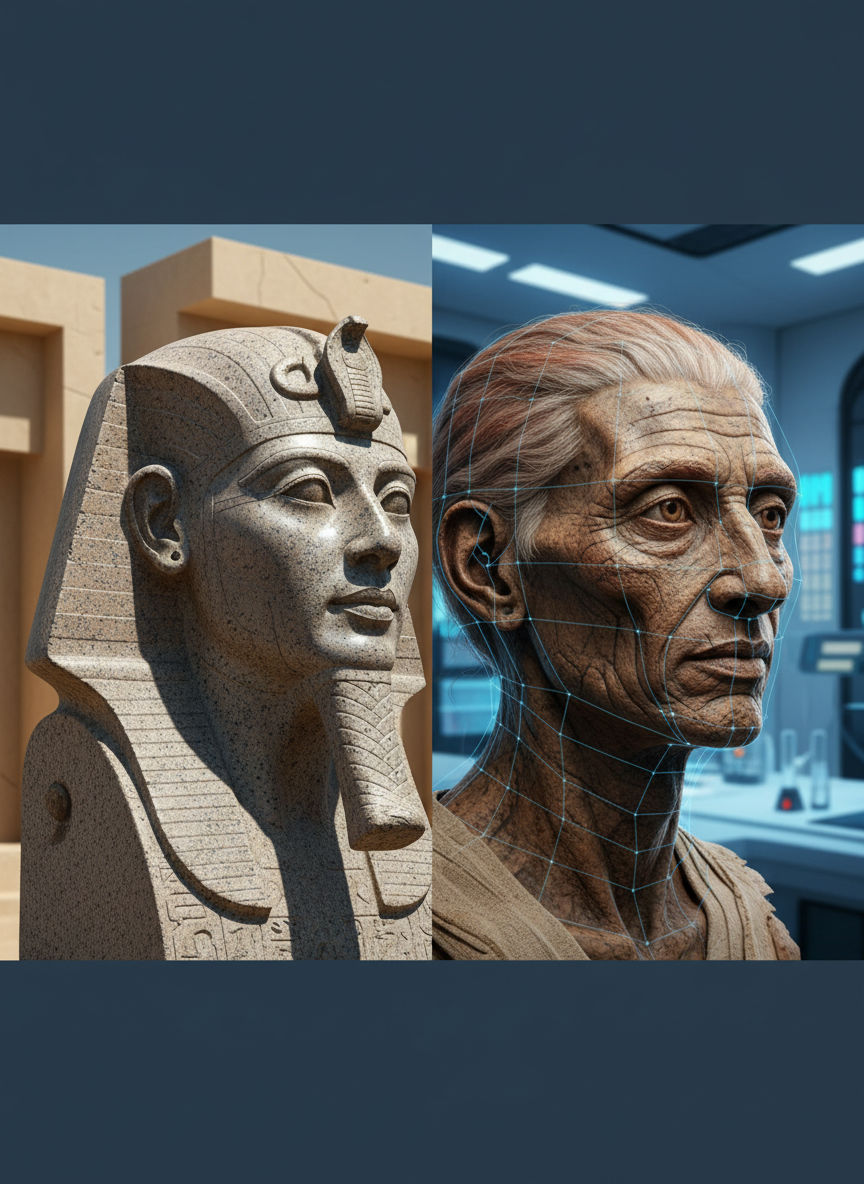
What did a 3,200-year-old king *really* look like, beneath the stone statues?
Prompted by A NerdSip Learner
Uncover the truth behind a pharaoh's image.
Let's journey back over 3,200 years to meet one of ancient Egypt's most famous rulers: Ramesses II, also known as Ramesses the Great. He wasn't just any pharaoh; he was a superstar of his time, reigning for an incredible 66 years, which was one of the longest reigns in Egyptian history.
During his time on the throne, Egypt was a superpower. Ramesses II was a formidable military leader, famously clashing with the Hittite Empire at the Battle of Kadesh. He was also a master builder, leaving his mark all over Egypt with massive temples, cities, and colossal statues.
Think of him as the ultimate brand manager. He understood the power of image. His goal was to create a legacy of a mighty, god-like ruler that would echo through eternity. And as we'll see, his branding was so effective that it still fascinates us today.
Key Takeaway
Ramesses II was a long-reigning, powerful pharaoh who was a master of propaganda and monumental construction.
Test Your Knowledge
What was a major reason Ramesses II is considered 'Great'?
When you see a statue of Ramesses II, you're not looking at a simple portrait. You're looking at a carefully crafted piece of propaganda. These statues, especially the giant ones at places like Abu Simbel, were designed to send a powerful message.
Notice the features: he is always young, muscular, and serene. His face is calm and confident, showing no weakness or emotion. This was intentional. The goal was to portray the pharaoh not as a man, but as a living god on Earth—eternal, unchanging, and all-powerful.
These statues were public relations tools for a domestic and international audience. To the Egyptian people, they were a reminder of the divine order and the stability the pharaoh provided. To foreign visitors and rivals, they were an intimidating display of Egypt's might and wealth. They weren't meant to be realistic; they were meant to be symbolic.
Key Takeaway
Egyptian royal statues were not realistic portraits, but idealized symbols of divine kingship and eternal power.
Test Your Knowledge
What was the main purpose of Ramesses II's statues?
In 1881, the mummy of Ramesses II was discovered, and modern science has allowed us to peel back the layers of legend. The reality is far more human and fascinating than the stone statues suggest. This was no eternally young god; this was a man who lived a very long life.
Scientific analysis reveals Ramesses II died at approximately 90 years of age. He was tall for his time, standing around 5 feet 7 inches (170 cm). He had a prominent, hooked nose and, surprisingly to many, evidence suggests he was a redhead in his youth!
More importantly, his mummy shows the tell-tale signs of old age. He suffered from severe arthritis, which would have made walking difficult and painful. He also had serious dental problems, including abscesses that could have contributed to his death. This was the mortal man, subject to the same pains of aging as anyone else.
Key Takeaway
Scientific analysis of his mummy reveals Ramesses II as an elderly man who suffered from age-related ailments like arthritis.
Test Your Knowledge
What did the analysis of Ramesses II's mummy reveal about his health in old age?
So, we have two very different versions of Ramesses II. On one hand, the idealized god-king carved in stone: forever young, strong, and perfect. On the other, the mortal man: an aged, arthritic redhead with bad teeth. Why the huge difference?
It wasn't because the artists were unskilled. It's because the art and the body served two completely different purposes in Egyptian culture. The statues represented the divine office of the pharaoh, which was eternal and perfect. That image had to be flawless to maintain cosmic order, or *ma'at*.
The physical body, however, was just a temporary vessel. While it was preserved through mummification for the afterlife, its earthly frailties were irrelevant to the eternal image of kingship. This separation is key: the man could grow old and weak, but the institution of the pharaoh remained eternally powerful.
Key Takeaway
The gap between his statues and mummy highlights the Egyptian belief in separating the mortal king from the eternal, divine office of the pharaoh.
Test Your Knowledge
Why is there such a major difference between Ramesses II's statues and his mummy?
What's the big lesson from all of this? By comparing the art to the archaeology, we get a much richer, more complete picture of the past. We see that powerful leaders have *always* carefully managed their public image.
But more than that, we get to see the humanity behind the legend. Ramesses II wasn't just a name in a history book or a face on a temple wall. He was a real person who ruled for decades, built incredible things, fought battles, and eventually grew old and frail.
The statues show us the legend Ramesses wanted us to see. The mummy shows us the man he actually was. Having access to both is a gift of modern science and archaeology, allowing us to connect with a person who lived more than three millennia ago in a much more personal and meaningful way.
Key Takeaway
Comparing a historical figure's official image with the scientific reality gives us a more complete and human understanding of the past.
Test Your Knowledge
What is the main benefit of comparing Ramesses II's statues to his mummy?
Track your progress, earn XP, and compete on leaderboards. Download NerdSip to start learning.