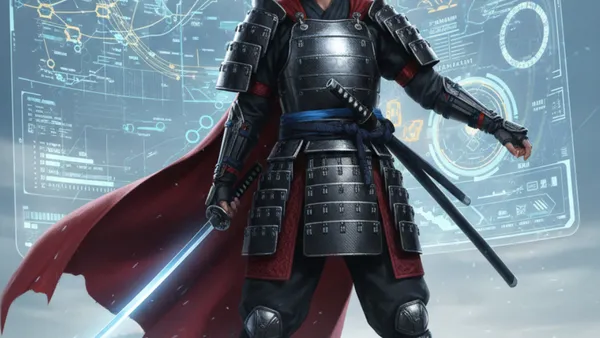
Did you know women in feudal Japan were trained to use the Naginata?
Prompted by A NerdSip Learner
The hidden history of female samurai who fought on the front lines.
When you hear the word 'samurai,' you likely picture a stoic man wielding a gleaming katana. However, the reality of Japan's noble warrior class is far more diverse. Women also belonged to this elite social tier, known as the bushi class, and were fully expected to uphold its strict codes of honor.
While the term 'samurai' was historically reserved for men, women trained rigorously in martial arts. Many of these women were known as onna-bugeisha, and their primary duty was defensive. They guarded their households, castles, and children from marauders while the men were away on campaign.
But there was another, much rarer group: the onna-musha. Unlike their defensive counterparts, the onna-musha were female warriors who took to the battlefield offensively. They donned armor, rode on horseback, and fought shoulder-to-shoulder with male samurai in some of Japan's most brutal historical conflicts.
Key Takeaway
Onna-musha were a rare subset of female warriors in the Japanese noble class who actively fought in offensive battles.
Test Your Knowledge
What is the primary difference between an onna-musha and an onna-bugeisha?
How could a smaller female warrior overpower a fully armored male samurai? The secret was in her weapon of choice.
The iconic armament of the Japanese female warrior was the naginata. It was a versatile polearm consisting of a long wooden shaft topped with a curved, single-edged blade. While the katana is famously associated with male samurai, the naginata was perfectly suited for women and remains closely tied to their historical legacy.
The naginata offered several tactical advantages. Its long reach allowed a female warrior to keep heavier, stronger opponents at a safe distance. Furthermore, the sweeping motions used to wield it relied on physics and leverage rather than brute physical strength.
By utilizing momentum and gravity, a skilled practitioner could execute devastating strikes. The weapon was highly effective for fighting on foot, dismounting enemy cavalry, and defending the narrow corridors of a besieged castle.
Key Takeaway
The naginata was a strategic polearm that utilized reach and leverage, making it highly effective for female warriors.
Test Your Knowledge
Why was the naginata particularly advantageous for female warriors?
The history of Japanese female warriors stretches back centuries before the word 'samurai' even existed. The origins of this martial tradition are often traced back to the semi-legendary figure of Empress Jingū.
According to traditional historical accounts, she lived during the 3rd century and boldly took the throne as regent following the sudden death of her husband. Rather than stepping aside, she supposedly led a massive military expedition across the sea to the Korean peninsula.
Legend states that she commanded this victorious invasion without shedding a single drop of blood—and did so while pregnant! While modern historians debate the exact factual details of her life and reign, her cultural impact is undeniable.
Empress Jingū established a powerful archetype for centuries to come. She defied the rigid social norms of her era, proving that a woman could be just as fierce, capable, and commanding as any male ruler.
Key Takeaway
Empress Jingū is a semi-legendary 3rd-century ruler who established the cultural archetype of the fierce Japanese female warrior.
Test Your Knowledge
Why do historians consider Empress Jingū an archetype for the onna-musha?
Have you ever heard of a warrior so fearsome that enemy generals fled rather than face her in single combat?
Tomoe Gozen is perhaps the most famous onna-musha in all of Japanese history. She lived during the late 12th century and fought in the Genpei War, a massive civil conflict that shaped the future of Japan. According to the famous epic 'The Tale of the Heike', she was an archer of rare strength and a swordswoman 'worth a thousand.'
Tomoe served the general Minamoto no Yoshinaka as a trusted captain. At the pivotal Battle of Awazu in 1184, she supposedly commanded hundreds of samurai and personally defeated several prominent enemy leaders.
While her ultimate fate after the battle remains a mystery wrapped in legend, her unmatched bravery made her an immortal figure in Japanese culture, inspiring countless generations of warriors who followed in her footsteps.
Key Takeaway
Tomoe Gozen was a legendary 12th-century onna-musha celebrated for her exceptional martial skill and bravery during the Genpei War.
Test Your Knowledge
According to historical epics, what was Tomoe Gozen's role in the Genpei War?
What happens to a fierce warrior class when the wars finally come to an end?
During the Edo period, which began in the early 17th century, Japan entered a long era of relative peace. The constant battlefield clashes of previous centuries faded away, and the role of the warrior class underwent a profound shift.
The naginata, once a bloody and practical weapon of war, slowly transformed into a powerful symbol of social status and female virtue. Noble women were still trained in martial arts, but the focus shifted toward moral discipline, self-defense, and character building.
The naginata became a highly prized heirloom, often included in the dowries of high-ranking samurai daughters as a representation of their dedication to their families. Numerous martial arts schools specifically for women were established during this time, ensuring that the techniques of the ancestors were carefully preserved.
Key Takeaway
During the peaceful Edo period, the naginata transitioned from a battlefield weapon to a revered symbol of noble status and moral discipline.
Test Your Knowledge
How did the significance of the naginata change during the peaceful Edo period?
In the fading days of the samurai era, a young woman led a fearless charge against a modernized imperial army.
During the Boshin War in 1868, a fierce civil conflict erupted over the political future of Japan. In the domain of Aizu, a highly educated 21-year-old martial arts instructor named Nakano Takeko demanded the right to fight for her home. When domain leaders refused to let women officially join the army, Takeko took matters into her own hands.
She formed an independent, unofficial unit of female fighters. This group, later dubbed the Jōshitai (Girls' Army), boldly stepped onto the front lines. Wielding traditional naginatas, they charged directly into enemy forces armed with modern firearms.
Takeko fought with incredible ferocity but was fatally wounded by a bullet. To prevent the enemy from taking her head as a battlefield trophy, she famously asked her sister to behead her, preserving her honor to the very end.
Key Takeaway
Nakano Takeko formed an independent female combat unit to fight in the Boshin War, bravely defending her home with traditional weapons.
Test Your Knowledge
Why did Nakano Takeko form the Jōshitai (Girls' Army)?
If these women were so incredible, why aren't their names as globally famous as their male counterparts?
The legacy of the onna-musha has often been overshadowed by traditional, male-centric historical narratives. In later eras, and particularly in traditional art, women of the noble class were frequently depicted through a purely domestic lens. History preferred to emphasize their roles as obedient wives and mothers rather than fierce combatants.
However, the fighting spirit of these women never truly disappeared. While the days of armored warfare are long gone, their legacy lives on in modern martial arts.
Today, the practice of Atarashii Naginata (new naginata) is a popular, highly respected martial art and sport both in Japan and internationally. It continues a centuries-old tradition, teaching modern practitioners the very same discipline, grace, and unshakable strength that defined the female warriors of the past.
Key Takeaway
Although historically overshadowed by male narratives, the legacy of the onna-musha survives today through modern martial arts practices.
Test Your Knowledge
What is one major reason the stories of the onna-musha are less well-known today?
Track your progress, earn XP, and compete on leaderboards. Download NerdSip to start learning.