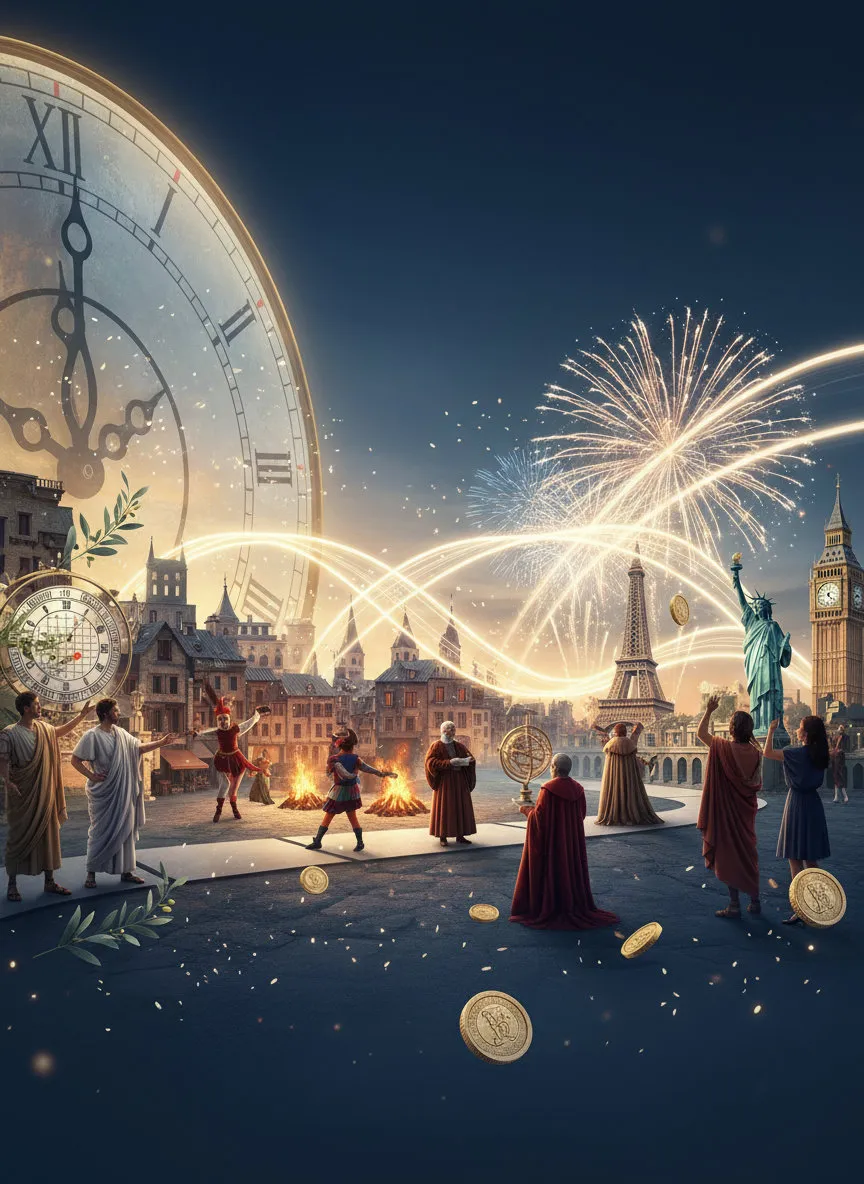
Ever wondered why we light up the sky on December 31st? Discover why.
Prompted by A NerdSip Learner
Unlock the fascinating history behind your favorite New Year's traditions.
Why is the last day of the year named 'Silvester' in so many languages? No, it’s not about the cartoon cat! The name actually honors Pope Sylvester I, who led the Church in the 4th century. He passed away on December 31, 335, in Rome. Back then, it was simply his feast day and had nothing to do with the turn of the year.
It wasn't until 1582 that the Gregorian calendar we use today was introduced. This reform officially moved the end of the year from late December to the 31st. Suddenly, the global New Year’s festivities happened to fall exactly on Saint Sylvester’s remembrance day.
It was essentially a historical accident. The Pope never launched a single firework or poured lead to tell the future. Yet, through this calendar shift, his name became immortalized as the entire world celebrates the start of a new cycle on his day.
Key Takeaway
The name Silvester comes from Pope Sylvester I, whose feast day coincided with the new calendar's end.
Test Your Knowledge
Why is December 31st called 'Silvester' in many countries?
We take January 1st for granted, but it wasn’t always the start of the year. In ancient Rome, the year originally began in March. This is why 'September' (from the Latin *septem* meaning seven) was actually the seventh month, not the ninth. Quite confusing, right?
Julius Caesar finally brought order to the chaos in 46 BC. He introduced the Julian calendar and moved the New Year to January. He chose this month to honor Janus, the god of doors and gates. Janus is depicted with two faces: one looks back at the past, while the other gazes forward into the future.
Even with Caesar’s reform, the Middle Ages saw a return to confusion, with many Christians celebrating on Christmas or Easter. It wasn't until 1691 that Pope Innocent XII finalized January 1st as the global standard. Since then, the night before has served as the definitive close of the old cycle.
Key Takeaway
Julius Caesar moved New Year to January to honor Janus, the two-faced god of beginnings.
Test Your Knowledge
Which Roman god is the namesake for the month of January?
Why the midnight racket? Today, fireworks are a beautiful spectacle, but they used to be serious business. Ancient Germanic tribes believed that during the dark winter nights, or 'Rauhnächte,' evil spirits and demons roamed the earth looking for trouble.
To drive these shadows away, people made an incredible noise using whips, rattles, and pots. The bright light of fire was meant to conquer the freezing darkness. Our modern fireworks are actually rooted in these ancient rituals designed to ward off the supernatural and protect the community.
Beyond the noise, symbols like lucky pennies or four-leaf clovers represent our collective hope. We don't just want to scare away the bad; we want to 'summon' good fortune for the coming months. So, the next time you hear a firework, remember: you’re symbolically scaring away the bad vibes of the past year!
Key Takeaway
Fireworks and noise were originally used to drive away evil spirits during the dark nights of winter.
Test Your Knowledge
What was the original purpose of making noise on New Year's Eve?
Track your progress, earn XP, and compete on leaderboards. Download NerdSip to start learning.