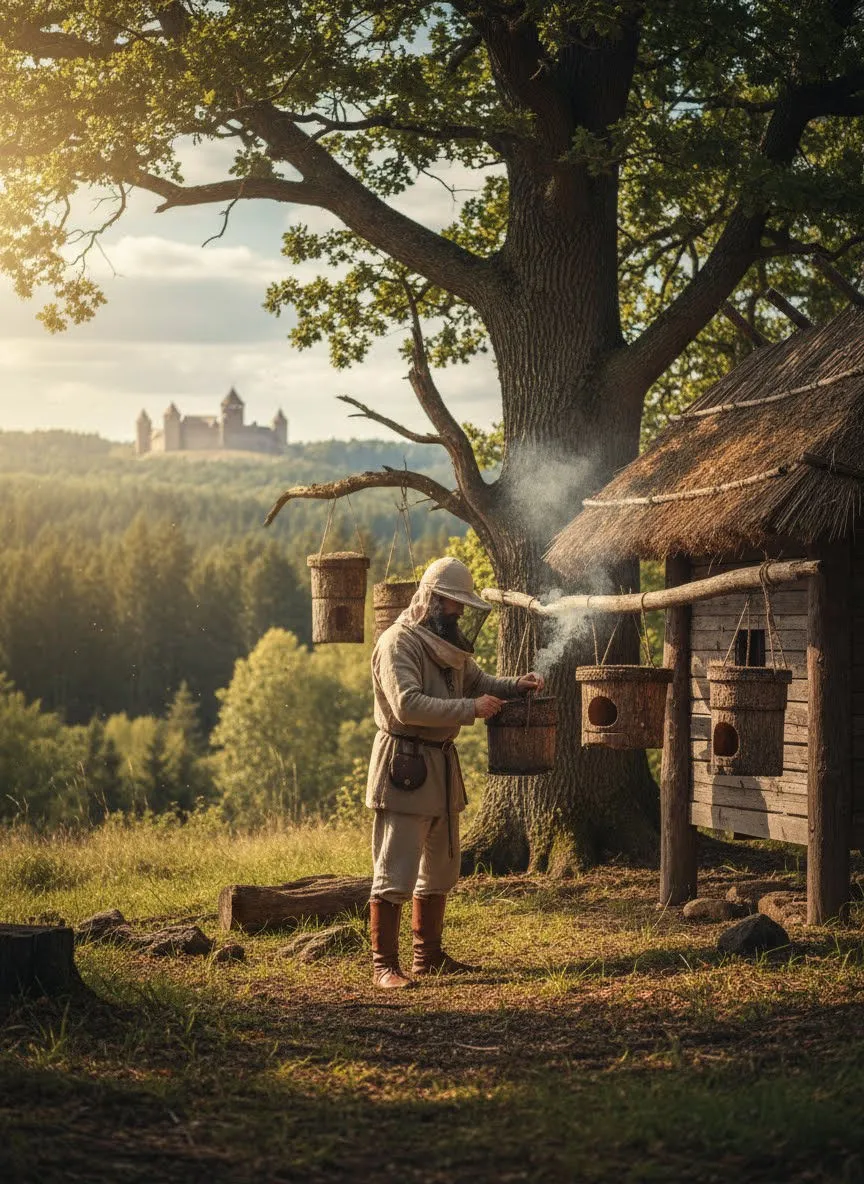
Why did medieval Lithuanians fight bears 10 meters up in the air?
Prompted by A NerdSip Learner
Understand the ancient art of wild forestry beekeeping.
Imagine farming, but you are hanging 10 meters in the air! In the 1300s, Lithuanians didn't keep bees in little white boxes on the ground. Instead, they practiced wild hive beekeeping (known as *drevinė bitininkystė*). They carved hollows directly into massive living pine or oak trees deep in the forest.
These weren't just random trees. A beekeeper, called a bartininkas, would own specific trees scattered across the Grand Duchy's vast woodlands. They had to be athletic climbers! To reach the hives, they used a special braided rope made of elk hide or hemp called a *geinys* to hoist themselves up the trunk.
This wasn't just a hobby; it was a serious profession. By keeping bees in their natural habitat high up in the trees, the bees were tough and produced distinct, dark forest honey. It was a partnership with nature, where the forest itself was the hive.
Key Takeaway
Medieval Lithuanians farmed bees inside hollows of living trees, not man-made boxes.
Test Your Knowledge
What was the 'geinys' used for?
So, you have delicious honey high up in a tree. Who else loves honey? Bears. In medieval Lithuania, bears were the beekeeper’s number one rival. Because the hives were out in the wild woods rather than a fenced garden, beekeepers had to invent clever "bear security systems."
One popular defense was a heavy log suspended on a rope right in front of the hive opening. When a bear climbed up and swatted the log away to get to the honey, the log would swing back and smack the bear. The harder the bear hit it, the harder it hit back! eventually, the bear would get tired (or sore) and give up.
Other methods included upturned iron spikes at the base of the tree or wooden platforms that would tip over if a heavy animal stepped on them. It was a literal engineering arms race between the *bartininkai* and the hungry forest giants.
Key Takeaway
Beekeepers used swinging logs and spikes to protect their valuable hives from bears.
Test Your Knowledge
How did the swinging log defense work?
In the 1300s, honey and beeswax weren't just groceries; they were practically currency. The Grand Duchy of Lithuania was one of Europe’s biggest exporters of wax. Why wax? Before electricity, all of Europe’s grand cathedrals, castles, and monasteries needed huge amounts of beeswax candles for light.
This trade made beekeeping highly prestigious. Lithuanian customary laws (which were later written into Statutes) protected bee trees fiercely. Destroying a bee tree was a major crime, often carrying penalties as severe as those for harming a human! Beekeepers even had special legal rights to enter noble-owned forests just to tend to their insects.
The wax from these dark Lithuanian forests lit up the churches of Western Europe. So, the *bartininkas* wasn't just a farmer; he was a vital link in the international economy, trading liquid gold for silver, salt, and weapons.
Key Takeaway
Beeswax was a major export for Lithuania, making bee trees legally protected assets.
Test Your Knowledge
Why was Lithuanian beeswax so valuable in Europe?
Track your progress, earn XP, and compete on leaderboards. Download NerdSip to start learning.