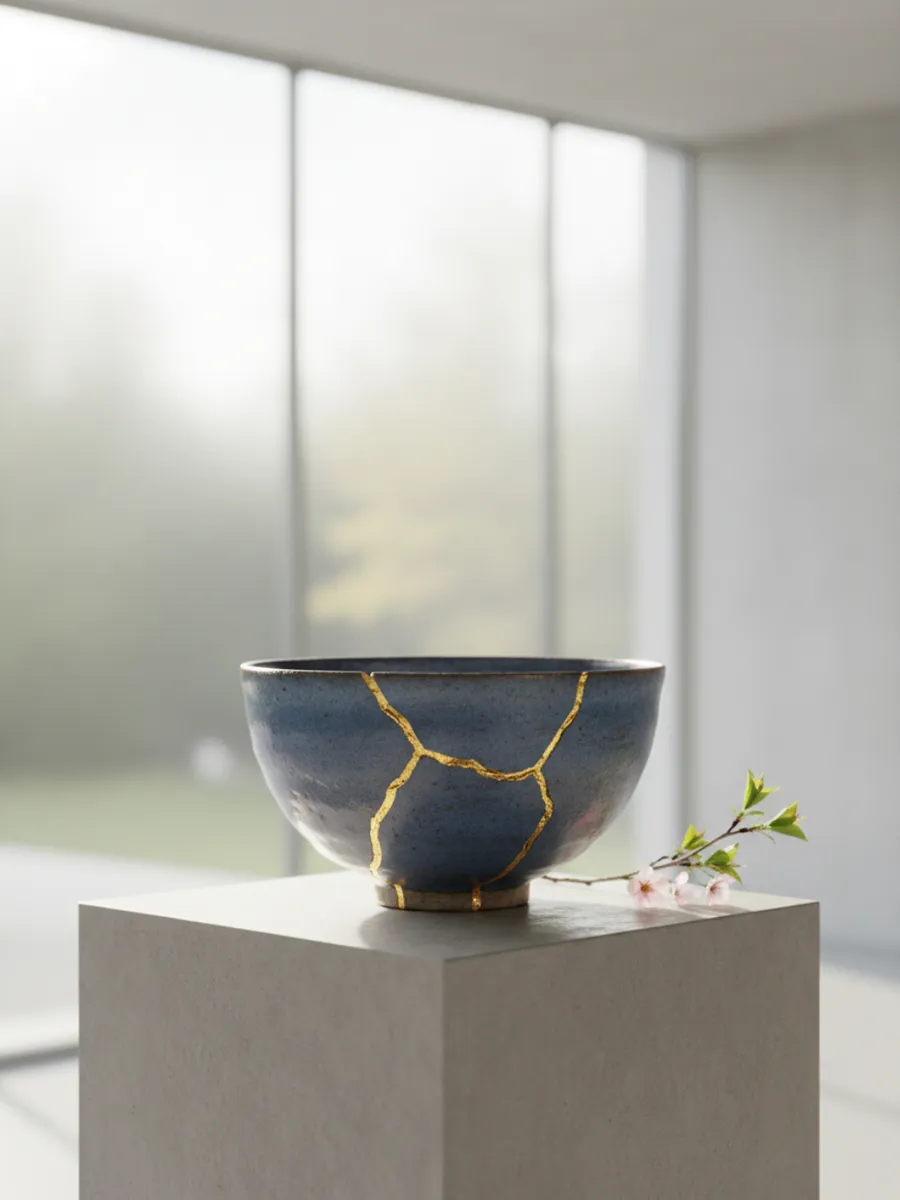
Did you know that in Japan, broken objects are often seen as more beautiful than new ones?
Prompted by A NerdSip Learner
The Japanese philosophy of repairing pottery with gold to embrace flaws.
Kintsugi, or 'golden joinery,' is a centuries-old Japanese art form that treats breakage and repair as part of the history of an object. Rather than throwing away a shattered bowl, craftsmen mend it with a special lacquer dusted with powdered gold. The result is a piece that is often considered more beautiful and valuable than the original.
Legend has it that the practice began in the late 15th century when the Japanese Shogun, Ashikaga Yoshimasa, sent a broken tea bowl to China for repair. It was returned held together by ugly metal staples. Disappointed, Japanese craftsmen looked for a more aesthetic solution, eventually developing the golden seams we recognize today.
In Kintsugi, the cracks are not hidden; they are illuminated. This shift in perspective turns a 'flaw' into a 'feature,' celebrating the object's unique story and its survival through change.
Key Takeaway
Kintsugi transforms brokenness into a unique form of beauty by highlighting repairs with gold.
Test Your Knowledge
According to legend, what event led to the creation of Kintsugi?
The 'glue' of traditional Kintsugi isn't a modern synthetic adhesive. Instead, it uses *urushi*, a natural lacquer made from the sap of the Japanese lacquer tree. This substance has been used in Japan for thousands of years because it is incredibly durable and becomes food-safe once it has fully cured.
The process is slow and meticulous. Pieces are first joined with *mugi-urushi* (a mix of lacquer and flour). Then, any small gaps are filled with a paste called *sabi-urushi*. Only after the repair is structurally sound is the final layer of lacquer applied and dusted with fine gold, silver, or platinum powder.
Because *urushi* hardens by absorbing moisture from the air, the pieces must sit in a humid cabinet called a *muro* for weeks. This reminds us that true restoration and healing cannot be rushed; they require time and the right environment.
Key Takeaway
Traditional Kintsugi uses natural tree sap lacquer and real gold powder in a process that requires patience and precision.
Test Your Knowledge
What is 'urushi' in the context of Kintsugi?
Kintsugi is the physical manifestation of the Japanese philosophy of *Wabi-Sabi*. This worldview finds beauty in things that are imperfect, impermanent, and incomplete. It stands in contrast to the Western ideal of perfection, which often prizes symmetry and 'brand new' appearances.
*Wabi* refers to a type of understated elegance and simplicity, while *Sabi* refers to the beauty that comes with age and the passage of time. Together, they suggest that an object’s value increases as it acquires 'scars' and signs of use.
By applying *Wabi-Sabi* to our lives, we can stop chasing an impossible standard of perfection. We can begin to see that our own quirks, signs of aging, and past mistakes are what make us uniquely ourselves.
Key Takeaway
Wabi-Sabi teaches us to find beauty in the natural cycle of growth, decay, and repair.
Test Your Knowledge
Which philosophy is most closely associated with finding beauty in imperfection?
Have you ever felt a pang of regret when throwing something away? This is the essence of *Mottainai*. It is a Japanese term that roughly translates to 'what a waste' or 'don't be wasteful.' It reflects a deep respect for the resources we use and the belief that even inanimate objects have a 'soul' or purpose.
Kintsugi is a radical act of *Mottainai*. Instead of discarding a broken vessel because it is no longer 'useful' in its original state, the owner invests time and gold to give it a second life. This honors the work of the original potter and the history of the object.
In a world of fast fashion and disposable goods, *Mottainai* encourages us to pause. It asks us to consider the value of what we already own and to choose repair over replacement whenever possible.
Key Takeaway
Mottainai is the philosophy of respecting resources and feeling regret when something is wasted.
Test Your Knowledge
How does Kintsugi reflect the concept of 'Mottainai'?
The practice of Kintsugi is also linked to *Mushin*, or 'no mind.' This Zen concept involves a state of non-attachment and the acceptance of change as a natural part of fate. When a bowl breaks, *Mushin* allows us to accept the accident without anger or despair.
Trying to glue a bowl back together so it looks 'exactly like new' is a form of denial. It is an attempt to pretend the break never happened. Kintsugi takes the opposite approach: it acknowledges the trauma of the break and incorporates it into the new design.
This mindset is a powerful tool for resilience. When we practice *Mushin*, we stop fighting the reality of change. We learn that while we cannot always control what breaks, we can always choose how we put the pieces back together.
Key Takeaway
Mushin teaches us to accept change and accidents with a calm, non-attached mind.
Test Your Knowledge
What does 'Mushin' emphasize in the process of repair?
At age 25, you are likely navigating the transitions of early adulthood—career shifts, relationship changes, or the 'quarter-life' realization that life doesn't always go as planned. Kintsugi serves as a powerful metaphor for personal growth during these times.
We often try to hide our emotional scars, fearing they make us look weak or 'damaged.' However, just like the gold in Kintsugi, our experiences of overcoming hardship can become our greatest strengths. They add depth, character, and resilience to our personality.
Psychologically, this is known as post-traumatic growth. It is the idea that individuals can experience positive psychological change as a result of struggling with highly challenging life circumstances. You aren't just 'fixed'—you are transformed.
Key Takeaway
Personal 'cracks' and hardships are not failures; they are the gold seams that make your story unique.
Test Your Knowledge
In the metaphor of Kintsugi, what do the gold seams represent in a person's life?
Kintsugi is not about returning to the past. A repaired bowl will never be the 'same' as it was before it fell. It is something entirely new—a hybrid of its original form and the event that broke it. This 'new wholeness' is the ultimate goal of the art.
Integration is the final step. To live a 'Kintsugi life' means integrating your past, your mistakes, and your broken pieces into your current identity. It means walking into a room not in spite of your history, but with your history proudly displayed like golden lacquer.
As you move forward, remember: the break was just an event, not the end of the story. You have the tools to mend, the time to heal, and the gold to make yourself shine brighter than ever before.
Key Takeaway
True healing is not about being 'undamaged' again, but about integrating your history into a new, stronger version of yourself.
Test Your Knowledge
What is the ultimate goal of the Kintsugi philosophy?
Track your progress, earn XP, and compete on leaderboards. Download NerdSip to start learning.