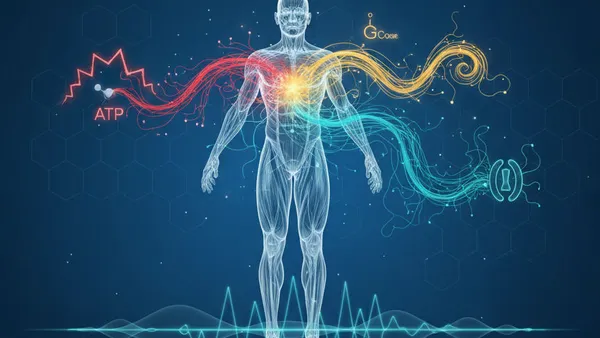
Where does your body actually get the energy to lift, run, and live?
Prompted by NerdSip Explorer #9682
Master the three metabolic pathways that power your body.
Think of your body as a complex machine that needs fuel to run. However, it doesn't run directly on the sandwich you had for lunch. Instead, your digestive system breaks down that food to create a very specific molecule called ATP (Adenosine Triphosphate).
ATP is essentially the ultimate energy currency of your cells. Whenever you blink, breathe, or sprint for the bus, your cells are "spending" ATP to get the job done. It is the universal power source for every single biological process in the human body.
Structurally, ATP stores a massive amount of energy in its chemical bonds. When a cell needs energy, it breaks off one of ATP's three phosphate groups. This separation releases a quick burst of energy, turning ATP into a depleted molecule called ADP (Adenosine Diphosphate).
To keep you moving, your body has to constantly rebuild ADP back into ATP. That is exactly what your energy systems are designed to do! They act as intricate, biological recycling plants working 24/7 to ensure you never run out of cellular cash.
Key Takeaway
All food is ultimately converted into ATP, the universal energy currency your cells spend to function.
Test Your Knowledge
What happens when ATP releases energy for your cells to use?
Now that we know ATP is the fuel, how does the body actually produce it? Your body relies on three distinct metabolic pathways—or "engines"—to generate ATP. These are the ATP-PC System, the Glycolytic System, and the Oxidative System.
Imagine you have a garage with three very different vehicles. The first is a top-fuel dragster: unbelievably fast and powerful, but it runs out of gas in seconds. This represents your ATP-PC system, designed for explosive, instant energy.
The second vehicle is a high-performance sports car. It can go very fast for a couple of minutes, but it overheats quickly. This is your Glycolytic system, which powers intense but short-lived activities.
The final vehicle is a highly efficient hybrid sedan. It is not very fast, but it can drive all day on a single tank of gas. This is your Oxidative (aerobic) system, responsible for sustained, long-term energy. Depending on what you are doing, your body automatically chooses the best engine for the job.
Key Takeaway
Your body has three distinct energy systems—ATP-PC, Glycolytic, and Oxidative—each tailored for different intensities and durations.
Test Your Knowledge
Which analogy best describes the Oxidative system?
When you need maximum power instantly—like dodging a falling object, jumping for a basketball, or lifting a heavy weight—your body taps into the ATP-PC System (also known as the Phosphagen system).
This system is your cellular dragster. It doesn't use oxygen or carbohydrates. Instead, it relies on the tiny amount of ATP already floating around in your muscles, plus a compound called Phosphocreatine (PC). When your initial ATP is spent, Phosphocreatine rushes in to immediately rebuild ADP back into ATP.
The massive advantage of the ATP-PC system is its incredible speed. It supplies energy faster than any other pathway in the human body. You get an immediate, explosive burst of absolute power.
The catch? It has an incredibly small gas tank. This system hits maximum capacity instantly but is entirely depleted within 10 to 12 seconds. Once it runs out, your power output drops sharply, and your body is forced to switch to a slower, longer-lasting energy engine to keep you moving.
Key Takeaway
The ATP-PC system provides explosive, instant power for up to 12 seconds without needing oxygen.
Test Your Knowledge
What is the primary limitation of the ATP-PC system?
If you sprint for longer than 10 seconds, the ATP-PC system gives out. At this point, your body revs up the second engine: the Anaerobic Glycolytic System. "Anaerobic" means without oxygen, and "glycolysis" means the breakdown of glucose (sugar).
This system powers high-intensity activities lasting from roughly 15 seconds to 2 minutes. Think about running a 400-meter sprint, doing a grueling set of 15 squats, or a fast-paced CrossFit workout. Your body takes carbohydrates stored in your muscles and rapidly breaks them down to manufacture ATP.
While it produces energy quickly, this speed comes at a cost. The chemical reactions of anaerobic glycolysis create metabolic byproducts, including hydrogen ions. As these ions accumulate in your muscle tissue, the environment becomes increasingly acidic.
This rising acidity is what causes that familiar, agonizing "burn" in your muscles during hard exercise. Eventually, the acidity interferes with muscle contraction, forcing you to slow down or stop entirely so your body can clear out the waste.
Key Takeaway
Anaerobic glycolysis burns carbohydrates for fast energy (15s to 2min) but produces acidic byproducts that cause muscle fatigue.
Test Your Knowledge
What causes the 'burning' sensation during high-intensity exercise?
For activities lasting longer than two or three minutes, your body relies on the Oxidative System. This is the only system that requires a constant supply of oxygen to function, making it an "aerobic" pathway.
When you are jogging, cycling, hiking, or even just sitting at your desk reading this, your Oxidative system is hard at work. It takes glucose and fatty acids, mixes them with the oxygen you breathe in, and runs them through complex cellular powerhouses called mitochondria to produce ATP.
The Oxidative system is relatively slow to kick in and cannot generate the explosive power of the other two systems. However, its efficiency is unmatched. It squeezes a massive amount of ATP out of every molecule of fuel it burns.
Because it clears its own metabolic waste efficiently, this engine has a virtually limitless capacity. As long as you have fuel (food) in your body and oxygen in your lungs, the Oxidative system can keep you moving for hours on end.
Key Takeaway
The Oxidative system uses oxygen to efficiently produce long-lasting energy for sustained, low-to-moderate intensity activities.
Test Your Knowledge
What is the key ingredient the Oxidative system requires that the other two systems do not?
To keep these energy systems running, your body needs raw materials. The most accessible and preferred fuel for moderate to high-intensity exercise is carbohydrates. When you eat carbs, your body breaks them down into glucose.
Some of this glucose circulates in your blood for immediate use, but the majority is packaged together and stored in your liver and muscles as a substance called glycogen. Think of glycogen as your body's on-board fuel tank.
Carbohydrates are incredibly versatile. They are the *only* fuel source that can be used by both the Anaerobic Glycolytic system (without oxygen) and the Oxidative system (with oxygen). Because breaking down carbs is chemically straightforward, it allows for rapid ATP production.
However, your body can only store a limited amount of glycogen—usually enough to fuel about 90 to 120 minutes of intense exercise. When athletes "hit the wall" or "bonk" during a marathon, they have quite literally emptied their glycogen tanks, forcing their bodies to rely on slower fuel sources.
Key Takeaway
Carbohydrates are stored as glycogen and act as the versatile, premium fuel for moderate to high-intensity activities.
Test Your Knowledge
What is the stored form of carbohydrates in the muscles and liver called?
While carbohydrate stores are limited, your body has an almost endless supply of another fuel source: dietary and body fat. Fats are stored throughout the body as triglycerides and represent an enormous, dense reservoir of potential energy.
Unlike carbs, fats can only be burned aerobically—meaning they require the Oxidative system and plenty of oxygen to be transformed into ATP. The chemical process of breaking down a fat molecule is much slower and far more complex than breaking down a carbohydrate.
Because it takes so long to convert fat into ATP, it cannot be used for explosive sprints or heavy lifts. Instead, fat is the perfect fuel for low-intensity activities. When you are sleeping, walking, or doing light chores, your body relies primarily on fat for energy.
Even the leanest athletes carry tens of thousands of calories worth of stored body fat. This massive reserve ensures that humans can survive, walk long distances, and endure periods of food scarcity without running out of energy.
Key Takeaway
Fats provide an immense, slow-burning energy reserve that requires oxygen and is primarily used during low-intensity activities.
Test Your Knowledge
Why isn't fat used to fuel explosive, high-intensity movements?
It is easy to imagine the three energy systems working like relay runners, handing off a baton. You might think the ATP-PC system stops entirely at 10 seconds, handing off to Glycolysis, which then stops at 2 minutes for the Oxidative system. But this is a myth!
In reality, your energy systems work more like dimmer switches on a soundboard. All three systems are "turned on" and producing ATP at all times. This concept is known as the Energy Continuum.
What changes is the *contribution* of each system based on the intensity and duration of your activity. If you are lightly jogging, your Oxidative system is doing 90% of the work, but the other two are still humming in the background. If you suddenly sprint up a steep hill, the Glycolytic system dials up to maximum output instantly.
Your body seamlessly shifts the balance between these three engines second by second, ensuring you have the exact type of energy required to meet the demands of your environment.
Key Takeaway
All three energy systems work simultaneously all the time, shifting their dominance based on the intensity of your movement.
Test Your Knowledge
How do the three energy systems interact during exercise?
The human body is highly adaptable. When you stress a specific energy system through exercise, your body upgrades that system to handle the stress better next time. This is known as the principle of Specificity.
If you want to build a bigger ATP-PC "dragster" engine, you need to train with max effort. Short, heavy weightlifting or 40-yard dash sprints with long rest periods will increase the stored phosphocreatine in your muscles.
To improve your Glycolytic system, you must embrace the burn. High-Intensity Interval Training (HIIT), such as 45 seconds of hard effort followed by 15 seconds of rest, teaches your body to produce ATP faster and clear acidic waste more efficiently.
Finally, to upgrade your Oxidative engine, you need steady, prolonged work. Long runs, cycling, or swimming at a conversational pace (often called Zone 2 cardio) increases the number and efficiency of mitochondria in your cells, allowing you to burn fat more effectively and push fatigue further away.
Key Takeaway
You can target and upgrade specific energy systems by tailoring the intensity, duration, and rest periods of your workouts.
Test Your Knowledge
Which type of training is best for improving the Oxidative system?
When you finish an intense workout, your breathing stays heavily elevated even after you sit down. You aren't exercising anymore, so why are you still gasping for air?
This phenomenon is called EPOC (Excess Post-exercise Oxygen Consumption), informally known as the "oxygen debt." During intense, anaerobic exercise (using the ATP-PC and Glycolytic systems), your body borrows energy faster than your oxygen-based system can provide it.
Once the workout ends, the bill comes due. Your body must take in a massive amount of oxygen to restore balance. It uses this oxygen to clear out metabolic waste (like lowering muscle acidity), repair damaged muscle fibers, and restock your depleted ATP and glycogen reserves.
The higher the intensity of your workout, the larger the oxygen debt you create, and the longer your metabolism stays elevated to recover. Proper nutrition, hydration, and sleep are the final tools your body relies on to fully reset these intricate energy engines for another day.
Key Takeaway
After intense exercise, your body relies on an 'oxygen debt' (EPOC) to clear waste and restock depleted energy stores.
Test Your Knowledge
What is the primary purpose of EPOC (Excess Post-exercise Oxygen Consumption)?
Track your progress, earn XP, and compete on leaderboards. Download NerdSip to start learning.