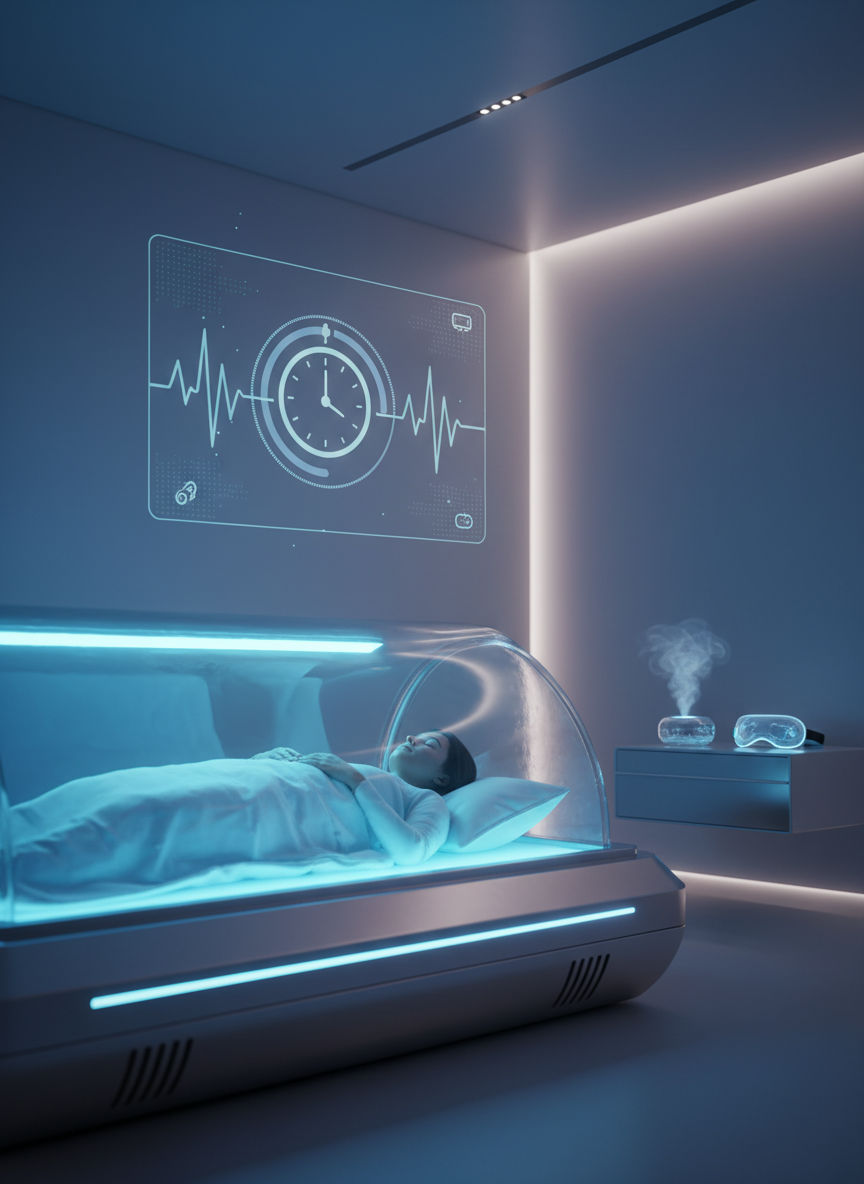
Ready to engineer your brain's delta waves?
Prompted by NerdSip Explorer #1890
Master acoustic, respiratory, and microbial sleep hacks.
Deep sleep is characterized by Slow-Wave Sleep (SWS), where your brain fires in highly synchronized, low-frequency patterns known as *delta waves* (roughly 0.5 to 2.0 Hz). Think of these waves as a massive neurological stadium wave. But what if you could act as the conductor to make that wave larger?
Enter Closed-Loop Acoustic Stimulation (CLNS). This cutting-edge biohacking technique uses a wearable device to monitor your electroencephalogram (EEG) in real-time. When the algorithm detects the exact "UP phase" of a slow oscillation (the moment neurons are firing), it delivers a precise burst of "pink noise" through headphones.
By timing this auditory pulse to the precise moment of neuronal depolarization, CLNS promotes greater neural synchronization, dramatically amplifying the amplitude of the delta wave. Larger, more robust delta waves mean profound sleep deepening and accelerated memory consolidation, without requiring you to sleep for a longer overall duration. You aren't just sleeping; you are actively engineering the voltage of your brain.
Key Takeaway
Acoustic stimulation timed to the UP phase of delta waves artificially amplifies the depth and restorative power of slow-wave sleep.
Test Your Knowledge
What does Closed-Loop Acoustic Stimulation (CLNS) target to deepen sleep?
You likely already know that mouth breathing is sub-optimal, but its biochemical impact on your sleep architecture is profound. The secret lies in a molecule called Nitric Oxide (NO), which is synthesized almost exclusively in the paranasal sinuses.
When you tape your mouth and enforce nasal breathing during the night, you pull this pooled NO directly into your lungs. Nitric Oxide is a potent *vasodilator*. It widens blood vessels, decreases airway resistance, and drastically improves the oxygen perfusion rate in your alveoli.
More importantly for deep sleep, this optimized gas exchange modulates your autonomic nervous system. The steady, diaphragmatic rhythm required by nasal resistance increases vagal tone, shifting your body away from sympathetic ("fight or flight") micro-arousals and locking it into parasympathetic dominance. This unbroken parasympathetic state is a strict physiological requirement for sustaining continuous, uninterrupted cycles of deep sleep.
Key Takeaway
Nasal breathing harnesses nitric oxide to induce vasodilation and lock the nervous system into the parasympathetic state required for unbroken deep sleep.
Test Your Knowledge
How does nitric oxide (NO) production from nasal breathing specifically aid deep sleep?
Your gut bacteria have a direct, biochemical dial into your brain's sleep centers. This bidirectional communication network is known as the gut-brain axis, and the key currency for deep sleep is a specific short-chain fatty acid (SCFA) called butyrate.
When you feed your microbiome prebiotic fibers (like those found in asparagus, garlic, and chicory root), specific gut bacteria ferment them into butyrate. Recent neurogastroenterology research reveals that butyrate acts as a powerful sleep-promoting agent. It doesn't just stay in the gut; it enters your portal vein.
Scientists have identified hepatoportal sensory mechanisms—receptors located in your liver and portal vein that detect circulating butyrate and send sleep-inducing signals to the brain. Studies demonstrate that an increase in systemic butyrate can radically multiply the duration of non-REM (deep) sleep. By optimizing your evening prebiotic fiber intake, you are literally outsourcing your sleep initiation to trillions of microbial allies.
Key Takeaway
Gut bacteria ferment prebiotic fiber into butyrate, a short-chain fatty acid that triggers hepatoportal receptors to heavily promote non-REM deep sleep.
Test Your Knowledge
What is the primary role of butyrate in the context of sleep architecture?
Track your progress, earn XP, and compete on leaderboards. Download NerdSip to start learning.