What if religion came before farming?
Prompted by A NerdSip Learner
Discover the 11,000-year-old temple that changed human history.
Welcome to the oldest known temple on Earth! Imagine a time long before the ancient Egyptian pyramids, before the massive stones of Stonehenge, and even before the invention of the wheel or written language.
Göbekli Tepe (pronounced Guh-bek-lee Teh-peh) is a breathtaking archaeological site located in the southeastern region of modern-day Turkey. Built roughly 11,500 years ago, it is so unbelievably ancient that it predates recorded human history itself. To put that massive timeline into perspective: there is actually more time between the construction of Göbekli Tepe and the Great Pyramid of Giza than there is between the Pyramid and our modern lives today!
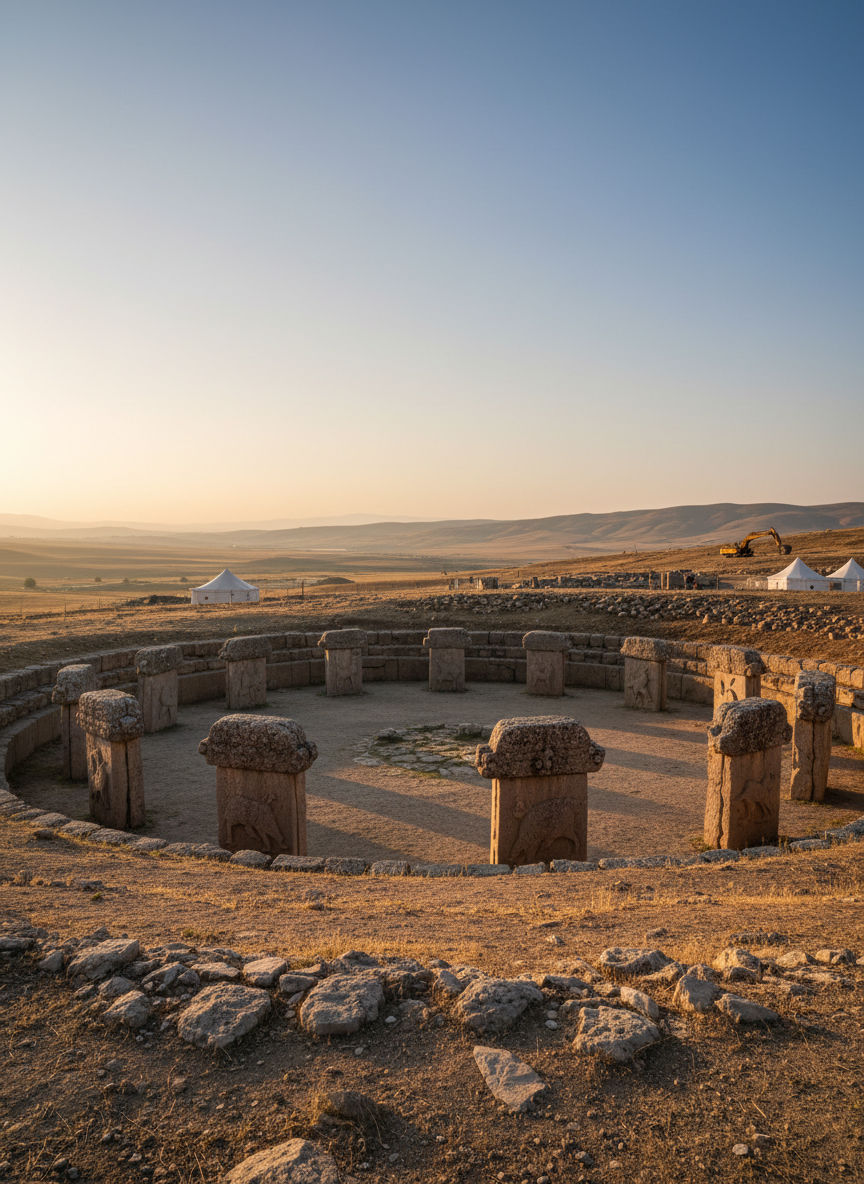
When the site was first seriously excavated in the 1990s, it completely shocked the scientific community. Instead of simple, primitive huts, researchers unearthed massive, beautifully carved stone pillars arranged in huge, deliberate circles. It was an ancient architectural masterpiece hiding in plain sight, completely untouched for millennia.
Key Takeaway
Göbekli Tepe is an 11,500-year-old temple complex that predates almost all other known monumental human architecture.
Test Your Knowledge
How does the age of Göbekli Tepe compare to the Egyptian Pyramids?
Who exactly built this ancient marvel? If you are picturing a highly advanced civilization with specialized tools, sprawling farms, and domesticated beasts of burden, you would be mistaken!
Historians and archaeologists believe Göbekli Tepe was built entirely by hunter-gatherers. These were nomadic or semi-nomadic groups of people who survived day-to-day by foraging for wild plants and hunting wild animals across the plains. They did not possess any metal tools, formal engineering degrees, or even simple wheeled carts to help them move impossibly heavy objects.
Using only basic, primitive stone tools like flint, these ambitious communities managed to carve, lift, and transport massive limestone blocks—some of which weigh up to a staggering 20 tons! Completing a project of this scale required immense teamwork, social organization, and shared vision. It proves that early humans were much more capable, cooperative, and coordinated than we ever previously imagined.
Key Takeaway
The site was built by ancient hunter-gatherers using only basic stone tools, long before the invention of metal or the wheel.
Test Your Knowledge
What kind of technology did the builders of Göbekli Tepe rely on?
If you could somehow travel back in time and walk into Göbekli Tepe thousands of years ago, you would find yourself surrounded by towering, T-shaped stone pillars. Some of these massive central pillars stand over 15 feet tall and weigh several tons!
Many archaeologists believe these distinct T-shapes were meant to represent highly stylized, abstract human figures. But what makes these pillars truly special is the breathtaking artwork carved directly onto them. The stones are covered in highly detailed, three-dimensional reliefs of wild animals.
You won't find any cute, domesticated farm animals here. The ancient carvings prominently feature fierce and intimidating creatures like scorpions, vultures, foxes, wild boars, and lions. Experts don't believe these were simply the animals they hunted for dinner. Instead, it is highly likely they served as powerful spiritual symbols, mythical story characters, or perhaps fiercely protective guardians of the sacred temple.
Key Takeaway
The site features giant T-shaped stone pillars beautifully decorated with elaborate carvings of wild, dangerous animals.
Test Your Knowledge
What types of animals are most prominently carved onto the pillars?
For a very long time, historians and anthropologists agreed on a strict, linear timeline for human progress. The story went like this: First, early humans figured out how to farm. Then, they settled down into permanent villages. Finally, with reliable food and extra free time, they developed complex religions and built grand temples.
The discovery of Göbekli Tepe flipped this classic theory completely upside down.
Because this massive site was built entirely by hunter-gatherers *long before* agriculture was ever established, it suggests the exact opposite sequence of events occurred! The powerful human desire to gather, worship, and build a monumental temple came *first*. In order to feed all the hundreds of workers needed to construct the temple over generations, they eventually had to figure out how to cultivate wild wheat nearby. In other words, the temple might have accidentally sparked the invention of the farm!
Key Takeaway
Göbekli Tepe suggests that the human desire to gather for religion led to the invention of agriculture, not the other way around.
Test Your Knowledge
How did Göbekli Tepe change our understanding of human history?
After being an active center of culture and gathering for well over a thousand years, Göbekli Tepe was eventually completely abandoned. But the massive stone rings weren't just left exposed to crumble in the wind and rain.
For decades, the leading archaeological theory was that the ancient builders intentionally and meticulously buried the entire site under thousands of tons of dirt, gravel, and refuse, carefully hiding it away like a giant prehistoric time capsule.
However, science is always evolving. Recently, newer research from modern excavations has challenged this dramatic idea. Some experts now suggest the ruins may have naturally filled in over many centuries due to landslides, erosion, and the crumbling of newer, smaller buildings built on the slopes above. Whether it was a deliberate, ritualistic burial or the slow, unstoppable march of nature, the earth perfectly preserved this ancient marvel for over 10,000 years until we finally brought it back to the light.
Key Takeaway
The temple was eventually abandoned and buried under the earth, perfectly preserving it for millennia, though how it was buried is still debated.
Test Your Knowledge
What is currently debated by archaeologists regarding the end of Göbekli Tepe?
Track your progress, earn XP, and compete on leaderboards. Download NerdSip to start learning.