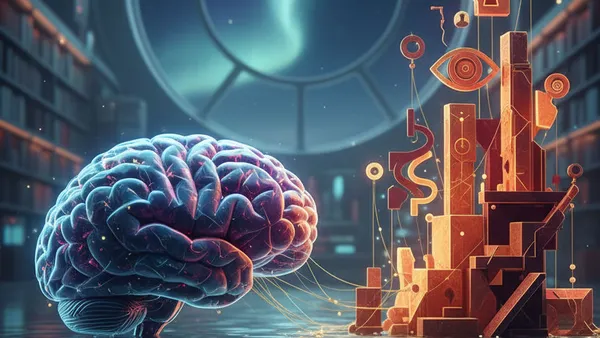
What lies beyond the shadow and the ego?
Prompted by NerdSip Explorer #1450
Master the ultimate stages of Jungian individuation.
Coined by anthropologist Lucien Lévy-Bruhl and later adopted by Carl Jung, participation mystique denotes an archaic, unconscious identity with an external object or person.
Unlike a standard psychological projection—where an unrecognized inner quality is merely mapped onto another individual—participation mystique implies an absolute, structural lack of psychological boundaries. The subject is literally, energetically entangled in the object. At this profound level of depth psychology, psychic energy flows without a differentiating membrane.
When the external object changes or suffers, the subject feels a somatic, immediate impact as if the event happened to their own body. It is the primal, foundational state of the psyche, the baseline from which all ego-consciousness must eventually and painfully abstract itself.
In advanced psychoanalysis, identifying a state of participation mystique is absolutely critical for resolving intractable, stubborn transferences. Dissolving this archaic bond requires the ego to recognize that its very ontological security has been outsourced to the external world, forcing a terrifying but necessary withdrawal of psychic energy back into the sovereign Self.
Key Takeaway
Participation mystique is a boundaryless state of unconscious identity with an object, preceding all psychological differentiation.
Test Your Knowledge
What distinguishes 'participation mystique' from a standard psychological projection?
Beyond the personalized encounters with the anima or animus lies a much deeper structural reality known as the Syzygy—the supreme archetypal pairing.
Representing the divine couple, the Syzygy is the foundational blueprint for all psychological binaries: male and female, conscious and unconscious, form and formlessness. It is the deep-seated template of wholeness. In its rawest, unintegrated state, the Syzygy operates completely autonomously.
It often projects itself onto human relationships, compelling us to seek a messianic totality or divine completion in our mortal partners—a demand that invariably destroys ordinary love. However, in advanced depth psychology, the Syzygy is recognized not as a relational mandate for the outer world, but as an internal, intrapsychic architecture.
When an individual successfully withdraws these massive, cosmic projections from the external world, they must endure the immense psychic tension of housing the divine hermaphrodite within themselves. The Syzygy ultimately acts as the necessary scaffolding for the realization of the Self, representing a primordial state of unity that paradoxically drives the ongoing evolution of individual consciousness.
Key Takeaway
The Syzygy is the archetypal pairing of opposites that structures the psyche and drives our unconscious demand for ultimate totality.
Test Your Knowledge
In advanced depth psychology, what is the primary danger of the Syzygy if it remains entirely unconscious?
In his privately circulated, mystical text *Seven Sermons to the Dead*, Jung outlines a profound metaphysical framework using ancient Gnostic terminology: the Pleroma and the Creatura.
The Pleroma is the absolute, undifferentiated ground of being. It is a paradoxical void that is simultaneously an absolute fullness. Because it contains all conceivable qualities, forces, and opposites in perfect equilibrium, it effectively possesses no distinct qualities at all.
In sharp contrast, the Creatura is the realm of psychological differentiation, manifestation, and ego-consciousness. To exist in the Creatura is to be fundamentally bound by the friction of opposites—light and dark, beautiful and ugly, good and evil. The ego's fundamental tragedy is its inherent separation from the eternal peace of the Pleroma, yet this painful separation is the exact mechanism that makes consciousness possible.
If the ego leans too far back into the Pleroma, it risks a psychotic dissolution into the collective unconscious. Conversely, if it becomes fully absorbed in the material Creatura, it suffers severe spiritual desiccation. Advanced individuation demands standing firmly in the Creatura while maintaining an open axis to the infinite.
Key Takeaway
Consciousness requires existing in the differentiated Creatura while maintaining a delicate connection to the undifferentiated Pleroma.
Test Your Knowledge
According to Jung's Gnostic framework, what happens when the ego leans too far back into the Pleroma?
Moving beyond conventional theological constructs of absolute good or absolute evil, advanced depth psychology forces a confrontation with the terrifying archetype of Abraxas.
Borrowed from Basilidean Gnosticism, Abraxas represents the paradoxical totality of the objective psyche. He is a deity that unifies light and shadow perfectly. Abraxas is the raw, unadulterated driving force of life itself—the monstrous, amoral energy that generates and destroys without hesitation, pity, or malice.
It is the profound psychological realization that the deepest layers of the Self do not conform to human morality, ethical frameworks, or the ego's desire for comfort. Abraxas is the burning fire of the real. Integrating the psychological reality of Abraxas means permanently abandoning the infantile desire for a purely benevolent cosmos.
It requires the ego to develop a radical, unflinching psychological fortitude. The individual must acknowledge that the highest, most profound manifestations of the unconscious contain both supreme, blinding beauty and absolute, devastating horror—intertwined forever as a single, indivisible psychic force.
Key Takeaway
Abraxas symbolizes the supreme, amoral energy of the objective psyche, encompassing both absolute creation and absolute destruction.
Test Your Knowledge
What psychological shift is required to integrate the archetype of Abraxas?
The ultimate goal of the deep psychological process is not mere symptom reduction, nor simply achieving a balanced personality, but the realization of the Unus Mundus (the One World).
While the transcendent function facilitates momentary bridges between opposing psychic forces, the Unus Mundus represents a sustained, ontological shift where the strict division between inner psyche and outer matter collapses entirely. Modeled after the final, esoteric stages of the alchemical *Rosarium Philosophorum*, this exalted state follows the agonizing putrefaction of the ego.
The Unus Mundus is characterized by a state of profound, ongoing synchronistic attunement, where the individual directly experiences the underlying, unified fabric of reality. The illusion of a purely subjective inner world and a dead, objective outer world is shattered.
In this ultimate state, the ego does not dissolve into the madness of psychosis, nor does it inflate into the delusion of a mana-personality. Instead, the ego becomes a clear, conscious mirror for the cosmos—a highly localized point of quiet awareness where the universe ultimately reflects upon its own undivided, eternal nature.
Key Takeaway
The Unus Mundus is the ultimate realization of individuation, where the dichotomy of psyche and matter permanently dissolves into unified awareness.
Test Your Knowledge
How does the realization of the Unus Mundus differ from ego-inflation (the mana-personality)?
Track your progress, earn XP, and compete on leaderboards. Download NerdSip to start learning.