Did you know that many ancient cultures worshipped gods who were professional liars and thieves?
Prompted by A NerdSip Learner
Analyze the roles of Loki, Anansi, and Hermes in shaping cultural morality and human storytelling.
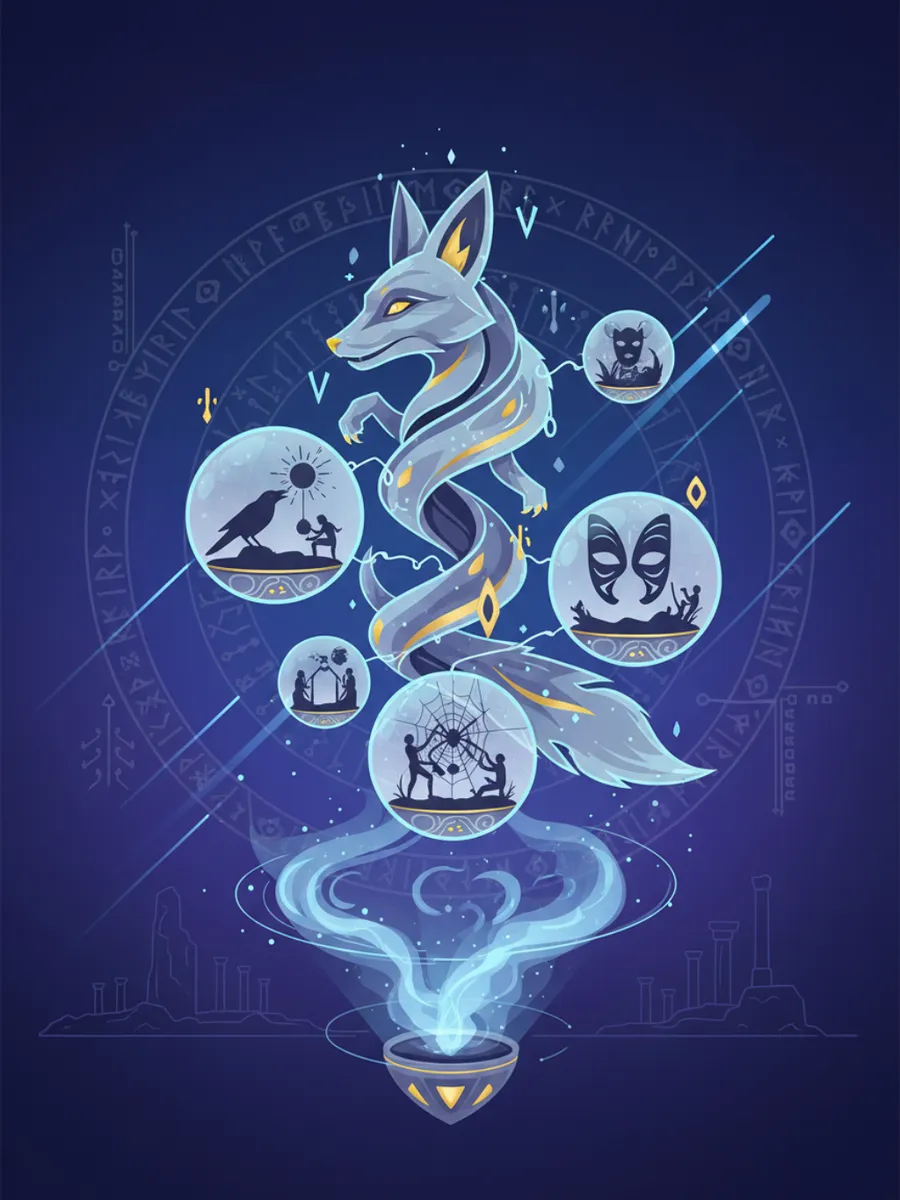
Did you know that some of history's most revered gods were also professional liars, thieves, and shape-shifters? Welcome to the world of the trickster archetype. Across different ancient cultures, these cunning deities subverted authority, broke the rules, and turned the established order upside down.
But why would anyone worship a god who constantly causes trouble? The answer lies in the human experience. Life is unpredictable, and tricksters embody the chaos that humans must navigate every day. They show us that intellect, wit, and adaptability are often more valuable than brute strength.
Trickster deities like Loki, Anansi, and Hermes aren't strictly "evil." Instead, they operate in the gray areas of morality. They cross boundaries between the mortal world and the divine, often acting as catalysts for change. By breaking the rules, they force both gods and humans to grow, adapt, and evolve. Throughout this course, we will explore how these divine scoundrels shaped human storytelling and cultural morality.
Key Takeaway
Trickster deities embody chaos and rule-breaking, demonstrating that adaptability and wit are essential for navigating an unpredictable world.
Test Your Knowledge
Why are trickster deities important in cultural mythology?
In Norse mythology, no figure is as complex or frustrating to the gods as Loki. A shape-shifter and the blood-brother of Odin, Loki is the ultimate agent of chaos in Asgard. He is entirely unpredictable, oscillating between helping the Aesir (the Norse gods) and conspiring against them.
Loki's primary role in Norse myths is the "problem creator and problem solver." He frequently lands the gods in terrible predicaments—such as carelessly causing the goddess Idunn and her apples of youth to be kidnapped. However, it is almost always Loki’s cunning that gets them out of the mess. In fact, many of the gods' greatest treasures, including Thor's iconic hammer Mjolnir, were acquired solely because of Loki's schemes.
This duality makes Loki a fascinating moral mirror. He teaches the Norse people that chaos is an inescapable part of life. While unchecked deceit leads to ruin, a sharp mind and quick thinking are necessary tools for survival. Loki embodies the very human trait of making mistakes and relying on ingenuity to fix them.
Key Takeaway
Loki serves as both the creator and solver of problems in Norse mythology, highlighting the value of ingenuity in fixing one's mistakes.
Test Your Knowledge
What is a common pattern in Loki's interactions with the Norse gods?
While Loki’s early antics are often somewhat humorous, his story takes a dark turn that deeply shapes Norse morality. Loki is not just a trickster; he is the father of monsters. With the giantess Angrboda, he sired three terrifying children: the great wolf Fenrir, the Midgard Serpent Jormungandr, and Hel, the ruler of the dead.
As the myths progress, Loki's tricks evolve into outright malice, culminating in his orchestration of the death of Baldur, the most beloved of the gods. This act crosses a line from which there is no return. The gods bind Loki in a cave with a venomous snake dripping poison onto his face, signaling the end of his tolerance in Asgard.
Loki’s trajectory is a cautionary tale. He demonstrates that while wit and rebellion are useful, malice and unchecked betrayal eventually destroy communities. His actions ultimately trigger Ragnarok—the apocalyptic end of the Norse world. Through Loki, Norse mythology warns that tearing down the social order without rebuilding it leads only to destruction.
Key Takeaway
Loki’s evolution from a playful trickster to a malicious betrayer serves as a cautionary tale about the destructive consequences of unchecked deceit.
Test Your Knowledge
What does Loki's eventual punishment and role in Ragnarok teach in Norse mythology?
Moving from the icy fjords of Scandinavia to the vibrant cultures of West Africa, we meet Anansi, the legendary spider. Originating from the oral traditions of the Akan and Ashanti people of modern-day Ghana, Anansi is one of the most famous tricksters in global mythology.
Unlike the destructive Loki, Anansi is a figure of intelligence and survival. He is often depicted as a small, physically weak spider who must rely entirely on his brain to outsmart much larger, more dangerous animals like leopards and pythons. In one of his most famous myths, Anansi buys all the stories of the world from the sky god, Nyame, by completing seemingly impossible tasks through sheer cunning.
Anansi shapes cultural morality by proving that brain always triumphs over brawn. For the Akan people, Anansi is a symbol of wisdom and speech. His stories, known as "Anansesem," were designed to teach children that they don't need to be the biggest or strongest in the room to succeed, so long as they are the smartest.
Key Takeaway
Originating in West Africa, Anansi the Spider uses extreme intellect and wit to overcome physically superior opponents, proving that brain beats brawn.
Test Your Knowledge
How does Anansi typically defeat his opponents in Akan folklore?
The mythology of Anansi did not remain confined to West Africa. During the horrific era of the transatlantic slave trade, millions of enslaved African people were forcibly brought to the Americas and the Caribbean. Along with them, they brought the stories of the clever spider.
In places like Jamaica, the United States, and the wider Caribbean, Anansi underwent a profound cultural evolution. He was no longer just a playful trickster; he became a vital symbol of resistance and survival. For enslaved people, a hero who was small, powerless, yet constantly outsmarted his oppressive "masters" through deception and wit was deeply resonant.
Anansi taught a new kind of morality in the Americas: the morality of survival in an unjust system. The tales provided hope and psychological resilience, proving that the weak could subvert the strong. To this day, Anansi remains a celebrated folk hero across the African diaspora, demonstrating how mythological figures can adapt to provide comfort and strength to marginalized communities.
Key Takeaway
During the transatlantic slave trade, Anansi evolved from a West African trickster into a powerful symbol of resistance and survival for enslaved people.
Test Your Knowledge
Why did Anansi become such an important figure in the Caribbean and the Americas?
In ancient Greece, the trickster archetype was embodied by Hermes, the messenger of the gods. From the very day he was born, Hermes proved himself to be a brilliant scoundrel. According to myth, he was only a few hours old when he snuck out of his crib and stole 50 prized cattle belonging to his half-brother, the sun god Apollo.
To avoid getting caught, the infant Hermes tied branches to the cows' tails so they would sweep away their own footprints, and even forced them to walk backwards to confuse anyone tracking them. When Apollo finally caught him, Hermes played an instrument he had just invented—the lyre, crafted from a tortoise shell. Apollo was so enchanted by the music that he traded the cattle for it, and the two became close allies.
Hermes was the patron god of thieves, merchants, and travelers. He governed the crossing of boundaries, acting as the "psychopomp" who guided souls to the underworld. For the Greeks, Hermes represented the necessary flexibility of life. He taught that strict rules could be bent with charm, negotiation, and creativity.
Key Takeaway
Hermes, the Greek messenger god, used his charm and inventiveness to bend the rules, representing flexibility, negotiation, and the crossing of boundaries.
Test Your Knowledge
How did the infant Hermes avoid getting caught after stealing Apollo's cattle?
From the Norse frost to the West African plains and the Greek coastlines, trickster deities share remarkable similarities. Loki, Anansi, and Hermes all subvert authority, rely on cunning over strength, and straddle the boundary between creator and destroyer. But what is their ultimate purpose in human storytelling?
Tricksters serve as a cultural pressure valve. In highly structured ancient societies, people needed a safe way to imagine what happens when the rules are broken. These cunning deities act as moral mirrors, showing us the consequences of deception. Sometimes, like with Loki, they warn us against malicious betrayal. Other times, like with Anansi and Hermes, they celebrate the ingenuity needed to survive an unfair world.
Ultimately, these professional liars and thieves remind us of our own humanity. We are not perfectly good or entirely bad. We are adaptable, deeply flawed, and capable of profound cleverness. By studying tricksters, we understand that humanity's greatest superpower has never been sheer strength, but rather the limitless bounds of human imagination.
Key Takeaway
Trickster deities act as a cultural pressure valve and moral mirror, reflecting human flaws, adaptability, and the power of imagination.
Test Your Knowledge
What ultimate purpose do tricksters serve in ancient storytelling?
Track your progress, earn XP, and compete on leaderboards. Download NerdSip to start learning.