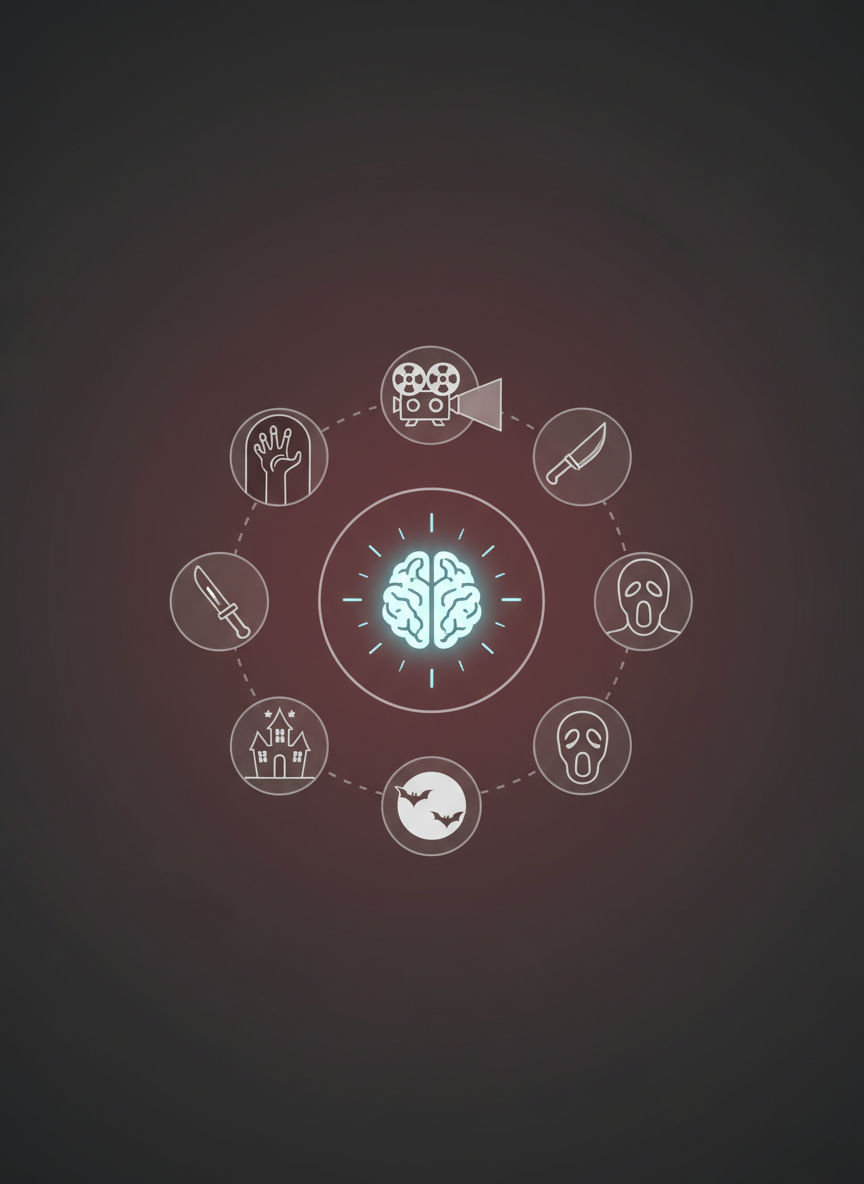
Ever wonder why we love being scared? Let's dive into the dark.
Prompted by A NerdSip Learner
Identify the 5 essential horror genres and their iconic masterpieces.
Welcome to the dark side! Have you ever wondered why we pay to be terrified? It’s essentially a roller coaster ride for your brain. Your body pumps out adrenaline because it senses danger, but your mind stays cool knowing you’re safe on the sofa. This controlled thrill is addictive!
Horror uses two main tools to get your heart racing. First, there’s the jump-scare: a sudden noise or image that makes you leap. Then there’s suspense: that slow, creeping feeling that something awful is about to happen. Both are essential for a good fright.
A true masterpiece that perfected both is Alfred Hitchcock’s "Psycho" (1960). Instead of monsters in Gothic castles, Hitchcock brought terror to an everyday motel. It was a revolutionary move that proved horror can happen anywhere, even in the shower. Get ready to explore more!
Key Takeaway
Horror works like a roller coaster, offering a safe thrill through a mix of sudden shocks and slow-building tension.
Test Your Knowledge
What made Hitchcock’s "Psycho" so revolutionary?
Let’s start with a classic: supernatural horror. This genre deals with things science can't explain—ghosts, demons, and cursed places. Here, the threat is often invisible, making it much harder to escape. It taps into our deepest fears of the unknown.
The "haunted house" movie is the ultimate example. The setup is simple: a normal family moves into a new home, and suddenly, the walls start talking. Doors creak, shadows move, and the atmosphere becomes thick with dread as the haunting intensifies.
Stanley Kubrick’s "The Shining" (1980) is the gold standard. It shows how a massive, empty hotel can slowly drive a man toward total madness. These films work because they exploit our primal helplessness; when you can’t punch a ghost, you feel completely trapped.
Whether it's a spirit or a poltergeist, the supernatural reminds us that some things are beyond our control.
Key Takeaway
Supernatural horror exploits our fear of the invisible and unexplainable, often using haunted locations to build dread.
Test Your Knowledge
Why is supernatural horror so unsettling?
Moving from the invisible to the physical: Monster Movies. Since the dawn of cinema, we’ve been obsessed with creatures like Dracula, Frankenstein, and werewolves. These beasts often represent the darker, animalistic side of human nature that we try to hide.
Over time, monsters evolved. They left old castles and started attacking us in the wilderness or even deep space. These films play on an evolutionary nerve: the fear of becoming prey. It reminds us that we aren't always at the top of the food chain.
The king of this genre is "Alien" (1979). A small crew is trapped on a spaceship with a perfect killing machine. The film is brilliant because you rarely see the monster in full. Our imagination creates something far scarier than any prop.
Monster films force us to confront creatures that are faster, stronger, and much hungrier than we are.
Key Takeaway
Monster movies trigger our primal fear of being hunted by something faster, stronger, and hungrier than us.
Test Your Knowledge
According to the text, why is the monster in "Alien" (1979) so frightening?
In the late 1970s, a new subgenre exploded: the Slasher. The formula was simple: a group of teenagers is hunted one by one by a masked, silent killer. It was low-budget, high-tension, and incredibly profitable for studios.
"Halloween" (1978) started the trend. It didn't need expensive monsters; it just needed pure evil in a quiet suburb. This success paved the way for icons like Jason Voorhees and Freddy Krueger. By the 90s, however, the formula felt tired and predictable.
Then came "Scream" (1996). It revitalized the genre by breaking the fourth wall. The characters actually knew horror movie rules and discussed clichés while being chased. It turned the slasher into a meta-commentary while still delivering the gore.
Slasher films are essentially modern, bloody games of hide-and-seek—predictable, but that's exactly why they are so much fun to watch.
Key Takeaway
Slasher films are modern games of hide-and-seek where masked killers hunt unsuspecting victims.
Test Your Knowledge
What made the 1996 film "Scream" so unique?
Finally, we reach the heavy hitter: Psychological Horror. Here, there are no masked men or aliens. The greatest threat is the human mind itself. These stories focus on paranoia, manipulation, and the total loss of reality.
As a viewer, you’re constantly questioning what’s real. Is the protagonist going crazy, or is everyone else out to get them? This type of horror doesn't just make you jump; it crawls under your skin and stays there long after the credits roll.
A modern masterpiece is "Get Out" (2017). It starts as an awkward social visit but slowly transforms into a waking nightmare. It proves that the scariest places aren't dark woods or haunted houses, but the hidden depths of the human soul.
Psychological horror reminds us that the most terrifying monster might be the person looking back at us in the mirror.
Key Takeaway
Psychological horror focuses on internal threats like paranoia and the breakdown of reality rather than external monsters.
Test Your Knowledge
What defines a "Psychological Horror" film?
Track your progress, earn XP, and compete on leaderboards. Download NerdSip to start learning.