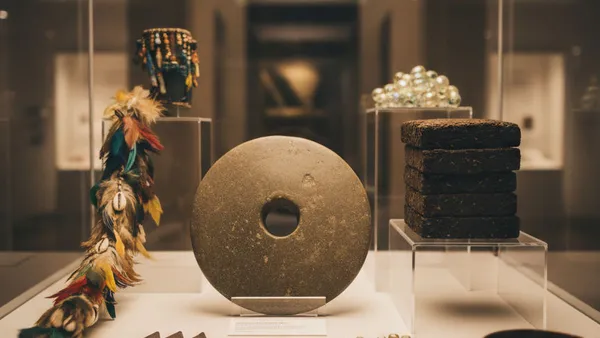
What happens when currency melts, rots, or is carved from 8,000-pound limestone rocks?
Prompted by NerdSip Explorer #6116
Analyze the macroeconomic logic behind history's strangest currency experiments.
In 1685, the French colony of New France (modern-day Canada) faced a severe liquidity crisis. The ship carrying silver coins to pay the local military garrison was disastrously delayed. Without pay, soldiers couldn't buy goods, threatening a severe localized economic depression.
Intendant Jacques de Meulles devised a brilliantly simple fiat intervention. He collected standard playing cards, cut them into specific shapes to denote different denominations, signed them, and stamped them with his seal. He then issued a decree mandating that merchants accept these cards as legal tender.
This experiment effectively introduced unbacked paper money to the Western Hemisphere. The cards were a tremendous success because they solved a fundamental problem of medium of exchange versus store of value. They were rigid, hard to forge, and backed purely by the governor's promise to redeem them for silver when the ships eventually arrived.
Key Takeaway
Currency doesn't need intrinsic value to function; it just needs an enforceable decree and mutual trust.
Test Your Knowledge
What fundamental macroeconomic problem did playing card money solve in New France?
Long before digital networks envisioned the blockchain, the island of Yap in Micronesia operated on an incredibly sophisticated distributed ledger system. Their currency consisted of Rai stones—massive, heavy limestone discs, some weighing over 8,000 pounds.
Because moving these stones was nearly impossible, the Yapese developed a system of intersubjective consensus. When a transaction occurred, the physical stone didn't move. Instead, the community simply updated their collective oral history to reflect the new ownership. The stone remained exactly where it was.
The most fascinating nuance of this system occurred when a crew transporting a Rai stone encountered a storm, and the stone sank to the bottom of the Pacific Ocean. Because the community agreed the stone still existed, it retained its purchasing power. It was continuously traded for generations, despite no one ever seeing it again. This perfectly illustrates that money is simply a socially agreed-upon ledger of accounts.
Key Takeaway
Money is fundamentally an accounting system based on mutual consensus, not a physical object.
Test Your Knowledge
Why did a Rai stone at the bottom of the ocean retain its economic value?
During the depths of the Great Depression in 1932, the Austrian town of Wörgl suffered from massive unemployment and cash hoarding. To stimulate the local economy, the mayor implemented a radical theory by economist Silvio Gesell: demurrage.
He issued a local currency known as *Freigeld* (Free Money). But there was a catch—the money essentially rusted. To keep a banknote valid, the holder had to purchase a stamp every month equivalent to 1% of the note’s face value. This acted as a negative interest rate, heavily penalizing anyone who hoarded cash.
The macroeconomic impact was instantaneous. The velocity of money skyrocketed as citizens rushed to spend their *Freigeld* before it depreciated. The town used this rapid circulation to pave streets, build a bridge, and drastically reduce unemployment. The experiment was so successful it sparked panic at the Austrian Central Bank, which swiftly shut it down to protect its monopoly on currency issuance.
Key Takeaway
Penalizing the hoarding of cash through demurrage can radically increase the velocity of money and stimulate economic growth.
Test Your Knowledge
What is the primary economic effect of a 'demurrage' currency?
In 1934, as global credit markets froze, a group of Swiss businessmen created a brilliant B2B clearing network called the WIR (short for *Wirtschaftsring*, or Economic Circle). It operates as an entirely private, parallel fiat currency used exclusively among small and medium-sized enterprises (SMEs).
The genius of the WIR system is its counter-cyclical nature. When the broader Swiss economy booms and bank credit is cheap, businesses primarily use standard Swiss Francs. But during recessions, when traditional banks tighten lending requirements and liquidity dries up, SMEs instantly pivot to trading in WIR francs.
Because the WIR network is fundamentally a mutual credit system—where every debit is matched by a credit within the closed loop—it acts as an automatic macroeconomic shock absorber. By bypassing the traditional banking sector's pro-cyclical lending habits, the WIR has successfully insulated thousands of Swiss businesses from liquidity crises for nearly a century.
Key Takeaway
Private, parallel credit networks can provide critical liquidity to businesses during traditional macroeconomic downturns.
Test Your Knowledge
Why is the Swiss WIR considered 'counter-cyclical'?
For centuries, stretching into the early 20th century, vast regions of Siberia, Mongolia, and Tibet relied on a highly functional commodity money: tea bricks. These were dense blocks of compressed tea leaves, often bound together with aromatic herbs and ox blood to maintain their rigid shape.
In a modern fiat system, destroying currency decreases the money supply, leading to deflation. But tea bricks represented a dual-use asset. In harsh, freezing climates, the bricks were highly prized not just as a medium of exchange, but as a vital medicine and caloric beverage.
This created a fascinating macroeconomic dynamic. During brutal winters or famines, people literally consumed their liquidity. Eating the money naturally contracted the regional money supply, which elegantly adjusted the purchasing power of the remaining bricks. Furthermore, unlike metal coins, tea bricks actually increased in value the further they traveled from the Chinese tea plantations, naturally pricing in the cost of logistics.
Key Takeaway
Dual-use commodity money creates an automatic, self-regulating money supply when the currency is consumed during hard times.
Test Your Knowledge
What happened to the regional money supply when communities consumed their tea bricks?
In 1991, community organizer Paul Glover launched a localized currency in Ithaca, New York, designed to fundamentally reprice human capital. Dubbed Ithaca Hours, this complementary currency explicitly tied the concept of money to the labor theory of value.
One Ithaca Hour was pegged to the equivalent of $10, which was roughly the average hourly wage in the county at the time. The goal was to create a fiercely localized micro-economy. By denominating transactions in time rather than federal dollars, the system sought to equalize the perceived value of different types of labor, from plumbing to graphic design.
Crucially, because Ithaca Hours could not be spent outside the community or deposited into Wall Street banks, they prevented capital flight. The currency forced citizens to source goods and services locally, building a resilient, high-velocity regional economy that insulated the town from broader macroeconomic shocks.
Key Takeaway
Localized currencies backed by labor hours can prevent capital flight and forcibly insulate a regional economy.
Test Your Knowledge
What was the primary economic objective of pegging the Ithaca Hour to local labor time?
During the Middle Ages, the Novgorod Republic in modern-day Russia suffered a severe 'silver famine.' Unable to mint traditional metallic coins, the economy organically pivoted to its most abundant natural resource, creating a literal fur standard.
While large transactions were settled with whole pelts, everyday commerce required small change. To solve the divisibility problem, the state minted 'leather money' by stamping specific parts of the squirrel—such as snouts, claws, and ears—pegging them to the value of a silver rouble.
However, this system ultimately triggered one of history's most bizarre bouts of hyperinflation. Just like a central bank aggressively printing fiat, local hunters realized they could effectively 'print' money by killing more squirrels. The market was flooded with pelts, and the purchasing power of the snout collapsed. Compounding the crisis, counterfeiters began circulating untanned or low-quality leather, ultimately leading to the total collapse of the system.
Key Takeaway
If the supply of a currency can be easily increased by the public, it will inevitably suffer from hyperinflation.
Test Your Knowledge
What fatal macroeconomic flaw caused the collapse of the Novgorod 'Squirrel Standard'?
In the Emilia-Romagna region of Italy, a truly bizarre yet highly logical financial instrument has been utilized since the 1950s. The regional Credem Bank actively accepts massive wheels of Parmigiano-Reggiano cheese as collateral for SME business loans.
This isn't a gimmick; it’s a brilliant solution to cash flow latency. Producing authentic Parmigiano-Reggiano requires the cheese to age for up to 36 months. This creates a severe liquidity bottleneck for dairy farmers, who have capital tied up in aging inventory.
By taking physical possession of the 80-pound wheels and storing them in highly secured, climate-controlled bank vaults, Credem effectively monetizes an illiquid asset. The bank charges a low interest rate, plus a storage fee. If a farmer defaults, the bank simply sells the cheese. Because the cheese physically appreciates in value as it ages, the bank’s collateral actually becomes less risky over the duration of the loan.
Key Takeaway
Monetizing illiquid, appreciating inventory as collateral allows producers to survive long manufacturing cycles without suffering cash flow crises.
Test Your Knowledge
Why does Parmigiano-Reggiano serve as highly effective loan collateral for Credem Bank?
In the chaotic aftermath of World War I, Germany’s Weimar Republic was crippled by hyperinflation. As the central bank relentlessly printed marks to pay war reparations, the official currency lost its value by the hour. A wheelbarrow of cash was needed just to buy bread.
To keep localized trade functioning, municipalities, savings banks, and even private companies began issuing *Notgeld* (Emergency Money). Because high-quality paper and metal were scarce, these localized scrips were printed on incredibly bizarre materials: silk, wood, pressed coal, leather, and even porcelain.
While *Notgeld* originated as a desperate liquidity intervention, it rapidly evolved into a psychological coping mechanism. The notes were highly decorative, featuring dark folklore, political satire, and gallows humor about the economic collapse. Eventually, the sheer volume of uncoordinated, localized fiat issuance blurred the lines between money and collectible art, perfectly illustrating the absurdity of a collapsed monetary system.
Key Takeaway
When a sovereign currency collapses, localized emergency scrips will rapidly emerge to fill the vacuum of trust and liquidity.
Test Your Knowledge
What was the primary economic driver behind the creation of German Notgeld?
In 2003, a high school teacher in Bavaria, Germany, launched a modern monetary experiment that has become one of the most successful complementary currencies in the world: the *Chiemgauer*.
Like the Wörgl experiment of the 1930s, the Chiemgauer operates on a system of demurrage to maximize the velocity of money. To maintain its parity with the Euro, a Chiemgauer note must be renewed every three months by attaching a 'scrip stamp' costing 2% of the note's face value.
Because holding the currency literally costs money, consumers are highly incentivized to spend it immediately. Consequently, the Chiemgauer circulates nearly three times faster than the standard Euro. Furthermore, because it is only accepted by regional merchants, it acts as a 'sticky' currency. It prevents the extraction of local wealth by multinational corporations, creating a hyper-localized, self-sustaining economic multiplier effect.
Key Takeaway
Combining demurrage with geographical restrictions creates a high-velocity currency that aggressively traps and multiplies local wealth.
Test Your Knowledge
How does the 2% renewal stamp on the Chiemgauer impact consumer behavior?
Track your progress, earn XP, and compete on leaderboards. Download NerdSip to start learning.