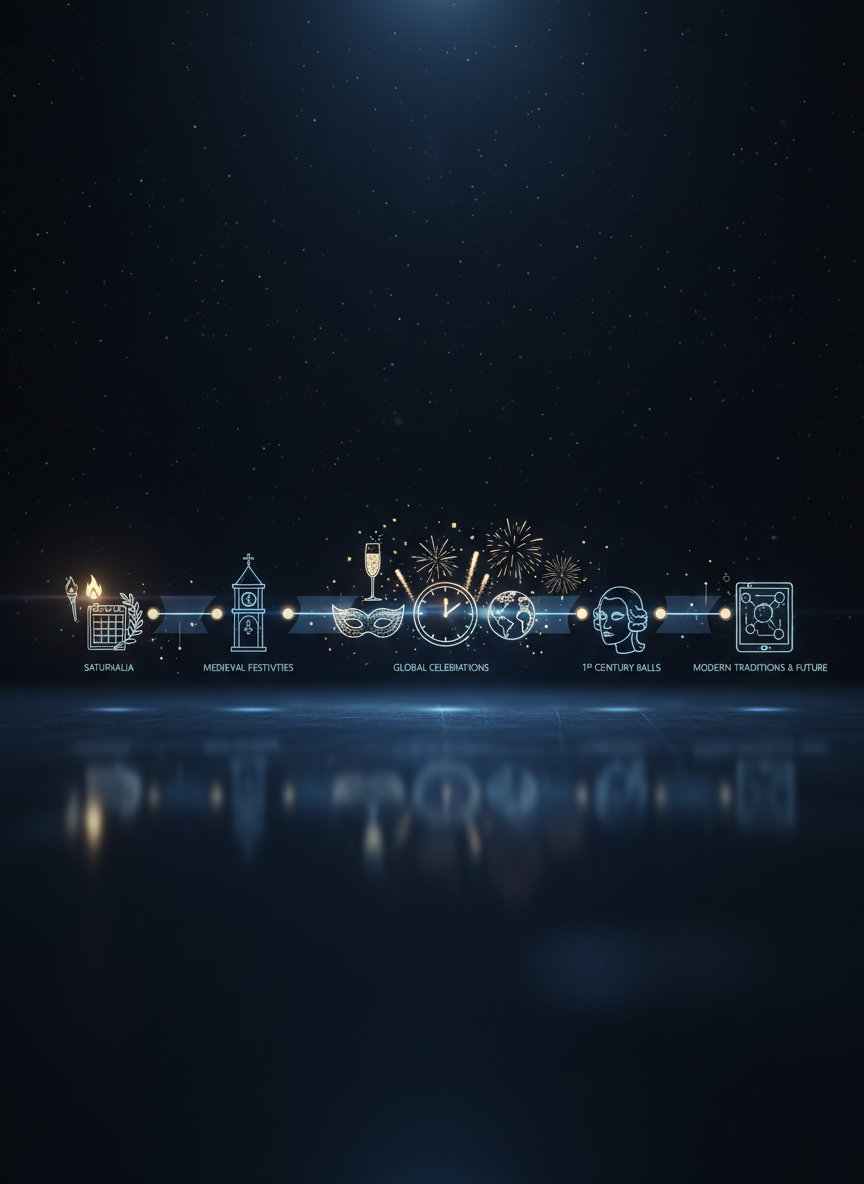
Think your party is modern? It’s actually 1,600 years in the making.
Prompted by A NerdSip Learner
Uncover the ancient popes, Roman gods, and linguistic twists behind our New Year's traditions.
Have you ever wondered why many countries call New Year’s Eve "Silvester"? The answer lies in the year 335 AD. Our protagonist is Pope Sylvester I, who passed away on December 31st. In an era of martyrs, he was a rarity: a Pope who died of natural causes—a true sign of peace at the time!
Fascinatingly, Saint Sylvester had nothing to do with fireworks or champagne. The connection is purely chronological. When the calendar eventually fixed the New Year on December 31st, it just happened to coincide with his feast day. It is a classic case of historical coincidence turning a saint into a party icon.
While legends claim he cured Emperor Constantine’s leprosy and even slayed a dragon, his modern role is simpler. He serves as the symbolic "gatekeeper" of the year. His death marks the boundary between the old and the new, making him the perfect patron for this transitional night.
Key Takeaway
The name 'Silvester' comes from Pope Sylvester I, who died on Dec 31, 335; the party link is a calendar fluke.
Test Your Knowledge
Why is December 31st often referred to as 'Silvester'?
Starting the year on January 1st feels obvious today, but it was once total chaos. In ancient Rome, the year originally began on March 1st. This explains why "September" (from the Latin 'septem' for seven) is now our ninth month. It wasn’t until Julius Caesar stepped in that the start moved to January.
Caesar chose January to honor Janus—the two-faced god of transitions, who looks both backward and forward. However, during the Middle Ages, consistency vanished again. Different regions celebrated the new year on Christmas, Easter, or even in late March, leading to centuries of bureaucratic confusion.
Order finally arrived with the Gregorian Calendar in 1582. Yet, it took until 1691 for the Church to strictly mandate January 1st as the official start for the Christian world. When you celebrate today, you are actually honoring a masterpiece of global synchronization that took nearly two millennia to perfect!
Key Takeaway
New Year's Day moved from March to January thanks to Julius Caesar, but wasn't fully standardized until 1691.
Test Your Knowledge
When did the year begin in the original Roman calendar before Caesar's reform?
Why do we make so much noise at midnight? While we now toast with elegant glasses, the cacophony has primal, pagan roots. Ancient Germanic tribes believed that during the dark winter nights, evil spirits roamed the earth. To drive these demons away, they used whips, rattles, and eventually gunpowder to scream into the void.
There is also a fascinating linguistic secret in the common German wish for a "Good Slide" (*Guten Rutsch*) into the new year. It isn't actually about slipping on ice! Scholars believe it stems from the Yiddish or Hebrew word "Rosch" (as in Rosh Hashanah), meaning "head" or "beginning."
Over time, the unfamiliar Hebrew word was adapted into the catchy "Rutsch." So, when you wish someone a smooth transition today, you might unknowingly be echoing an ancient Hebrew blessing for a "good head of the year." It’s a beautiful mix of superstition, sound, and semantics.
Key Takeaway
Fireworks were originally meant to scare off demons, and the term 'Rutsch' likely has Hebrew roots.
Test Your Knowledge
What is the likely historical origin of the 'Rutsch' (slide) in New Year's greetings?
Track your progress, earn XP, and compete on leaderboards. Download NerdSip to start learning.