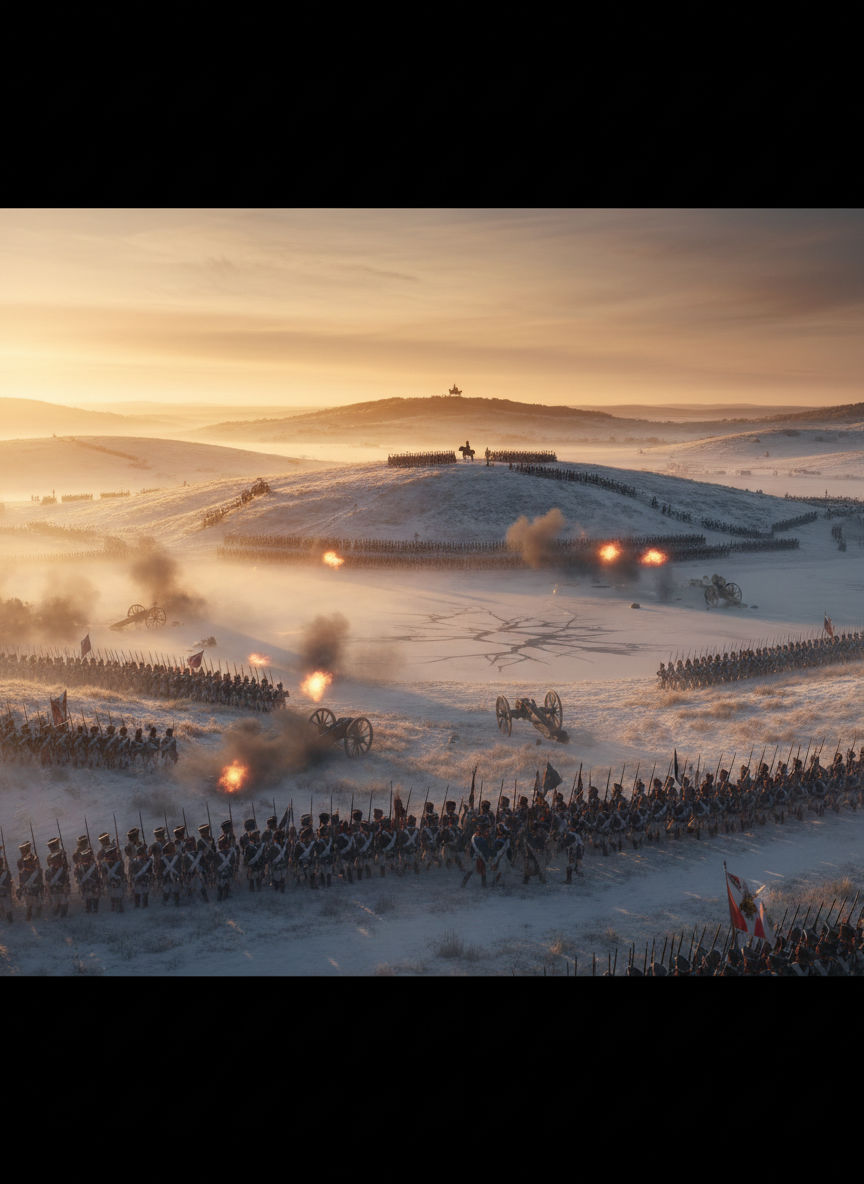
How did Napoleon's greatest trap destroy two empires in a single day?
Prompted by NerdSip Explorer #6484
Master the tactics of Napoleon's defining victory.
By 1805, Europe was once again a powder keg. Great Britain, Austria, and Russia joined forces to form the Third Coalition, a powerful military alliance with one primary goal: to crush the newly crowned French Emperor, Napoleon Bonaparte, and halt his expanding influence.
Napoleon had spent months assembling a massive invasion force on the coast of France, intending to cross the English Channel. However, realizing the British Royal Navy was too strong, he abruptly abandoned his plans. Instead, he spun his massive army around and marched them east toward central Europe. This highly disciplined, battle-hardened force became known as the Grande Armée.
The stage was set for a monumental clash. On one side stood the dynamic, fast-moving French forces under a young, ambitious emperor. On the other stood the combined, traditional might of the Austrian Empire (led by Emperor Francis II) and the Russian Empire (led by Tsar Alexander I).
This geopolitical showdown would soon culminate in the Battle of the Three Emperors, an engagement that would fundamentally redraw the map of Europe and change the course of history.
Key Takeaway
The Battle of Austerlitz was the defining clash of the War of the Third Coalition, pitting France against Austria and Russia.
Test Your Knowledge
Why was the Third Coalition formed?
Before the legendary Battle of Austerlitz could even happen, Napoleon had to get his army across Europe—and he did so with terrifying speed. In the autumn of 1805, the French army marched rapidly into Germany, catching the Austrian military completely off guard.
In a brilliant strategic move known to historians as the Ulm Campaign, Napoleon outmaneuvered a massive Austrian force commanded by General Mack. Rather than fighting a traditional, bloody pitched battle, Napoleon used speed and deception to completely surround the Austrians, forcing tens of thousands of trapped soldiers to surrender.
This stunning maneuver cleared the path directly to the Austrian capital, Vienna, which the French swiftly captured without major resistance. However, the war was far from over.
A massive Russian army, commanded by the seasoned and cautious General Kutuzov, was retreating to the east. They were desperately waiting to join forces with the remaining Austrian troops. Napoleon knew he was deep in enemy territory and needed a decisive, crushing victory before the Allies could gather their full, overwhelming strength.
Key Takeaway
Napoleon achieved a massive strategic advantage by surrounding an Austrian army at Ulm, clearing the path to Vienna.
Test Your Knowledge
What was the result of the Ulm Campaign?
As winter approached in late 1805, the opposing armies finally converged near the small town of Austerlitz in Moravia (located in the modern-day Czech Republic). The battlefield was dominated by a gently sloping plateau known as the Pratzen Heights.
In classical military strategy, whoever holds the high ground usually holds a massive advantage. The Heights offered sweeping, panoramic views of the surrounding valleys and provided a perfect, elevated platform for placing heavy artillery.
Naturally, the Allied army of Russians and Austrians heavily occupied this high ground, confident in their superior numbers. They boasted an estimated 85,000 men compared to Napoleon's roughly 72,000 troops.
But Napoleon had a radical, unconventional plan. Instead of fighting a costly uphill battle for the high ground, he intentionally abandoned the Pratzen Heights, leaving it completely to the enemy. It was a calculated risk that baffled his own generals, who urged him to retreat. Instead, Napoleon was quietly setting the stage for one of the most legendary tactical traps in military history.
Key Takeaway
Napoleon deliberately abandoned the strategic high ground of the Pratzen Heights to lure the Allies into a trap.
Test Your Knowledge
Why did Napoleon abandon the Pratzen Heights before the battle?
To make his elaborate trap work, Napoleon needed the Allies to believe he was terrified and vulnerable. He immediately initiated a campaign of intense psychological warfare, feigning weakness at every possible turn.
He sent diplomatic envoys to the Allied camp to ask for an armistice, intentionally acting highly anxious, hesitant, and unsure of himself. He ordered his frontline troops to stage chaotic, disorganized retreats to make his formidable army look fragile and deeply demoralized.
Most importantly, he deliberately weakened his right flank (the southern end of his battle line). He positioned only a remarkably thin line of defenders there, making it look incredibly vulnerable to a concentrated attack.
Tsar Alexander I and his ambitious younger generals took the bait hook, line, and sinker. Seeing what looked like a panicked, outgunned French army, the Allies eagerly planned a massive assault on that 'weak' right flank. Their goal was simple: crush the right side and cut off Napoleon's only escape route back to Vienna.
Key Takeaway
Napoleon used psychological warfare and a deliberately weakened right flank to manipulate the Allies into attacking where he wanted.
Test Your Knowledge
How did Napoleon intentionally deceive the Allied commanders?
On the freezing morning of December 2, 1805, the Allies confidently set their aggressive plan in motion. Eager to crush the seemingly vulnerable French right flank, thousands of Russian and Austrian troops began marching down from the commanding Pratzen Heights.
This was exactly what Napoleon had been waiting for. By moving the bulk of their forces south to attack the French right, the Allies were fatally stretching their army and falling right into his carefully laid trap.
Most critically, they were completely emptying out their center. The dominant high ground they had so easily occupied the day before was now severely under-defended, held only by a skeleton crew of rear-guard troops.
As the Allied generals focused all their attention and manpower on the southern flank, they failed to realize a terrifying truth. Napoleon had hidden his main strike force—roughly 16,000 men commanded by Marshal Soult—at the bottom of the valley, perfectly concealed by a thick, heavy morning fog.
Key Takeaway
By moving off the heights to attack the French right, the Allies fatally weakened the center of their own battle line.
Test Your Knowledge
What fatal mistake did the Allies make when they took Napoleon's bait?
In Napoleon's daring plan, timing was absolutely everything. If he ordered his men to attack too early, the Allies would spot them and rush back to defend the heights. If he waited too long, his intentionally weakened right flank would be completely destroyed by the massive Russian assault.
For hours, a dense winter fog blanketed the Moravian valley, perfectly hiding the 16,000 French soldiers waiting patiently in the center. Napoleon famously turned to Marshal Soult and asked how long it would take his men to storm the heights. 'Twenty minutes, Sire,' Soult confidently replied.
Around 8:00 AM, the thick fog finally began to lift. A brilliant, blinding sun broke through the clouds—a cinematic moment forever immortalized in French history as the "Sun of Austerlitz."
With the Allied center now visibly emptied of troops, Napoleon finally gave the order to advance. 'One sharp blow,' he declared to his officers, 'and the war is over.' The hidden French force surged upward into the sunlight.
Key Takeaway
A timely morning fog concealed Napoleon's central attack force until the perfect moment to strike.
Test Your Knowledge
Why was the thick morning fog crucial to Napoleon's plan?
Emerging from the dissipating fog like ghosts, Marshal Soult's massive infantry columns crashed violently into the weakened Allied center on the Pratzen Heights.
The remaining Russian and Austrian forces at the top of the plateau were caught completely by surprise. Desperate, bloody hand-to-hand combat erupted. Allied commanders, realizing their catastrophic mistake, frantically tried to turn their marching columns around to defend the heights, but it was simply too late.
By slicing straight through the center of the battlefield, the fast-moving French army physically split the massive Allied forces in two.
This maneuver is the absolute hallmark of Napoleon's genius at Austerlitz: he didn't just push the enemy back in a linear fight; he shattered their entire structural formation from the inside out. Cut off from one another, the Allies lost their chain of command and coordination, and the battle quickly devolved into a chaotic scramble for survival.
Key Takeaway
By capturing the Pratzen Heights, the French sliced the Allied army in half, destroying their coordination.
Test Your Knowledge
What was the devastating result of Marshal Soult's attack on the heights?
While the center of the battlefield was gloriously falling to the French, what was happening to Napoleon's intentionally weakened right flank? Down in the south, a thin line of French soldiers was fighting for its very life against overwhelming Allied numbers.
However, Napoleon had a brilliant ace up his sleeve. Days earlier, he had secretly ordered Marshal Davout to forcefully march his III Corps from Vienna to reinforce that specific vulnerable spot.
In a staggering display of physical endurance, Davout's men marched over 70 miles in just two days, arriving on the battlefield exactly when they were needed. They immediately engaged in brutal, house-to-house fighting in the small villages of Sokolnitz and Telnitz.
Thanks to Davout's iron defense and timely arrival, the French right flank bent under the pressure but never broke. They successfully tied down the vast majority of the Allied army, perfectly executing their critical role in Napoleon's master plan.
Key Takeaway
Marshal Davout's exhausted but resilient troops successfully defended the right flank, saving the entire French strategy.
Test Your Knowledge
How did Marshal Davout save the intentionally weakened French right flank?
While the southern villages and the central heights saw grinding infantry battles, the northern sector of Austerlitz witnessed one of the most spectacular and violent cavalry duels in military history.
Thousands of elite French and Russian horsemen charged and counter-charged in a swirling, chaotic melee. The sounds of clashing sabers, thrusting lances, and firing pistols echoed across the freezing plains.
As the Allied center began to totally collapse, Tsar Alexander I panicked and threw in his ultimate battlefield reserve: the elite Russian Imperial Guard. These giant, heavily armed veterans managed to break a French regiment, temporarily threatening to undo Napoleon's hard-won gains.
In swift response, Napoleon unleashed his own legendary French Imperial Guard cavalry. In a brutal, lightning-fast clash, the French guardsmen shattered the Russian elite forces. With their absolute best, most experienced troops routed and fleeing, the Allied army's spirit officially broke, triggering a disorganized, desperate retreat.
Key Takeaway
A massive clash between the elite Imperial Guards of France and Russia finalized the total collapse of the Allied army.
Test Your Knowledge
How did Napoleon counter the attack of the elite Russian Imperial Guard?
The Battle of Austerlitz was an absolute, unmitigated triumph for the French Empire. At the cost of approximately 9,000 casualties, Napoleon's forces inflicted over 25,000 dead, wounded, and captured on the shattered Allied army.
The geopolitical shockwaves of the victory were even greater than the staggering battlefield statistics. The crushing defeat forced a humiliated Austria to sign the Treaty of Pressburg, knocking them out of the war entirely and effectively triggering the dissolution of the centuries-old Holy Roman Empire.
Tsar Alexander I and his remaining troops were forced to retreat back to Russia in disgrace. The Tsar famously lamented, 'We are babies in the hands of a giant.'
Today, Austerlitz is studied in prestigious military academies worldwide as a flawless masterpiece of tactical deception. By masterfully faking weakness, manipulating the terrain, and trusting his commanders, Napoleon orchestrated what historians widely consider to be his greatest and most brilliant victory.
Key Takeaway
Austerlitz dismantled the Third Coalition, dissolved the Holy Roman Empire, and cemented Napoleon as a military genius.
Test Your Knowledge
What major political consequence followed the French victory at Austerlitz?
Track your progress, earn XP, and compete on leaderboards. Download NerdSip to start learning.