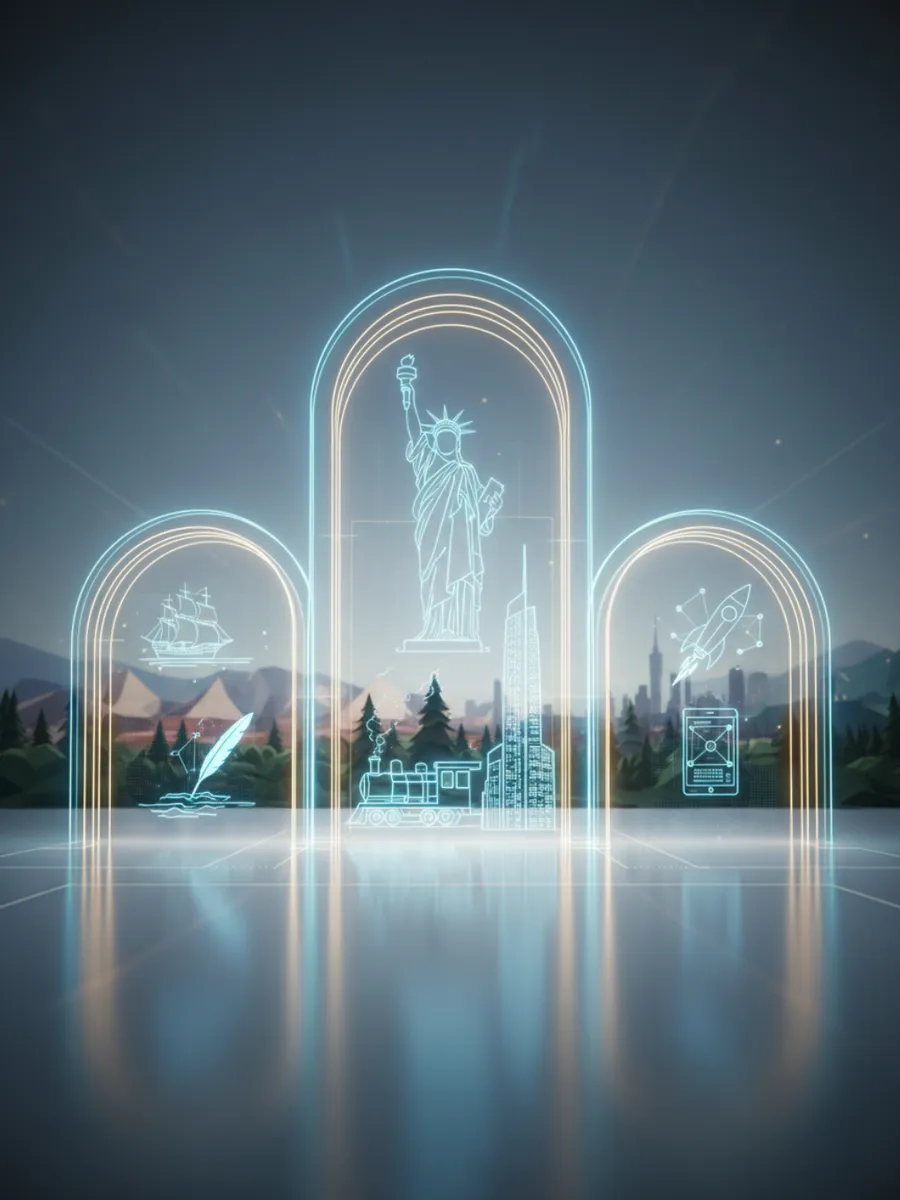
Think you know the real story behind the American experiment?
Prompted by NerdSip Explorer #9628
Master America's defining historical moments in five lessons.
Imagine walking into your living room and finding a stranger claiming they just "discovered" your TV. That’s a bit like what happened in 1492! Before European ships arrived, the Americas were already bustling with millions of Indigenous people, diverse cultures, and massive empires like the Aztecs and Incas. It wasn't an empty wilderness waiting to be found; it was a fully functional neighborhood with thousands of years of history.
When Christopher Columbus and later settlers arrived, it kicked off a massive "collision of worlds." This exchange brought new crops (like potatoes and corn) to Europe, but unfortunately brought deadly diseases and conflict to the Americas. This era set the stage for colonization, changing the global map forever. It’s the messy, complicated start to the story we know today, reminding us that history often has two very different sides.
Key Takeaway
The Americas were fully populated with complex societies long before Europeans arrived.
Test Your Knowledge
Why is the term 'discovery' controversial when talking about 1492?
Fast forward a few centuries to the 1700s. The British colonies on the East Coast were growing up and feeling like teenagers tired of a strict parent. King George III kept imposing taxes (on things like tea, paper, and sugar) without asking the colonists' opinion. This concept, known as "taxation without representation," was the spark that lit the fuse of revolution.
In 1776, Thomas Jefferson and the Founding Fathers wrote the Declaration of Independence. Think of it as the ultimate breakup letter to Great Britain, stating, "It's not us, it's you... actually, it is us, we want to be free." After a tough underdog victory in the Revolutionary War against the powerful British army, the United States was born. It was built on a brand new, risky experiment called democracy, where people voted for their leaders instead of bowing to a king.
Key Takeaway
The U.S. declared independence because they wanted a say in how they were governed and taxed.
Test Your Knowledge
What was the main complaint the colonists had against the British King?
By the mid-1800s, the young nation was growing fast, but it had a deep, terrible flaw: slavery. The Northern states had moved toward an economy based on factories and paid labor, while the Southern economy relied heavily on enslaved people to pick cotton. It was like two different countries trying to share one government, and the friction became unbearable. The country was split on whether this "institution" should be allowed to exist.
Abraham Lincoln was elected President in 1860, and the tension finally snapped. The South tried to leave (secede) to form their own country, leading to the Civil War. It was the deadliest conflict in American history, pitting brother against brother. Ultimately, the North won, keeping the country together and ending the legal practice of slavery, though the road to true equality and healing was still very long.
Key Takeaway
The Civil War was fought over slavery and the unity of the country, resulting in the end of slavery.
Test Your Knowledge
What was the primary economic difference between the North and South before the Civil War?
After the Civil War, America hit a massive growth spurt. Imagine trading a horse and buggy for a steam engine! The Industrial Revolution transformed the country from a land of farmers into a global powerhouse of steel, oil, and electricity. Immigrants from all over the world flooded into cities like New York and Chicago, looking for the "American Dream" and fueling this rapid expansion.
This new economic power pushed America onto the world stage. After trying to stay out of global fights for a long time, the U.S. played a decisive role in two World Wars. By the mid-20th century, the U.S. wasn't just a participant in global affairs; it was a superpower. We had a booming economy, a strong military, and were setting the trends for culture and technology worldwide.
Key Takeaway
Industrialization and immigration turned the U.S. into a global economic and military superpower.
Test Your Knowledge
What major change happened to the U.S. economy in the late 1800s?
Being a superpower didn't mean everything was perfect at home. The 1950s and 60s saw the Civil Rights Movement, where leaders like Martin Luther King Jr. fought to ensure that the promise of "liberty and justice for all" actually applied to Black Americans. It was a time of protests, bravery, and changing laws to end segregation and ensure voting rights.
Simultaneously, the U.S. was in a "Cold War" with the Soviet Union—a standoff not with guns, but with nuclear threats and a race to space. We won the Space Race by landing on the moon, the Berlin Wall eventually fell, and the internet was born. Today, America continues to evolve, constantly grappling with its history while trying to build a more perfect union for the digital age!
Key Takeaway
Modern history is defined by the struggle for civil rights and the technological boom.
Test Your Knowledge
What was the main goal of the Civil Rights Movement in the 1950s and 60s?
Track your progress, earn XP, and compete on leaderboards. Download NerdSip to start learning.