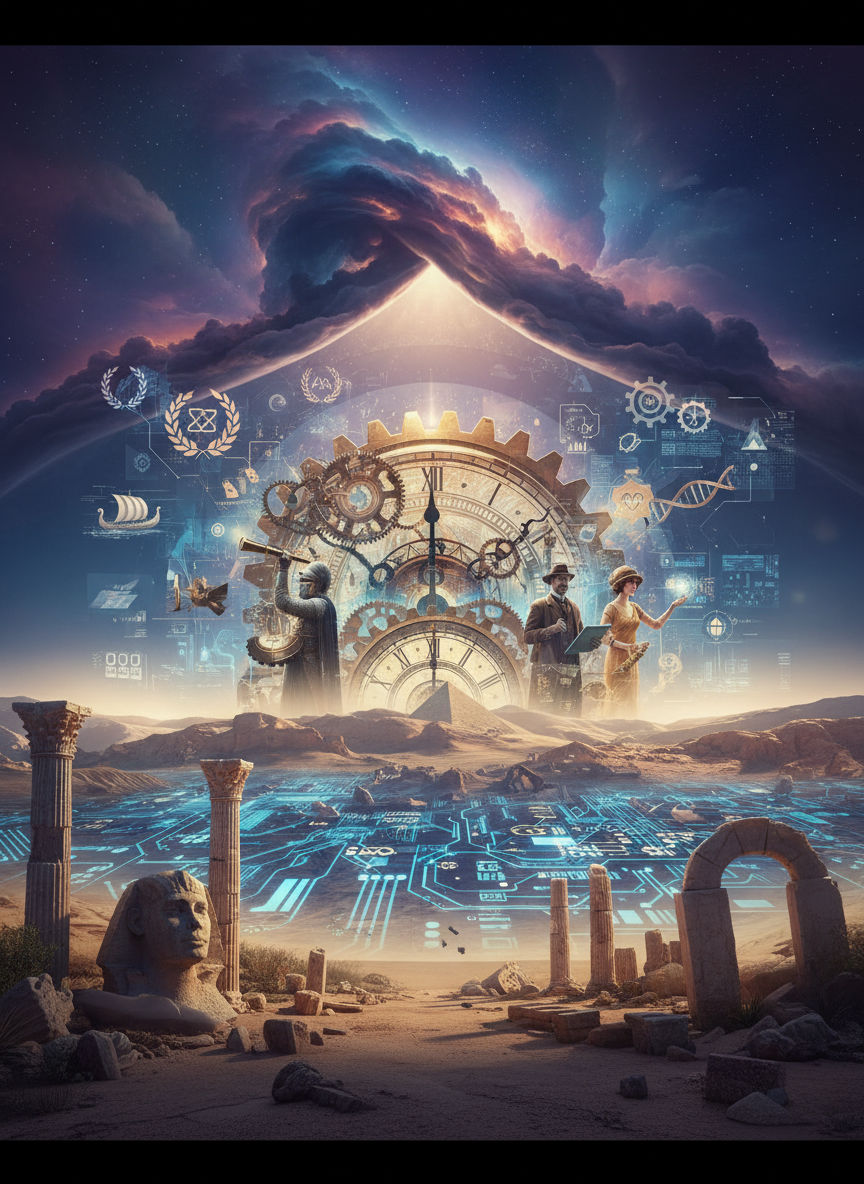
Imagine if the collective knowledge of humanity was deleted in a single night.
Prompted by A NerdSip Learner
Reconstruct what was inside the world's most famous library and how its loss changed history.
Imagine a time when books were painstakingly written by hand on fragile papyrus. To read a different perspective, you had to travel across oceans. In the 3rd century BCE, the Ptolemaic dynasty of Egypt decided to change this. They founded the Library of Alexandria with an unprecedented and audacious goal: to collect, translate, and organize 'all the books of the peoples of the world.'
Situated in the bustling port city of Alexandria, this wasn't just a reading room. It was an attempt to centralize human intellect. The kings of Egypt believed that by gathering the world's wisdom—from Greek philosophy to Egyptian records and Babylonian astronomy—they could understand and rule the world more effectively.
While exact numbers are debated, historians estimate the collection eventually grew to hold tens or even hundreds of thousands of scrolls. It became the ultimate intellectual magnet, sparking a golden age of learning that would shape the course of human history.
Key Takeaway
The Library of Alexandria was born from an unprecedented ambition to collect and organize all human knowledge in a single, centralized location.
Test Your Knowledge
What was the primary goal of the Library of Alexandria when it was founded?
How do you build the greatest collection of knowledge in the ancient world? With unlimited funds and a ruthless acquisition strategy. The rulers of Alexandria didn't just buy books; they essentially commandeered them.
One of their most famous strategies was the 'ships of the harbor' policy. Any ship docking in Alexandria was searched by authorities. If a manuscript was found, it was confiscated and taken to the Library. Scribes would then copy the text, keep the original for the Library, and hand the newly made copy back to the bewildered owner. These texts were officially cataloged as 'from the ships.'
The Ptolemies also used their massive wealth to secure texts. In one famous instance, they borrowed the original, irreplaceable manuscripts of the great Greek playwrights from Athens, leaving a massive fortune in silver as a deposit. Alexandria simply kept the originals, sent back copies, and cheerfully forfeited the silver.
Key Takeaway
The Ptolemaic rulers used aggressive and heavily funded tactics, including confiscation and immense bribes, to build their vast collection of scrolls.
Test Your Knowledge
How did the Library acquire scrolls that were designated as 'from the ships'?
When we hear 'Library of Alexandria,' we usually picture endless rows of dusty shelves. But the library was actually just one part of a much larger, incredible institution called the *Mouseion* (Temple of the Muses), which is where we get the modern word 'museum.'
The Mouseion operated more like a modern university or a heavily funded research think tank. To attract the brightest minds of the era, the Ptolemaic kings offered scholars an irresistible deal: free room and board, beautiful gardens, a handsome salary, and zero taxes for life.
With all their earthly needs met, these scholars were free to simply think, debate, and experiment. The campus reportedly featured anatomical theaters, astronomical observatories, and botanical gardens. By stripping away the daily struggle for survival and bringing geniuses from different disciplines together in one place, the Mouseion became a relentless engine of human discovery.
Key Takeaway
The Library was part of the Mouseion, a heavily funded research institute that provided scholars with lodging, salaries, and facilities to study freely.
Test Your Knowledge
What modern institution is the ancient Mouseion most often compared to?
Because of the Mouseion’s unparalleled resources, Alexandria attracted the absolute rockstars of ancient science and philosophy. It was a place where brilliant minds could build on each other’s work, leading to massive leaps in human understanding.
Take Eratosthenes, a chief librarian. By comparing shadows in different cities, he successfully calculated the circumference of the Earth with astonishing accuracy—over two thousand years before the space age!
Meanwhile, Euclid synthesized the foundational rules of geometry, writing a textbook that would be used globally until the 19th century. The astronomer Aristarchus used the library's data to propose that the Earth revolves around the sun, centuries ahead of Copernicus. In medicine, pioneers like Herophilos conducted groundbreaking studies of human anatomy. The sheer density of genius in this one city pushed the boundaries of what humanity thought was possible.
Key Takeaway
The concentration of texts and funding allowed brilliant scholars to make massive, world-changing leaps in mathematics, astronomy, and medicine.
Test Your Knowledge
Which of the following scientific breakthroughs is famously associated with a scholar working at Alexandria?
There is a pervasive myth that the collective knowledge of humanity was deleted in a single night by a catastrophic fire, plunging the world into the 'Dark Ages.' The reality is much less dramatic, though perhaps more tragic.
It is true that in 48 BCE, Julius Caesar accidentally set fire to the Alexandrian fleet, and the flames reportedly spread to the docks, destroying warehouses full of scrolls. However, historians largely agree that the main Library and the Mouseion survived this event and continued to operate for centuries.
So, what actually happened? The Library fell victim to a slow, agonizing decline. As the Ptolemaic dynasty weakened and the Roman Empire took control, funding dried up. Scholars were expelled during political purges. Over several centuries, through a mix of budget cuts, neglect, and later religious conflicts, the greatest archive of the ancient world simply faded away.
Key Takeaway
The Library wasn't destroyed in a single dramatic fire; it gradually declined over centuries due to lack of funding, political chaos, and neglect.
Test Your Knowledge
What is the most historically accurate explanation for the loss of the Library of Alexandria?
It is easy to mourn the Library of Alexandria as a total loss of ancient wisdom. However, the idea that all its knowledge vanished into thin air is a misconception.
Long before the Library's final demise, its texts had been endlessly copied, studied, and debated. Scholars who left Alexandria took their notes and copies with them, seeding other libraries across the Mediterranean.
More importantly, as the Roman Empire fractured, Byzantine and later Islamic scholars recognized the immense value of this Greek scientific and philosophical heritage. During the Islamic Golden Age, translation movements in cities like Baghdad meticulously translated these ancient works from Greek into Arabic. Centuries later, these texts would be translated into Latin, eventually making their way back to Europe to help spark the Renaissance. The physical scrolls were lost, but the ideas endured.
Key Takeaway
While the physical library was lost, much of its knowledge survived because texts were copied and preserved by Byzantine and Islamic scholars.
Test Your Knowledge
How did a significant portion of the scientific knowledge from Alexandria survive to the modern era?
The Library of Alexandria has never truly left our collective imagination. The loss of such an incredible institution serves as a powerful reminder of how fragile human knowledge can be, but also how vital it is to preserve it.
In 2002, Egypt paid homage to this ancient legacy by opening the *Bibliotheca Alexandrina*, a spectacular modern library and cultural center built near the original site.
But the true modern successor to Alexandria isn't a single building. It is the internet. Projects like Wikipedia, global digital archives, and open-source databases represent the ultimate realization of the Ptolemaic dream. We have finally built a universal, borderless library accessible to almost everyone on Earth. The ancient scholars of Alexandria would likely be amazed to see that their dream of shared human knowledge is now glowing in the palms of our hands.
Key Takeaway
The ancient dream of gathering all human knowledge in one place continues today through digital archives and the internet.
Test Your Knowledge
What modern project most closely mirrors the original ambition of the Library of Alexandria?
Track your progress, earn XP, and compete on leaderboards. Download NerdSip to start learning.