Ever wonder how ChatGPT is different from the FaceID on your phone?
Prompted by A NerdSip Learner
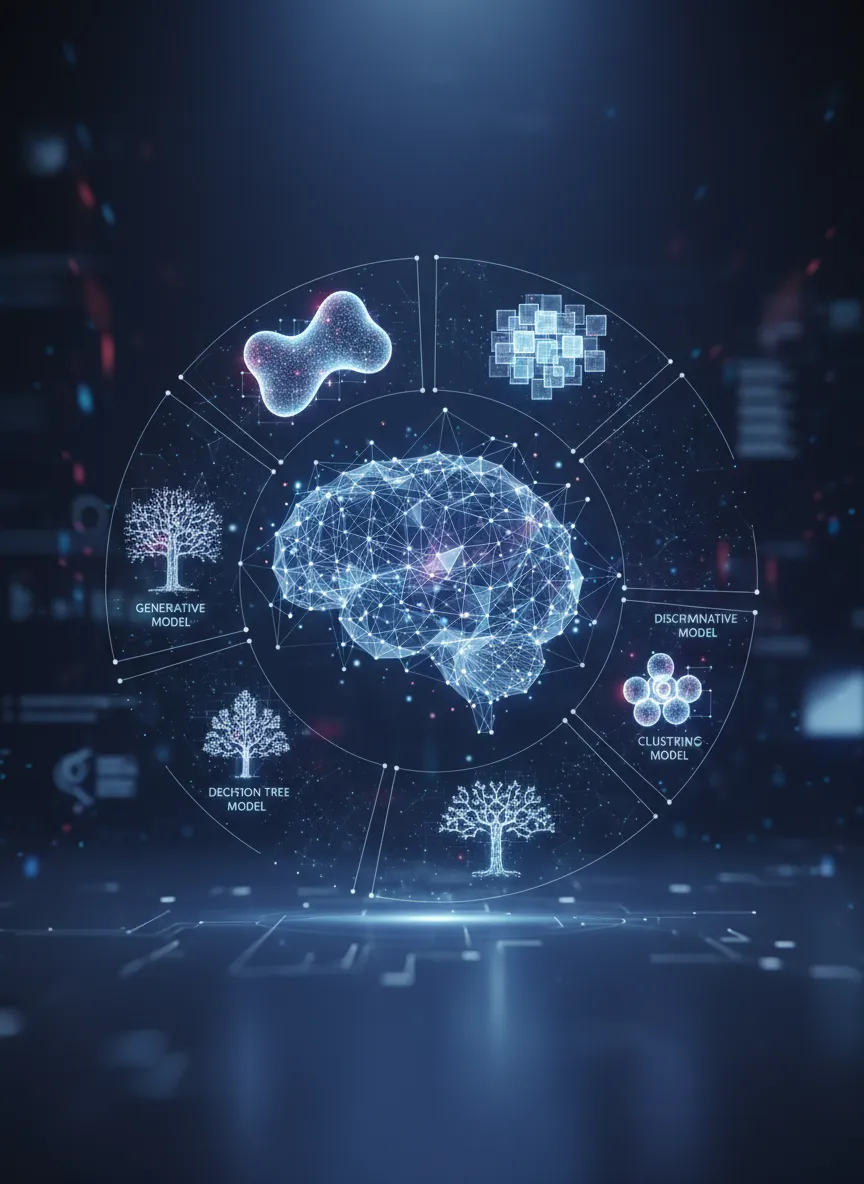
Identify the 3 distinct types of AI minds.
Imagine you have a massive pile of photos, and your job is to separate them into two stacks: 'Hotdogs' and 'Not Hotdogs.' This is essentially what Discriminative AI does. It’s the classic form of machine learning that ruled the tech world for years before ChatGPT showed up.
These models are trained on labeled data to classify things or predict a number. Think of them like a super-strict bouncer at a club. They look at the input (an ID card or a face) and make a binary decision (Let them in? Kick them out?).
You use this tech every single day without realizing it. When your email sends a message to the Spam folder, that's a Discriminative model. When Netflix predicts you'll rate a movie 4 stars, that's Discriminative too. It doesn't create anything new; it just analyzes what is already there with superhuman speed.
Key Takeaway
Discriminative AI is a classifier; it looks at data and decides what label fits it best.
Test Your Knowledge
Which of these tasks is best suited for Discriminative AI?
Now, let’s talk about the cool kid on the block: Generative AI. While the Detective sorts data, the Artist *creates* it. This is the tech behind tools like ChatGPT, Midjourney, and Suno. Instead of just analyzing a picture of a cat, it can draw a completely new cat that never existed before.
How does it work? These models digest billions of examples to learn the patterns and structures of data (like language or pixels). Once they understand the probability of which word usually follows another, they can predict the next piece of the puzzle to generate something brand new.
Think of it like a musician who has listened to every song ever recorded. They aren't just playing a cover song; they are improvising a totally new melody based on everything they've learned about music theory. It’s probability disguised as creativity.
Key Takeaway
Generative AI doesn't just analyze; it uses learned patterns to output brand new text, images, or audio.
Test Your Knowledge
What is the primary function of Generative AI?
The third type of AI is a bit different. It’s not looking at static pictures or reading text; it’s learning by doing. This is Reinforcement Learning (RL). Imagine dropping a robot into a maze. At first, it hits every wall. But every time it hits a wall, it loses points. Every time it finds a path, it gets a cookie (or a digital point).
Over millions of attempts (iterations), the AI learns to maximize its reward. It’s basically the ultimate gamer trying to get the high score. It doesn't need a teacher to tell it the answer; it figures it out through trial and error.
This is how we teach robots to walk without falling over, and it’s how the AI 'AlphaGo' beat the world champion at the complex board game Go. It played against itself millions of times, learning new strategies that humans hadn't invented in thousands of years!
Key Takeaway
Reinforcement Learning builds intelligence through trial, error, and a reward system.
Test Your Knowledge
How does a Reinforcement Learning model improve?
Track your progress, earn XP, and compete on leaderboards. Download NerdSip to start learning.