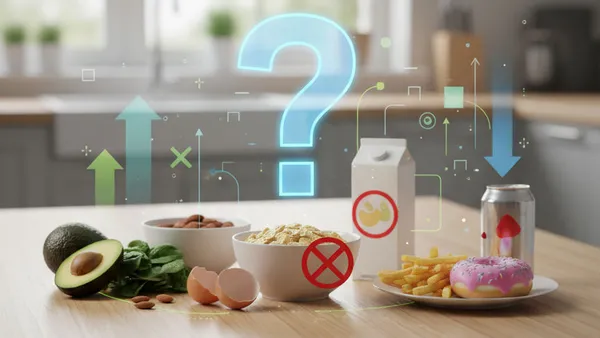
Ready to dismantle advanced nutrition dogma with metabolic science?
Prompted by NerdSip Explorer #1450
Master the biochemical nuance of 5 stubborn diet myths.
You've likely heard that the human body can only absorb 20 to 30 grams of protein per meal, and anything beyond that is simply excreted. This is a fundamental misunderstanding of gastroenterology and muscle protein synthesis (MPS).
In reality, your gastrointestinal tract is highly efficient. When you consume a massive dose of protein, your body releases hormones like cholecystokinin (CCK), which slows gastric emptying. This gives your enterocytes ample time to absorb virtually all the amino acids you ingest.
Where the '30g' myth originates is the leucine threshold. There *is* an upper limit to how much a single meal can stimulate MPS—usually around 20-40g of high-quality protein. However, amino acids absorbed beyond this cap aren't wasted.
Instead, they are directed toward repairing non-skeletal muscle tissues (like organs, skin, and tendons), synthesizing enzymes and neurotransmitters, or eventually undergoing deamination to be oxidized for energy. You absorb it all; your body just delegates the excess.
Key Takeaway
Your body absorbs almost all ingested protein, but caps the amount used specifically for building muscle per meal.
Test Your Knowledge
What happens to the amino acids consumed beyond the 'muscle protein synthesis' threshold?
Fasted cardio is often touted as the ultimate biohack for fat loss, under the assumption that without circulating glucose, your body is forced to mobilize fat stores. While the acute physiology is true, the long-term metabolic outcome is vastly misunderstood.
When you exercise in a fasted state, your Respiratory Exchange Ratio (RER) drops, meaning you do oxidize a higher *percentage* of fat during the session. However, the body is a dynamic system of homeostatic compensation.
If you burn a higher ratio of fat during a workout, your body shifts to utilizing more carbohydrates for energy at rest over the next 24 hours. Conversely, if you eat carbs pre-workout and burn them during exercise, your body increases fat oxidation at rest.
Ultimately, total fat mass reduction is governed by the thermodynamic balance of energy over days and weeks, not the specific substrate utilized during a 45-minute treadmill session. Fat oxidation does not equal fat loss if you aren't in a net deficit.
Key Takeaway
Fasted cardio changes what fuel you burn during the workout, but your body compensates over 24 hours, meaning total calories matter most.
Test Your Knowledge
What does the body do to compensate after burning a high percentage of fat during a fasted workout?
The narrative that non-nutritive sweeteners (NNS) like aspartame and sucralose provoke an insulin spike through 'Cephalic Phase Insulin Release' (CPIR) is a persistent myth. CPIR suggests that simply tasting sweetness primes the pancreas to release insulin.
However, robust clinical human trials demonstrate that artificial sweeteners do not induce clinically significant CPIR, nor do they acutely impact blood glucose or insulin levels. The metabolic cascade requires actual glucose in the bloodstream, not merely a neurological flavor response.
Furthermore, the claim that NNS obliterate the human gut microbiome largely stems from high-dose murine (mouse) models. When these studies are translated to humans consuming realistic dietary doses, the evidence for severe gut dysbiosis falls flat.
While water is undeniably the optimal beverage, substituting sugary sodas with zero-calorie alternatives remains a highly effective, evidence-based strategy for reducing total caloric intake and improving metabolic markers without crashing your endocrine system.
Key Takeaway
Clinical human trials show that zero-calorie sweeteners do not spike insulin, as actual glucose is required to trigger a significant metabolic response.
Test Your Knowledge
Why is the claim that artificial sweeteners destroy the gut microbiome controversial?
Many wellness influencers swap refined white sugar for agave nectar, honey, or maple syrup, claiming these 'natural' alternatives are metabolically superior. Biochemically, your liver disagrees.
All these sweeteners are primarily composed of glucose and fructose. Agave nectar, often marketed as a low-glycemic health food, can actually contain up to 85% fructose—significantly more than high-fructose corn syrup (HFCS).
Fructose metabolism occurs almost entirely in the liver. Crucially, it bypasses *phosphofructokinase*, the rate-limiting enzyme in glycolysis. In the context of a caloric surplus, this unregulated pathway heavily promotes de novo lipogenesis (the creation of new fat).
While honey and maple syrup do contain trace amounts of antioxidants and minerals, the quantities are biologically negligible. You would need to consume highly diabetogenic amounts of honey to yield any clinically relevant micronutrient benefit. Ultimately, organic 'natural' sugar induces the exact same metabolic load as table sugar.
Key Takeaway
Your liver processes 'natural' sugars like honey and agave almost identically to refined table sugar, making them virtually the same metabolically.
Test Your Knowledge
Why can heavy consumption of fructose, like that found in agave, easily lead to fat creation (de novo lipogenesis) in a caloric surplus?
A growing dietary trend warns against 'anti-nutrients'—compounds like lectins, oxalates, and phytic acid found in legumes, grains, and leafy greens. Proponents argue these compounds block nutrient absorption and cause systemic inflammation.
While phytic acid (inositol hexaphosphate) does bind to minerals like zinc and iron, inhibiting their absorption in a specific meal, this effect is heavily mitigated by standard food preparation. Soaking, boiling, and fermentation rapidly degrade these compounds.
More importantly, anti-nutrients often act as potent phytonutrients. Phytic acid functions as a powerful antioxidant, and moderate lectin consumption is linked to improved cellular signaling. The human microbiome is also highly adaptable, with specific gut bacteria evolving to help break down these exact compounds.
Systematic avoidance of anti-nutrients requires eliminating some of the most robustly studied, health-promoting foods on the planet. The epidemiological data overwhelmingly shows that populations consuming the highest amounts of these 'anti-nutrient' rich foods exhibit the lowest rates of metabolic syndrome.
Key Takeaway
Compounds labeled as 'anti-nutrients' are largely neutralized by cooking and actually provide significant antioxidant benefits to the body.
Test Your Knowledge
How does phytic acid, often labeled an 'anti-nutrient', actually benefit human health?
Track your progress, earn XP, and compete on leaderboards. Download NerdSip to start learning.