The "10,000 hour rule" is bullshit. Malcolm Gladwell popularized it in his book Outliers, citing research that elite violinists practiced for 10,000 hours. Everyone ran with it: "Want to master anything? Just invest 10,000 hours!"
How fast you get there depends a lot on how you practise. Our guide to how to learn anything covers the methods that shorten the road.
Except that's not what the research actually said. The study was about becoming world-class elite—not just competent. And it was specifically about violin performance, not "anything."
Here's what nobody tells you: you don't need 10,000 hours to get good at something. You need way less. Depending on what you're learning, you can go from complete beginner to functionally competent in 20-200 hours.
But—and this is crucial—"functionally competent" isn't "expert." And different skills have wildly different learning curves. Learning to cook a decent meal takes 20 hours. Learning brain surgery takes 10,000+.
So how long does it actually take to learn something new? Let's break down the real timelines, the myths, and what actually determines learning speed.
The 20-Hour Rule: From Zero to Functional
Josh Kaufman, author of The First 20 Hours, argues you can learn almost any skill to a functional level in about 20 hours of deliberate, focused practice.
What "functional" means:
- You're no longer completely lost
- You can perform basic tasks without constant reference
- You understand the fundamentals well enough to self-correct
- You can hold a simple conversation, cook a meal, play a song, write basic code
What it doesn't mean:
- Mastery
- Professional-level competence
- Ability to teach others
- Effortless fluency
Real examples of 20-hour learning:
- Basic conversational phrases in a new language
- Playing a simple song on guitar or piano
- Cooking 5-10 solid meals
- Basic website navigation and simple HTML/CSS
- Fundamentals of a new sport (enough to play casually)
Why 20 hours works: You overcome the initial confusion and frustration that kills most learning attempts. Once you're past "I have no idea what I'm doing," learning accelerates.
The first 20 hours aren't about excellence. They're about breaking through the painful beginner phase where everything feels impossible.
The Reality: Skills Have Different Complexity Tiers
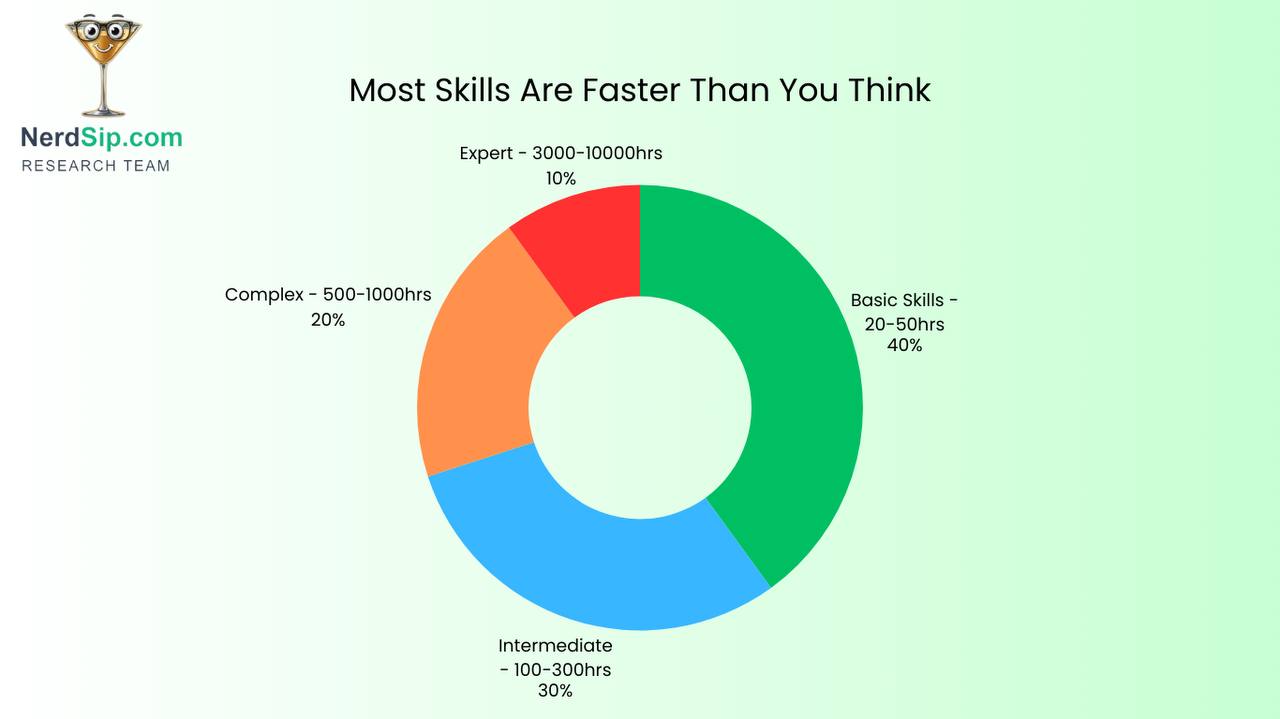
Not all skills are created equal. Some are simple motor skills. Others require years of accumulated knowledge. Here's a more honest breakdown:
Tier 1: Basic Skills (20-50 hours to functional)
Examples:
- Learning to ride a bike
- Basic cooking (following recipes)
- Using new software at a basic level
- Simple home repairs
- Touch typing
- Basic photography composition
Why they're fast: Limited moving parts. Clear feedback. Immediate results you can see.
Timeline to competent: 20-50 hours of focused practice
Tier 2: Intermediate Skills (100-300 hours to functional)
Examples:
- Conversational fluency in a new language (basic interactions)
- Playing an instrument well enough to perform simple songs
- Basic programming (writing functional scripts)
- Driving in complex traffic
- Public speaking without panic
- Intermediate fitness levels (running a 10K, lifting with proper form)
Why they take longer: More variables. Requires building mental models. Feedback is less immediate.
Timeline to competent: 100-300 hours (3-9 months at 1 hour daily)
Tier 3: Complex Skills (500-1,000 hours to functional)
Examples:
- Professional working proficiency in a foreign language
- Playing a musical instrument at performance quality
- Advanced programming (building full applications)
- Professional-level writing
- Advanced athletic performance
- Complex creative skills (animation, advanced graphic design)
Why they're harder: Multiple sub-skills that must integrate. Requires deep pattern recognition. Context-dependent application.
Timeline to competent: 500-1,000 hours (1-3 years at 1 hour daily)
Tier 4: Expert-Level Skills (3,000-10,000+ hours)
Examples:
- Native-level language fluency
- Concert-level musical performance
- Elite athletic performance
- Medical specialties
- Advanced mathematics or physics
- World-class craftsmanship
Why they're so slow: Requires internalization to the point of unconscious competence. Pattern recognition across thousands of scenarios. Mastery of edge cases and subtle nuances.
Timeline to expert: 3,000-10,000+ hours (5-15 years of dedicated practice)
What Actually Determines Learning Speed
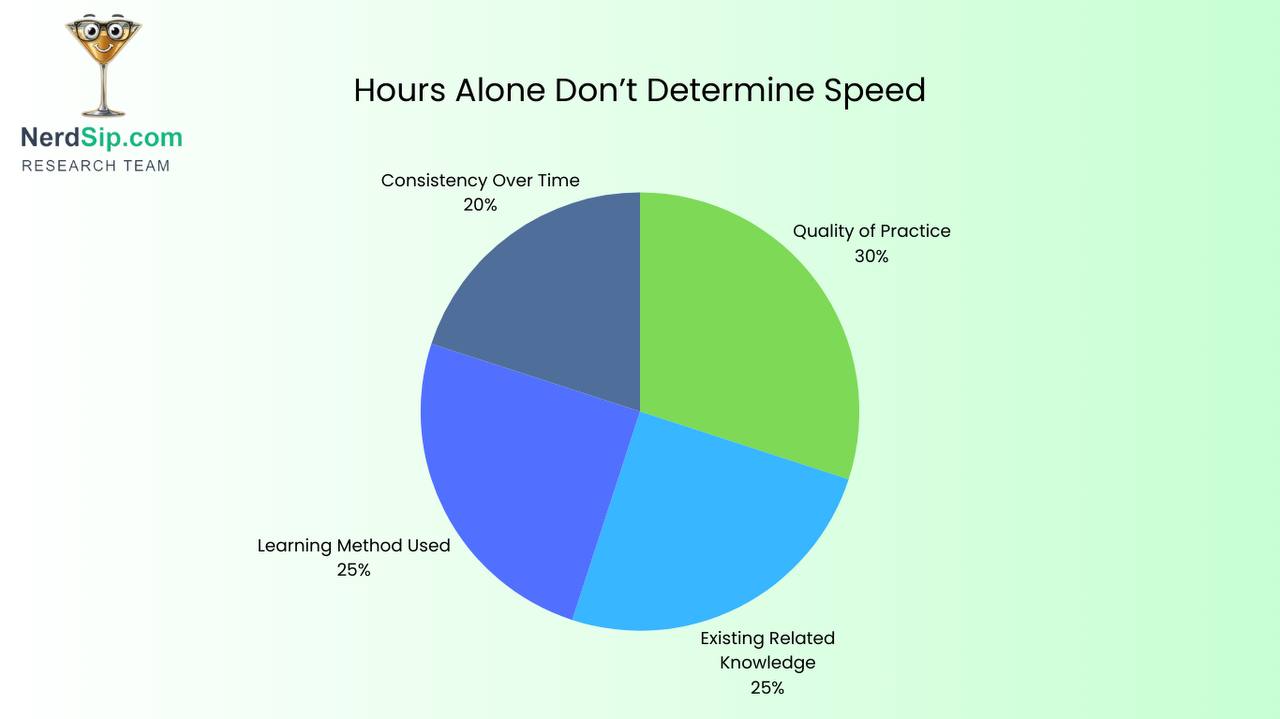
The "how long" question depends on way more than just the skill itself.
1. Similarity to Existing Knowledge
If you already play piano, learning keyboard synth is fast—most skills transfer.
If you already speak Spanish, learning Italian is way faster than learning Mandarin.
Your brain builds on existing neural patterns. The more overlap with what you already know, the faster you learn.
2. Quality of Practice vs. Quantity
20 hours of focused, deliberate practice beats 100 hours of unfocused repetition.
Deliberate practice means:
- Working at the edge of your ability (not too easy, not impossible)
- Immediate feedback on what worked and what didn't
- Focused attention (no multitasking or distraction)
- Specific goals each session ("learn this chord change" not "practice guitar")
Most people don't do this. They practice the same comfortable things repeatedly and wonder why they're not improving.
3. Your Starting Age (But Not How You Think)
Kids learn certain things faster—particularly language pronunciation and motor skills—because their brains are still developing.
But adults learn other things faster. Adults are better at:
- Understanding abstract concepts
- Applying existing frameworks to new domains
- Self-directed learning
- Metacognition (thinking about thinking)
The research shows adults can learn languages and complex skills just fine. The idea that "you can't learn after 25" is completely false.
What matters more than age: time availability and lack of ego. Adults often give up faster because they're embarrassed to suck at something.
4. How You Learn It
Learning methods matter enormously.
Bad: Reading about a skill passively, with no practice
Good: Practicing with immediate feedback
Best: Practicing with immediate feedback + understanding the underlying principles
Apps like NerdSip use this—breaking complex topics into 5-10 minute lessons with active recall questions. You're not just consuming information; you're testing yourself, which creates stronger learning.
Traditional classroom lectures? Among the least effective methods. Active practice? Among the best.
5. Your Personal Learning Factors
Motivation: If you actually care, you'll practice more and focus better. Forced learning is slower.
Previous learning experience: The first new skill is hardest. The fifth is easier because you've learned how to learn.
Sleep and health: Sleep-deprived brains learn 40% less effectively. Stress, poor diet, and lack of exercise all slow learning.
Consistency over intensity: 30 minutes daily beats 3.5 hours once a week. Spaced repetition works better than cramming.
Debunking Common Learning Myths
Myth 1: "I'm Too Old to Learn That"
False. Adults learn abstract concepts faster than children. You're not too old unless you're literally experiencing cognitive decline.
The issue isn't age—it's usually fear of looking stupid, lack of time, or impatience.
Myth 2: "Some People Are Just Naturally Talented"
Talent is way overrated. Research on expert performance shows that even "natural prodigies" put in thousands of hours.
The difference isn't talent. It's:
- Starting earlier (more total hours by age 20)
- Better coaching early on
- Environment that encouraged practice
- Personality traits (patience, persistence)
You don't need talent. You need good practice methods and consistency.
Myth 3: "You Need to Practice Every Day or You'll Lose Progress"
Missing a day doesn't erase your progress. Missing a week starts to degrade skills slightly. Missing a month has noticeable impact.
But even after months away, you return to competence way faster than learning from scratch. Your brain retains the patterns.
The "use it or lose it" fear is overblown. You lose sharpness, not foundational ability.
Myth 4: "You Should Master Basics Before Moving to Advanced Topics"
Sometimes yes, sometimes no.
In some skills (math, music theory), you absolutely need foundations before progressing.
In others (languages, cooking, programming), jumping into "advanced" stuff and figuring out the basics along the way can work better. Context makes the fundamentals more meaningful.
The key: don't get stuck in "tutorial hell" perfecting basics forever.
The Microlearning Advantage: Why 10 Minutes Daily Wins
Here's the counterintuitive truth: you don't need hour-long practice sessions.
Research shows:
- 10 minutes of focused practice daily beats 70 minutes once a week
- Your brain consolidates learning during sleep between sessions
- Spaced repetition (reviewing at intervals) creates stronger memories than cramming
The math on 10 minutes daily:
- 10 min/day x 365 days = 3,650 minutes = 60.8 hours per year
- That's enough to reach functional competence in many Tier 1 and Tier 2 skills
Why this works:
- Lower barrier to starting (anyone has 10 minutes)
- Easier to maintain consistency
- Fits into gaps in your schedule
- Less mental fatigue per session
Apps designed for this: NerdSip breaks learning into 5-10 minute lessons. You can learn quantum physics, psychology, history, or literally any topic in fragments throughout your day. The AI generates courses on demand, and built-in spaced repetition ensures you actually retain what you learn.
The traditional model is "dedicate your life to learning for months." The microlearning model is "dedicate 10 minutes daily and accumulate mastery over time."
The Bottom Line: Realistic Timelines by Goal
If your goal is "not embarrassing myself":
- Timeline: 10-20 hours
- What you get: Basic familiarity, can follow along, understand the terminology
If your goal is "functionally useful":
- Timeline: 50-200 hours (depending on complexity)
- What you get: Can perform the skill competently in common situations, self-correct basic mistakes
If your goal is "pretty damn good":
- Timeline: 300-1,000 hours
- What you get: Reliable competence, can handle most scenarios, beginning to develop personal style
If your goal is "expert/professional":
- Timeline: 2,000-10,000+ hours
- What you get: Mastery, can handle edge cases, unconscious competence, able to teach others
Most people don't need expert level. They need functional. And functional is way more achievable than you think.
Stack a few of these timelines back to back and you get the shape of a polymath's life: one field at a time, each taking months, adding up over years. We mapped that out step by step in how to become a polymath.
How to Actually Do This
Pick one thing. Not three. One. For the next 30-90 days, that's your learning focus.
Start stupidly small. Don't commit to "an hour daily." Commit to "10 minutes daily." You can always do more; you can't always do less.
Use tools with built-in systems. Apps like NerdSip handle spaced repetition automatically. You just show up; the algorithm handles the science.
Track your hours. Keep a simple log. Seeing "I've put in 20 hours" is motivating. It also helps you estimate future learning.
Focus on deliberate practice. Every session, work on something slightly harder than comfortable. That's where growth happens.
Be patient with the timeline. 100 hours sounds like a lot. It's only 10 minutes daily for 600 days. Or 30 minutes daily for 200 days. Totally doable.
Ready to Learn Something New?
The 10,000-hour rule scared people away from learning. "I'll never have time to master anything!"
But you don't need 10,000 hours. You need 20-200 hours to get functionally good at most things. And you can accumulate those hours in small daily chunks.
Want to learn something new?
Use apps like NerdSip that break complex topics into 5-10 minute daily lessons. Learn about literally anything—psychology, physics, history, whatever makes you curious. The AI generates structured courses, and the system handles spaced repetition automatically.
Or keep making excuses about not having time while years pass and you learn nothing.
Your choice.
Start today. Ten minutes on something you're genuinely curious about.
In six months, you'll have 30+ hours invested. That's enough to go from "I know nothing" to "I'm actually pretty decent at this."
The question isn't whether you have time. It's whether you'll use the time you already have.
Frequently Asked Questions
How many hours does it take to master something?
Roughly 10,000 hours to reach elite, world-class mastery — but only about 20 hours to become functionally competent, and a few hundred to be genuinely good. The 10,000-hour figure comes from studies of top-tier violinists and chess grandmasters, so it describes the summit of expert performance, not the level most people actually want. For the overwhelming majority of skills, useful ability arrives in the first 20 to 50 hours.
How long does it take to learn a new skill?
About 20 hours of focused practice takes most people from complete beginner to functional — able to do the thing badly but independently. Skills with low complexity, like a card shuffle or basic knife skills, can take under 10 hours. Complex skills with many sub-skills, like a musical instrument or a programming language, need 100 to 300 hours before they feel comfortable.
Is the 10,000-hour rule true?
Not as it is usually quoted. The original research found that 10,000 hours was the average practice time among elite performers, not a threshold anyone must cross. Later analyses showed practice explains only part of the variation in skill, and the amount needed varies enormously by domain. It is a description of what elite performers happened to have done, not a requirement.
Can you learn something in 10 minutes a day?
Yes, for knowledge-based subjects, and often better than in long occasional sessions. Ten focused minutes daily is about 60 hours a year, which is well past the 20-hour competence threshold for most subjects. Spacing also improves retention compared with cramming the same total time into fewer sittings. Physical skills needing sustained repetition benefit less from very short sessions.
Why does learning feel slower than it is?
Because competence grows faster than confidence early on, and because the gap between what you can recognise and what you can produce widens before it closes. You can usually tell good work from bad long before you can make good work yourself, which makes early progress feel like failure even when it is normal.
Every NerdSip course clears a four-layer fact-checking pipeline before it reaches the app: grounded in live sources, scored nightly, gated on failure, and reviewable by a person at one tap. Articles on this blog are drafted with AI assistance, then researched, verified, and edited by our team.
Editorial responsibility: ai51 UG (haftungsbeschränkt). Responsible editor named in the imprint.
📚 Keep Learning
Explore the NerdSip learning hubs
The blog is our editorial layer. When you want to move from reading into doing, these hubs organize the rest of NerdSip by format, including the app itself and the press that has written about it.
Keep going: five-minute courses on this
Pick one and finish it before your coffee cools. Every lesson ends with a quick question, so it sticks instead of scrolling past.
Courses on this topic
4.7 stars from 380 reviews · 10,000+ learners