You follow productivity influencers who wake up at 5AM, meditate for an hour, journal for 30 minutes, hit the gym, meal prep, read for an hour, and still have time for a side hustle before their 9-5 even starts.
And you think: "I can barely get out the door with coffee."
Here's the truth those influencers won't tell you: their entire job IS self-optimization. They get paid to wake up early and share their routines. You have an actual job, actual responsibilities, actual life chaos.
The good news? You don't need their routines to get better every day.
In fact, research shows that micro-habits are set to dominate 2026 as the preferred self-improvement method because they eliminate overwhelm and build consistency. These tiny actions—reading one page, stretching for 30 seconds, writing a single sentence—prove that big change doesn't require massive effort, just consistent effort.
The secret to self-optimization for busy people isn't doing more. It's doing less, but doing it every single day.
Why Traditional Self-Improvement Fails Busy People
Let's be honest about what "self-improvement" usually means:
- Wake up at 5AM (you're already exhausted)
- Hour-long morning routine (you don't have an hour)
- Meditation, journaling, exercise (pick one, maybe)
- Read 50 books a year (when?)
- Learn a new language (with what time?)
- Build a side hustle (after your full-time job and family?)
No wonder 92% of New Year's resolutions fail. They're designed for people who don't have your life.
The problem isn't you. The problem is treating self-improvement like a full-time job when you already have one.
Busy people need a different framework—one that fits into the life they actually have, not the life Instagram tells them they should have.
Traditional Self-Improvement vs. Self-Optimization for Busy People
| Aspect | Traditional Approach | Busy Person's Approach |
|---|---|---|
| Time Required | 1-3 hours daily | 5 minutes daily |
| Morning Routine | Wake at 5AM, elaborate ritual | Stack habits onto existing routine |
| Exercise | 60-minute gym sessions | 10 push-ups or 30-second stretch |
| Reading Goal | 50 books per year | 1 page per day (equals 12+ books/year) |
| Learning | Multi-week courses | 5-minute microlearning sessions |
| Success Rate | 8% (92% fail by February) | 80%+ with micro-habits |
| Sustainability | Burnout within weeks | Sustainable indefinitely |
| Results Timeline | "Transform in 30 days!" | 37x better in 365 days (compound effect) |
| Barrier to Entry | Complete life overhaul | Start immediately with what you have |
| Mindset | All-or-nothing perfectionism | 1% better, consistent progress |
The data is clear: micro-habits designed for busy people have a 10x higher success rate than traditional elaborate routines.
The 1% Rule: How Busy People Actually Get Better
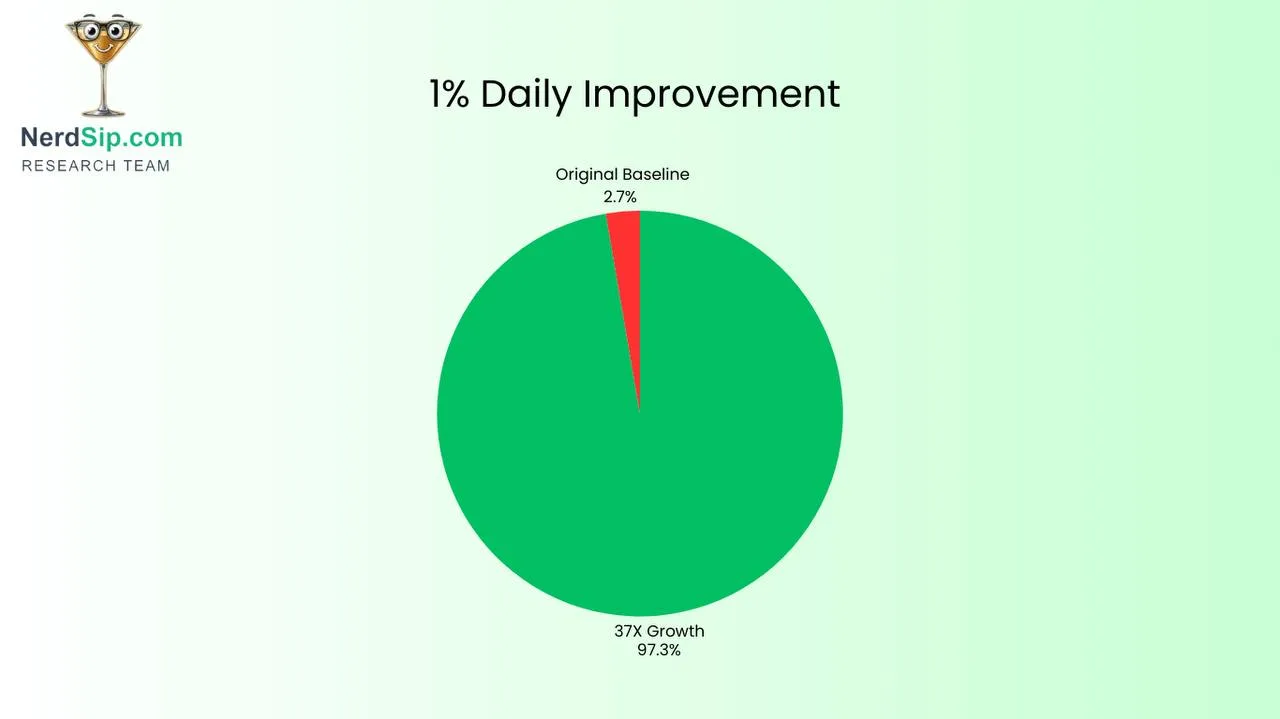
Here's the math that changes everything:
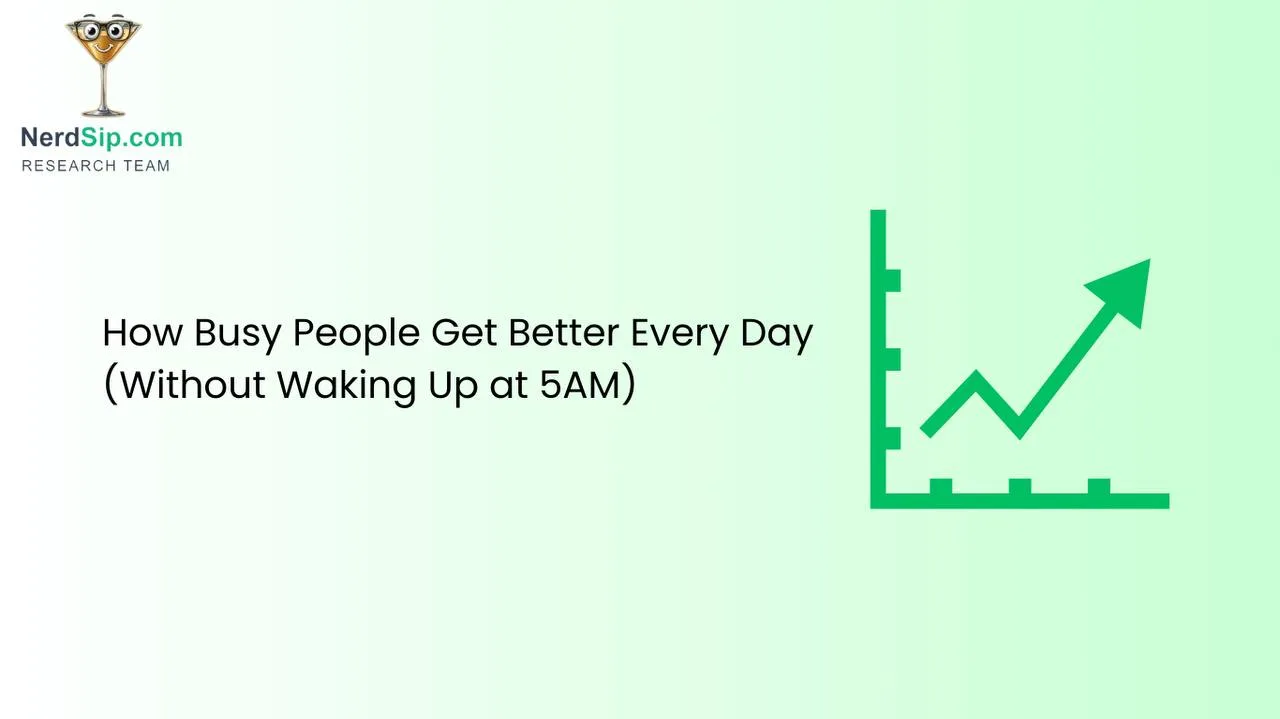
If you get 1% better every day for a year, you end up 37 times better by the end.
Not 365% better (that would be additive). 3,778% better (that's compound growth).
James Clear talks about how the British cycling team transformed themselves by focusing on 1% improvements in every area—tiny adjustments that, over time, added up to extraordinary results.
The key insight? These micro-actions reinforce identity and momentum, making growth feel accessible, natural, and sustainable.
You don't need massive transformations. You need tiny, consistent wins that compound over time.
Here's what 1% daily improvement actually looks like for busy people:
- 5 minutes of learning (not hours)
- One page of reading (not chapters)
- 10 push-ups (not hour-long workouts)
- One healthy meal (not meal prep for the week)
- 5 minutes of focused work (not deep work marathons)
These aren't placeholder activities until you "have time for real self-improvement." These ARE real self-improvement. And they work better than the elaborate routines you'll never maintain.
Why Self-Optimization Is Trending (And What Changed)
Something shifted in 2026. People stopped pretending burnout was a badge of honor.
Recent data shows that nearly 60% of manufacturing workers believe in constantly improving or they'll fall behind, representing untapped, large-scale potential. Even more striking, 55% of people believe failing to constantly improve means falling behind.
But here's what's different: instead of 'self-improvement at all costs,' there's a shift towards nervous system regulation—adaptable stress response, emotional resilience, micro-meditations, breathwork, and mental fitness training.
Translation: People still want to get better every day. But they're done destroying themselves in the process.
The trends for 2026 reflect this shift:
Slow Productivity Over Hustle Culture
This shift allows people to produce meaningful work without sacrificing well-being, becoming the new standard of sustainable success.
You don't have to choose between getting better and staying sane. Slow, consistent growth beats frantic, unsustainable sprints.
Micro-Habits Over Complete Overhauls
Complicated routines are losing relevance. Rather than overhauling entire routines, people are adopting smaller actions that make growth feel accessible and sustainable.
Evidence-Based Over Viral Hacks
With increasing skepticism around viral hacks and internet fads, people will gravitate toward methods backed by research.
What works? Short, focused actions repeated consistently. What doesn't? Elaborate routines you abandon by January 15th.
The 5-Minute Self-Optimization Framework for Busy People
Here's how to actually get better every day when you have zero extra time:
1. Stack It (Don't Create New Time)
You don't have spare time lying around. But you DO have existing routines.
Habit stacking = attaching new micro-habits to things you already do.
Examples:
- After I pour coffee → I read one page
- After I sit at my desk → I write one sentence
- After I brush my teeth → I do 10 push-ups
- While I commute → I learn something new for 5 minutes
- After I close my laptop → I stretch for 30 seconds
You're not adding time to your day. You're making existing time more valuable.
2. Pick One Thing (Not Five)
Busy people try to optimize everything at once. Career, fitness, relationships, learning, side hustle, health, hobbies—all simultaneously.
This is why you fail.
Pick ONE area to improve for the next 30 days. Just one.
- Want to get smarter? Learn something new for 5 minutes daily.
- Want to get healthier? Do 10 minutes of movement daily.
- Want better relationships? Send one thoughtful message daily.
- Want career growth? Practice one skill for 10 minutes daily.
After 30 days, that one thing becomes automatic. Then add another.
Slow accumulation of habits beats rapid accumulation of guilt.
3. Make It Stupidly Small
Your micro-habit should be so small it feels laughable.
Not "work out for 30 minutes." Do one push-up.
Not "read for an hour." Read one page.
Not "learn Spanish." Learn one word.
Why? Because once you start, you usually keep going. One push-up becomes five. One page becomes a chapter.
But even if it doesn't—even if you only do the bare minimum—you still win. You showed up. You reinforced the identity. You kept the streak alive.
The way to write a book is by producing "two crappy pages a day," by carving out a small win each and every day.
Consistency beats intensity every single time.
4. Track Completion, Not Perfection
Busy people need visible progress. Not because you're shallow—because your brain needs proof you're improving.
Use the simplest tracking method possible:
- Mark an X on a calendar for every day you complete your micro-habit
- Don't break the chain
- If you miss one day, never miss two
Even the most self-disciplined will stagger. All of us have fallen short. But now it's time to pick ourselves up and try again.
The visual streak becomes addictive. After 7 days, you don't want to break it. After 30 days, the habit is nearly automatic.
5. Optimize Your Identity, Not Your Schedule
Here's the secret busy people miss: self-optimization isn't about doing more. It's about becoming someone different.
Don't say "I want to read more." Say "I'm a reader."
Don't say "I should exercise." Say "I'm someone who moves daily."
Don't say "I need to learn." Say "I'm a lifelong learner."
When your identity shifts, behavior follows automatically. You don't need willpower to do things that match who you are.
Why Learning Is the Ultimate Busy Person's Optimization
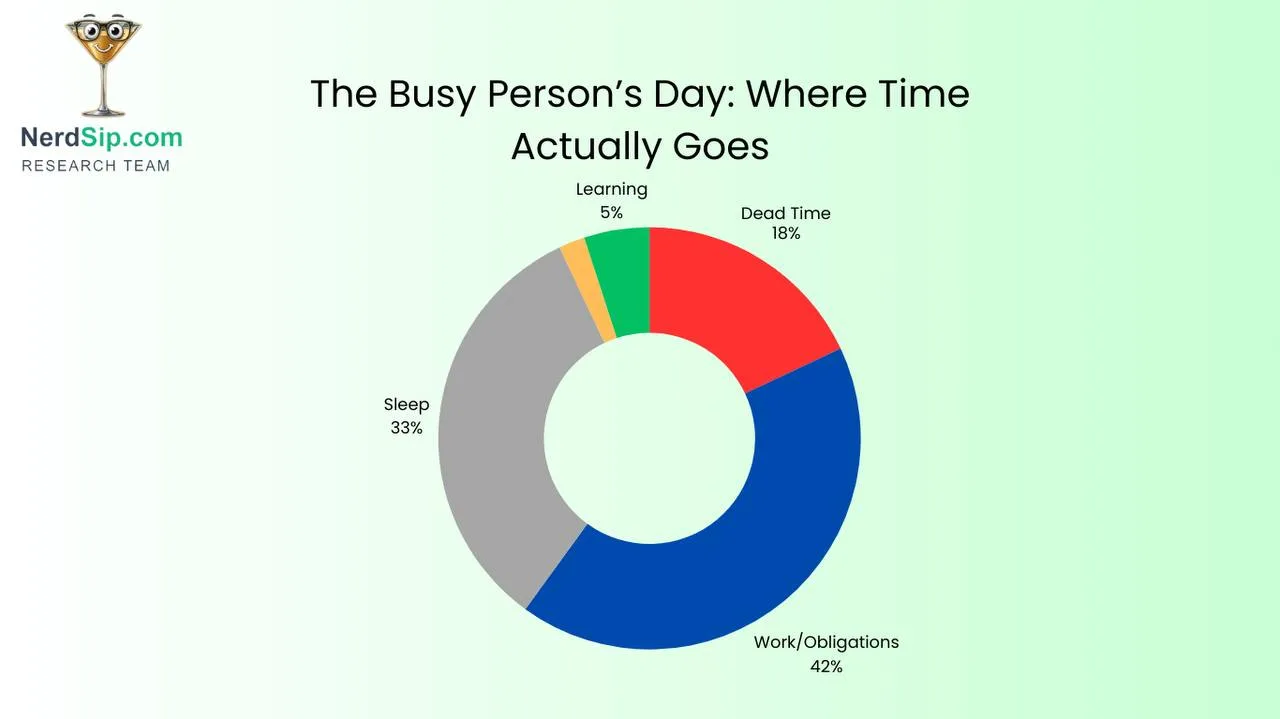
If you only have time to optimize ONE thing, make it learning.
Here's why:
1. Knowledge Compounds Faster Than Any Other Asset
Each new thing you learn connects to everything you already know. The more you learn, the faster you learn. Your brain starts seeing patterns everywhere.
After one year of learning something new for 5 minutes daily, you've learned 365 topics. You can talk intelligently about almost anything. You're more interesting, more valuable, more capable.
2. Learning Takes Zero Preparation
You don't need special equipment. No gym membership. No meal prep. No morning routine.
Just 5 minutes and curiosity.
3. It Works in Dead Time
Commuting. Waiting in line. Before bed. Between meetings.
Busy people don't have free time. But they have lots of dead time. Learning converts dead time into growth time.
4. It Rebuilds Your Sense of Agency
Busy people often feel stuck. Controlled by schedules, bosses, obligations.
Learning gives you back control. You're choosing to improve. You're investing in yourself. You're building an asset nobody can take away.
The Busy Person's Daily Optimization Routine (5 Minutes Total)
Here's the entire routine:
Morning (2 minutes):
- Drink water
- Move for 60 seconds (stretch, walk, whatever)
- Review your one priority for the day
Midday (0 minutes—stack it):
- While commuting/waiting: Learn something new for 5 minutes
Evening (3 minutes):
- Write one sentence about what you learned
- Write one sentence about tomorrow's priority
- Mark an X on your calendar
Total time invested: 5 minutes of dedicated time (plus using dead time you already have).
That's it. No 5AM wake-ups. No hour-long routines. No elaborate systems.
Just consistent, tiny actions that compound into transformation.
What Happens After 30 Days
Let's do the math on what 5 minutes of daily learning actually creates:
| Timeline | Topics Learned | Compound Growth | Real-World Impact |
|---|---|---|---|
| 30 Days | 30 topics | 1.35x better | Can contribute to new conversations, habit feels natural |
| 90 Days | 90 topics | 2.45x better | Knowledge base noticeably wider, people ask "how do you know that?" |
| 180 Days | 180 topics | 6.03x better | Connecting ideas across domains, genuine expertise building |
| 365 Days | 365 topics | 37.78x better | More knowledgeable than 99% of people, compound effect in full force |
After 30 days:
- You've learned 30 new topics
- You can contribute to conversations you couldn't before
- You've proven to yourself you can stick to something
- The habit feels automatic
After 90 days:
- You've learned 90 topics
- Your knowledge base is noticeably wider
- People start asking how you know so much
- You're more confident in your ability to learn anything
After 365 days:
- You've learned 365 topics
- You're genuinely more knowledgeable than 99% of people
- You can connect ideas across domains (the definition of intelligence)
- You've become someone who grows every single day
And it only took 5 minutes a day.
Compare that to the person who "doesn't have time" to improve. A year from now, they're exactly the same. You're 37 times better.
Busy people need a shortlist, not a catalogue. Ours is a 16-app comparison table for 2026 that sorts by the single problem each app fixes, so you can pick two and ignore the rest.
The Choice Busy People Actually Have
You don't have time for elaborate self-improvement routines. You're not going to wake up at 5AM. You're not meditating for an hour or journaling for 30 minutes.
But you do have 5 minutes.
And 5 minutes of focused improvement every day, compounded over a year, will transform you more than any intensive weekend retreat or month-long challenge ever could.
The question isn't "Do I have time to get better?"
The question is: "Am I willing to use the time I already have differently?"
Because you're either getting 1% better every day, or you're staying exactly the same.
This is what NerdSip was built for.
We designed microlearning specifically for busy people who want to get better every day without overhauling their entire lives.
5-minute lessons on any topic. Designed for retention, not just consumption. Built to fit into the tiny gaps in your schedule—commutes, lunch breaks, before bed.
No elaborate routines. No massive time commitments. Just consistent, compounding growth.
NerdSip is live in the App Store and on Google Play. Start getting 1% better every day.
Because busy people don't need more time. They need better systems.
And 5 minutes a day, compounded over a year, is the system that actually works.
Every NerdSip course clears a four-layer fact-checking pipeline before it reaches the app: grounded in live sources, scored nightly, gated on failure, and reviewable by a person at one tap. Articles on this blog are drafted with AI assistance, then researched, verified, and edited by our team.
Editorial responsibility: ai51 UG (haftungsbeschränkt). Responsible editor named in the imprint.
📚 Keep Learning
Explore the NerdSip learning hubs
The blog is our editorial layer. When you want to move from reading into doing, these hubs organize the rest of NerdSip by format, including the app itself and the press that has written about it.
Ready to Level Up?
Turn your screen time into knowledge. Download NerdSip and start learning in just 5 minutes a day.
4.7 stars from 380 reviews · 10,000+ learners