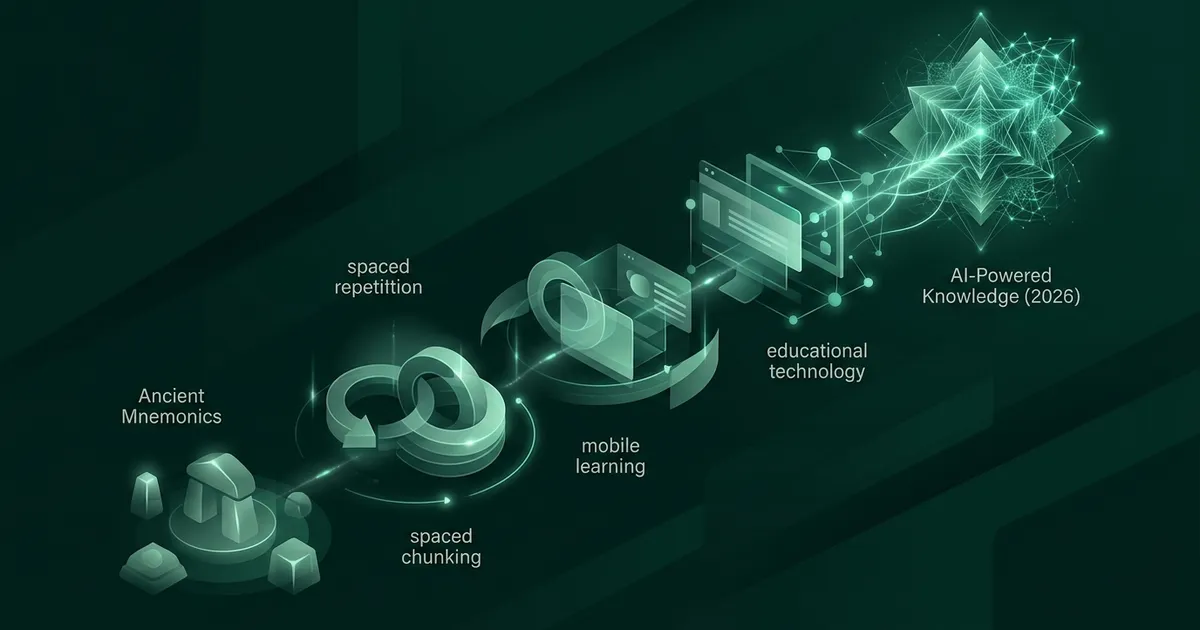
Every time you open a learning app on your phone, complete a five-minute lesson, and close it feeling slightly smarter, you're participating in an experiment that began in a German psychology lab in 1885. The microlearning app on your home screen is not a tech invention. It is the culmination of 140 years of cognitive science, decades of educational technology research, and a handful of breakthroughs that fundamentally changed how we understand human memory.
This is the complete scientific history of how we got here.
I. The Cognitive Foundations (1885–1970)
Ebbinghaus and the Forgetting Curve
The story begins with Hermann Ebbinghaus, a German psychologist who decided to use himself as a test subject. Working alone in his Berlin apartment, Ebbinghaus memorized lists of nonsense syllables (consonant-vowel-consonant combinations like "DAX" and "BUP") and meticulously tracked how quickly he forgot them [1].
His 1885 monograph, Über das Gedächtnis (On Memory), revealed something profound: forgetting follows a predictable exponential curve. Within 20 minutes, 42% of learned material is lost. Within one hour, 56%. Within 31 days, 79% [1]. But Ebbinghaus also discovered something hopeful: each review session flattened the curve. Spaced reviews could make memories nearly permanent.
This single finding, that timing matters more than duration, would become the bedrock of every microlearning app built over a century later.
Miller's Magic Number
In 1956, George A. Miller published what would become one of the most cited papers in psychology: "The Magical Number Seven, Plus or Minus Two" [2]. Miller demonstrated that human working memory can hold approximately seven chunks of information simultaneously. Try to load more, and performance collapses.
Miller's insight had a quiet but revolutionary implication for education. If working memory is this limited, then lessons that exceed cognitive capacity don't just become harder; they become counterproductive. Information that overflows working memory never reaches long-term storage. It simply vanishes.
This principle, later formalized as Cognitive Load Theory by John Sweller in 1988 [3], gave scientific language to what good teachers intuitively knew: less is more. Sweller distinguished between intrinsic load (the inherent complexity of the material), extraneous load (poor instructional design), and germane load (the mental effort that actually produces learning). Effective instruction minimizes extraneous load and respects the limits of intrinsic load.
Microlearning, at its core, is an engineering response to these constraints.
Skinner's Teaching Machines
While cognitive psychologists were mapping the architecture of memory, behaviorist B.F. Skinner was building something physical. In 1958, Skinner introduced his "teaching machine", a mechanical device that presented students with small frames of information, asked a question, and provided immediate feedback [4].
Skinner's machines were crude by modern standards. But they embodied three principles that remain central to microlearning apps today: content broken into small, sequential steps; active recall at each step; and immediate feedback. Skinner called this approach "programmed instruction," and it spread through American schools in the 1960s before fading due to the limitations of mechanical technology.
The machines disappeared. The principles survived.
Atkinson's Optimal Spacing
In 1972, Richard Atkinson at Stanford published a landmark paper on computer-assisted instruction for second-language vocabulary [5]. Atkinson didn't just use computers to present flashcards. He developed an algorithm that optimized the order in which items were reviewed, based on each student's individual performance history.
This was the first empirical demonstration that a computer could outperform a fixed study schedule by adapting to the learner. Atkinson's students learned German vocabulary significantly faster than control groups using traditional methods. The paper laid the theoretical groundwork for every adaptive learning algorithm that followed.
II. The Digital Pioneers (1987–2005)
SuperMemo: The Algorithm That Started It All
In 1987, a Polish graduate student named Piotr Woźniak wrote a program called SuperMemo. It was not elegant. It ran on an Amstrad PC 1512. But it implemented something no consumer software had done before: a working spaced repetition algorithm calibrated to the human forgetting curve [6].
Woźniak's SM-2 algorithm (published in full in 1990) calculated optimal review intervals for each individual flashcard based on how easily the user recalled it. Cards answered correctly moved to longer intervals. Cards answered incorrectly reset to shorter ones. The system modeled each user's memory decay per item [6].
SuperMemo was microlearning before the word existed. Daily sessions were short (15–30 minutes). Content was atomic (one fact per card). Scheduling was personalized. The software attracted a devoted following among medical students, language learners, and knowledge workers. But its interface remained utilitarian, and it never crossed into the mainstream.
The Rise of E-Learning (1990s)
The 1990s brought the World Wide Web, and with it an explosion of online learning. Universities built Learning Management Systems (LMS). Companies deployed web-based training modules. The term "e-learning" entered corporate vocabulary [7].
Most early e-learning ignored the cognitive science. Courses were long. Lectures were recorded and uploaded wholesale. Completion rates were dismal. A 2003 meta-analysis by Kulik found that computer-based instruction was modestly effective, but the effect sizes were small and highly variable [8]. The problem wasn't the medium. It was the instructional design: taking classroom formats and porting them to screens without rethinking the pedagogy.
Still, the infrastructure was being built. LMS platforms like Blackboard (1997) and Moodle (2002) normalized the idea that learning could happen asynchronously, on a screen, at the learner's pace. These systems would become the rails on which microlearning content later ran.
The Term Emerges
In 2004, Austrian researcher Gerhard Gassler formally introduced the term "Mikrolernen" (microlearning) in a conference paper [9]. Theo Hug of the University of Innsbruck expanded the concept in 2005, arguing that microlearning should be understood not just as short content, but as a distinct pedagogical approach defined by micro-content, micro-activities, and micro-media [10].
Hug's taxonomy was prescient. He identified seven dimensions of microlearning: time (seconds to minutes), content (fragments to modules), curriculum (single topics to themes), form (facets to episodes), process (reading, reflecting, searching), mediality (face-to-face to digital), and learning type (repetitive, reflexive, pragmatic) [10]. This framework moved the conversation beyond "short lessons" toward a principled understanding of what microlearning could be.
III. The Mobile Revolution (2007–2015)
The iPhone Changes Everything
On June 29, 2007, Apple released the iPhone. The App Store followed in July 2008. Overnight, every person with a smartphone carried a potential teaching machine in their pocket. The constraint that Skinner faced (specialized hardware) and that SuperMemo faced (desktop computers) dissolved.
Mobile learning research exploded. A 2012 meta-analysis by Wu et al., reviewing 164 studies from 2003 to 2010, found that 86% of mobile learning interventions reported positive outcomes, with the strongest effects in informal learning contexts [11]. Crucially, studies showed that mobile learning was most effective when sessions were short, frequent, and spaced across time, precisely the pattern that Ebbinghaus had identified 124 years earlier.
The Testing Effect Gains Mainstream Attention
In 2006, Roediger and Karpicke published a study that reverberated through education: students who practiced retrieving information from memory retained 80% after one week, compared to just 36% for students who simply re-read the material [12]. The "testing effect" (or retrieval practice) wasn't new. Researchers had documented it since the early 1900s [13]. But Roediger and Karpicke's elegant experiments, combined with effective communication to non-specialists, brought the finding to a much wider audience.
For app designers, the implication was clear: a learning app that merely shows information is doing half the job. Effective apps must force retrieval. Quizzes, flashcards, fill-in-the-blanks, and recall prompts are not assessments bolted onto learning. They are the learning.
Duolingo and the Gamification Breakthrough
Duolingo launched in 2012, founded by Luis von Ahn and Severin Hacker. It was not the first language-learning app. But it was the first to combine microlearning, spaced repetition, and gamification into a product that millions of people actually wanted to use every day [14].
Duolingo's design choices were deliberate and grounded in research. Lessons lasted 3–5 minutes. Each lesson required active production (typing, speaking, selecting). A spaced repetition system scheduled review sessions. And a layer of game mechanics (XP, streaks, leaderboards, lives) provided the motivational scaffolding that pure flashcard apps lacked [14].
The streaks feature proved particularly powerful. Behavioral research on "streak motivation" shows that maintaining a consecutive-day count triggers loss aversion, one of the strongest known cognitive biases [15]. Users who might otherwise skip a day continue not because they want to learn, but because they cannot bear to break their streak. Duolingo weaponized this insight with remarkable effectiveness. By 2024, the platform reported over 500 million registered users.
Duolingo also pioneered the use of A/B testing at scale in education. Settles and Meeder (2016) published research on Duolingo's spaced repetition model, showing that a half-life regression model could predict individual forgetting rates with high accuracy [16]. Every screen, every animation, every notification timing was tested on millions of users and optimized for engagement and retention.
The lesson for the industry was unmistakable: scientific foundations matter, but so does product design. The best algorithm in the world fails if nobody opens the app.
The Corporate Microlearning Wave
By 2013, the corporate training industry had noticed. Traditional corporate e-learning suffered from catastrophic completion rates. A 2014 Bersin by Deloitte infographic found that employees could dedicate only 1% of their work week to training, roughly 24 minutes per week [17]. Microlearning fit this reality perfectly.
Platforms like Axonify (2011), Grovo (2010), and EdApp (2016) emerged to serve enterprise microlearning. Vendors like Axonify reported that daily 3–5 minute training sessions substantially outperformed traditional annual training events in knowledge retention [18]. While proprietary vendor research should be interpreted cautiously, the trend was clear: organizations were moving from event-based training to continuous, bite-sized reinforcement.
IV. The Science Matures (2010–2020)
Bjork's Desirable Difficulties
Robert and Elizabeth Bjork's framework of "desirable difficulties" provided the theoretical glue that connected many of the principles underlying microlearning [19]. The Bjorks argued that conditions which make learning feel harder in the short term often produce stronger long-term retention. Spacing (rather than massing), interleaving (rather than blocking), and testing (rather than re-studying) all introduce desirable difficulty.
This framework resolved an apparent paradox in microlearning: why do short, spaced sessions outperform longer, concentrated ones when the total study time is equal? The answer is that the effort of re-accessing a partially forgotten memory strengthens the memory trace more than effortless re-reading does. Microlearning, by its very structure, forces this beneficial struggle.
Meta-Analyses Confirm the Effects
By the mid-2010s, enough research had accumulated for rigorous meta-analyses. Cepeda et al. (2006) synthesized 317 experiments from 184 articles on the spacing effect and confirmed that distributed practice produced significantly better retention than massed practice across virtually all conditions [20]. Dunlosky et al. (2013) evaluated ten common study techniques and rated practice testing and distributed practice as the only two with "high utility" [21].
Sung, Chang, and Liu (2016) conducted a meta-analysis of 110 mobile learning studies (1993–2013) and found a moderate overall effect size (g = 0.523) favoring mobile learning over traditional methods [22]. Effects were strongest for informal learning, short sessions, and inquiry-oriented approaches.
Leong et al. (2021) published a systematic review of microlearning trends and found that short, focused learning modules consistently produced positive knowledge outcomes across healthcare, corporate, and higher education contexts [23]. The evidence base, once thin, was becoming robust.
The Attention Economy Problem
As the science strengthened, a counter-narrative emerged. Smartphones delivered microlearning, but they also delivered social media, news feeds, games, and an endless stream of notifications competing for the same five-minute windows. Gloria Mark's research at UC Irvine found that the average attention span on a screen had dropped from 2.5 minutes in 2004 to 47 seconds by 2020 [24].
Microlearning apps found themselves in a Darwinian competition for attention against TikTok, Instagram, and Twitter. This pressure drove a wave of gamification features (some well-designed, some manipulative) and raised ethical questions about when engagement optimization crosses the line from helpful nudging into exploitative design [25].
V. The AI Era (2020–Present)
Adaptive Algorithms Get Smarter
Machine learning transformed spaced repetition from rule-based systems (like Woźniak's SM-2) into data-driven models that learn from millions of users simultaneously. Duolingo's half-life regression model [16], Anki's FSRS algorithm (developed by Jarrett Ye based on the DSR model), and various neural-network-based approaches now predict individual forgetting curves with unprecedented accuracy.
A 2019 study by Tabibian et al. modeled optimal review scheduling as a stochastic process and demonstrated that machine-learning-based schedulers could significantly outperform fixed-interval systems by adapting to individual forgetting rates [26]. The gap between "one schedule for everyone" and "a schedule optimized for you" turned out to be enormous.
Large Language Models Enter the Arena
The release of GPT-3 in 2020 and subsequent large language models opened a new frontier: automated content generation for microlearning. Previously, creating a microlearning course required subject matter experts, instructional designers, and significant time investment. LLMs compressed this process from weeks to minutes.
NerdSip, for example, uses Google's Gemini models to generate complete micro-courses from a single topic prompt, including lesson content, quiz questions, and infographics. The AI handles content creation while the app's architecture handles the science: spaced repetition scheduling, retrieval practice, cognitive load management, and gamified progression.
This combination addresses one of microlearning's historical bottlenecks. Hug (2005) noted that the "granularization" of content into micro-units was labor-intensive and often done poorly [10]. AI removes the bottleneck. A user who wants to learn about Byzantine history, quantum computing, or Stoic philosophy can have a complete, structured micro-course generated in seconds.
Personalization at Scale
Modern microlearning apps increasingly combine three layers of personalization that were previously impossible to deliver together:
- Content personalization: AI generates or adapts material to match the learner's interests, prior knowledge, and goals
- Scheduling personalization: Adaptive algorithms optimize when and how often each piece of content is reviewed
- Difficulty personalization: Systems calibrate challenge levels to maintain the "zone of proximal development" that Vygotsky identified in 1978 [27], the sweet spot where material is neither too easy (boring) nor too hard (frustrating)
The convergence of these three layers represents something genuinely new. No previous educational technology could personalize content, timing, and difficulty simultaneously for millions of individual learners.
VI. What the Science Actually Tells Us (and What It Doesn't)
Intellectual honesty requires acknowledging the limits of the evidence. Microlearning is not a universal solution.
Where microlearning excels, according to the research:
- Declarative knowledge acquisition (facts, vocabulary, terminology) [12][20]
- Procedural skill reinforcement (compliance protocols, clinical procedures) [23]
- Habit formation and daily engagement [14][15]
- Knowledge maintenance and preventing forgetting [1][6]
Where microlearning struggles:
- Complex problem-solving that requires sustained reasoning [10]
- Deep conceptual understanding that requires connecting many ideas simultaneously [3]
- Skills requiring extended practice periods (writing, musical performance)
- Topics where the intrinsic cognitive load cannot be reduced without distortion [3]
Kirschner, Sweller, and Clark (2006) warned against minimal guidance during instruction, arguing that novice learners need structured scaffolding, not just content exposure [28]. Well-designed microlearning apps heed this warning by providing clear explanations before testing recall. Poorly designed ones simply throw fragments of information at learners and call it "micro."
VII. The Timeline at a Glance
| Year | Milestone | Significance |
|---|---|---|
| 1885 | Ebbinghaus publishes On Memory | Forgetting curve and spacing effect discovered |
| 1956 | Miller's "Magic Number Seven" | Working memory limits defined |
| 1958 | Skinner's teaching machines | Programmed instruction: small steps + feedback |
| 1972 | Atkinson's adaptive computer instruction | First algorithm-optimized study scheduling |
| 1987 | SuperMemo released | First consumer spaced repetition software |
| 1988 | Sweller's Cognitive Load Theory | Scientific framework for "less is more" |
| 2002 | Moodle launches | Open-source LMS normalizes online learning |
| 2004 | Gassler coins "microlearning" | The concept gets a name |
| 2006 | Roediger & Karpicke on testing effect | Retrieval practice proven superior to re-reading |
| 2006 | Anki released | Open-source SRS reaches global audience |
| 2007 | iPhone launched | Smartphones create ubiquitous learning platform |
| 2012 | Duolingo launches | Gamified microlearning reaches mass market |
| 2016 | Settles & Meeder (Duolingo research) | ML-based spaced repetition at scale |
| 2020 | GPT-3 released | AI content generation becomes feasible |
| 2024 | AI-native microlearning apps emerge | Personalized content + adaptive scheduling converge |
VIII. Where We Go from Here
The trajectory is clear but the destination isn't. Several open research questions will shape the next decade of microlearning:
Transfer and depth. Can microlearning produce deep understanding, or is it inherently limited to surface knowledge? Early evidence from interleaving research suggests that mixing micro-topics can promote transfer [29], but more research is needed.
Long-term engagement. Gamification drives short-term engagement, but what sustains learning over years? Deci and Ryan's Self-Determination Theory suggests that intrinsic motivation (autonomy, competence, relatedness) must eventually replace extrinsic rewards [30].
AI-generated content quality. As LLMs generate more educational content, how do we ensure accuracy, pedagogical soundness, and appropriate difficulty calibration? The bottleneck shifts from creation to curation and validation.
Equity and access. Mobile microlearning has the potential to democratize education globally. But it also risks widening the digital divide if app design assumes high bandwidth, recent devices, and digital literacy that not all learners possess.
The history of microlearning apps is, ultimately, the history of a simple question that science keeps refining: What is the smallest effective unit of learning, and how should it be delivered? Ebbinghaus started answering it with nonsense syllables and a notebook. We continue answering it with neural networks and a billion smartphones. The question remains the same. The answers keep getting better.
References
- Ebbinghaus, H. (1885). Über das Gedächtnis: Untersuchungen zur experimentellen Psychologie. Leipzig: Duncker & Humblot.
- Miller, G. A. (1956). The magical number seven, plus or minus two: Some limits on our capacity for processing information. Psychological Review, 63(2), 81–97.
- Sweller, J. (1988). Cognitive load during problem solving: Effects on learning. Cognitive Science, 12(2), 257–285.
- Skinner, B. F. (1958). Teaching machines. Science, 128(3330), 969–977.
- Atkinson, R. C. (1972). Optimizing the learning of a second-language vocabulary. Journal of Experimental Psychology, 96(1), 124–129.
- Woźniak, P. A., & Gorzelańczyk, E. J. (1994). Optimization of repetition spacing in the practice of learning. Acta Neurobiologiae Experimentalis, 54, 59–62.
- Garrison, D. R. (2011). E-Learning in the 21st Century: A Framework for Research and Practice (2nd ed.). Routledge.
- Kulik, J. A. (2003). Effects of using instructional technology in elementary and secondary schools: What controlled evaluation studies say. SRI International.
- Gassler, G., Hug, T., & Glahn, C. (2004). Integrated micro learning: An outline of the basic method and first results. Interactive Computer Aided Learning, 4, 1–7.
- Hug, T. (2005). Micro learning and narration: Exploring possibilities of utilization of narrations and storytelling for the designing of "micro units" and didactical micro-learning arrangements. Proceedings of Media in Transition 4, MIT, Cambridge.
- Wu, W. H., Jim Wu, Y. C., Chen, C. Y., Kao, H. Y., Lin, C. H., & Huang, S. H. (2012). Review of trends from mobile learning studies: A meta-analysis. Computers & Education, 59(2), 817–827.
- Roediger, H. L., & Karpicke, J. D. (2006). Test-enhanced learning: Taking memory tests improves long-term retention. Psychological Science, 17(3), 249–255.
- Gates, A. I. (1917). Recitation as a factor in memorizing. Archives of Psychology, 6(40).
- Vesselinov, R., & Grego, J. (2012). Duolingo effectiveness study. City University of New York.
- Tversky, A., & Kahneman, D. (1991). Loss aversion in riskless choice: A reference-dependent model. The Quarterly Journal of Economics, 106(4), 1039–1061.
- Settles, B., & Meeder, B. (2016). A trainable spaced repetition model for language learning. Proceedings of the 54th Annual Meeting of the ACL, 1848–1858.
- Bersin by Deloitte. (2014). Meet the modern learner [Infographic]. Deloitte Development LLC.
- Axonify. (2018). Microlearning in the workplace [Industry report]. Axonify Inc.
- Bjork, R. A., & Bjork, E. L. (2011). Making things hard on yourself, but in a good way: Creating desirable difficulties to enhance learning. In M. A. Gernsbacher et al. (Eds.), Psychology and the Real World (pp. 56–64). Worth Publishers.
- Cepeda, N. J., Pashler, H., Vul, E., Wixted, J. T., & Rohrer, D. (2006). Distributed practice in verbal recall tasks: A review and quantitative synthesis. Psychological Bulletin, 132(3), 354–380.
- Dunlosky, J., Rawson, K. A., Marsh, E. J., Nathan, M. J., & Willingham, D. T. (2013). Improving students' learning with effective learning techniques. Psychological Science in the Public Interest, 14(1), 4–58.
- Sung, Y. T., Chang, K. E., & Liu, T. C. (2016). The effects of integrating mobile devices with teaching and learning on students' learning performance: A meta-analysis and research synthesis. Computers & Education, 94, 252–275.
- Leong, K., Sung, A., Au, D., & Blanchard, C. (2021). A review of the trend of microlearning. Journal of Work-Applied Management, 13(1), 88–102.
- Mark, G. (2023). Attention Span: A Groundbreaking Way to Restore Balance, Happiness and Productivity. Hanover Square Press.
- Luguri, J., & Strahilevitz, L. J. (2021). Shining a light on dark patterns. Journal of Legal Analysis, 13(1), 43–109.
- Tabibian, B., Upadhyay, U., De, A., Zarezade, A., Schölkopf, B., & Gomez-Rodriguez, M. (2019). Enhancing human learning via spaced repetition optimization. Proceedings of the National Academy of Sciences, 116(10), 3988–3993.
- Vygotsky, L. S. (1978). Mind in Society: The Development of Higher Psychological Processes. Harvard University Press.
- Kirschner, P. A., Sweller, J., & Clark, R. E. (2006). Why minimal guidance during instruction does not work. Educational Psychologist, 41(2), 75–86.
- Rohrer, D. (2012). Interleaving helps students distinguish among similar concepts. Educational Psychology Review, 24(3), 355–367.
- Deci, E. L., & Ryan, R. M. (2000). The "what" and "why" of goal pursuits: Human needs and the self-determination of behavior. Psychological Inquiry, 11(4), 227–268.
Frequently Asked Questions
When was the concept of microlearning first introduced?
The term 'microlearning' was coined by Gerhard Gassler in 2004, but the underlying principles date back much further. Hermann Ebbinghaus established the forgetting curve in 1885, George Miller defined cognitive chunking limits in 1956, and early computer-assisted instruction in the 1960s already used short, modular lessons. The concept evolved naturally from decades of cognitive science research.
What is the scientific basis for microlearning?
Microlearning rests on several well-established cognitive principles: Miller's Law (working memory holds 7±2 chunks), the spacing effect (Cepeda et al., 2006), testing effect (Roediger & Karpicke, 2006), and cognitive load theory (Sweller, 1988). These collectively demonstrate that short, spaced, retrieval-based learning produces stronger long-term retention than massed study sessions.
What was the first microlearning app?
While no single app holds the definitive title, early pioneers include SuperMemo (1987), which implemented the first computer-based spaced repetition algorithm, and Anki (2006), which made open-source flashcard-based learning accessible. Duolingo (2012) was the first to combine microlearning with gamification at massive scale, reaching over 500 million users.
How effective are microlearning apps compared to traditional learning?
Research consistently shows microlearning is effective for certain learning goals. Leong et al. (2021) found positive knowledge outcomes across healthcare, corporate, and education contexts. Dunlosky et al. (2013) rated practice testing and distributed practice as the only two 'high utility' learning techniques out of ten studied. However, researchers like Hug (2005) caution that microlearning works best for declarative knowledge and procedural skills, not complex problem-solving that requires sustained deep thinking.
What role does AI play in modern microlearning apps?
AI enables three major advances in microlearning: adaptive spacing algorithms that personalize review intervals based on individual forgetting curves (Settles & Meeder, 2016), automated content generation that scales course creation (as seen in platforms like NerdSip), and intelligent tutoring systems that provide real-time feedback. Large language models have further accelerated this by enabling on-demand explanation and content personalization.
Every NerdSip course clears a four-layer fact-checking pipeline before it reaches the app: grounded in live sources, scored nightly, gated on failure, and reviewable by a person at one tap. Articles on this blog are drafted with AI assistance, then researched, verified, and edited by our team.
Editorial responsibility: ai51 UG (haftungsbeschränkt). Responsible editor named in the imprint.
📚 Keep Learning
Explore the NerdSip learning hubs
The blog is our editorial layer. When you want to move from reading into doing, these hubs organize the rest of NerdSip by format, including the app itself and the press that has written about it.
Experience the Next Chapter
NerdSip combines everything learning science has taught us into one app. AI-generated micro-courses, spaced repetition, and gamified progression. Start learning in 5 minutes a day.
4.7 stars from 380 reviews · 10,000+ learners