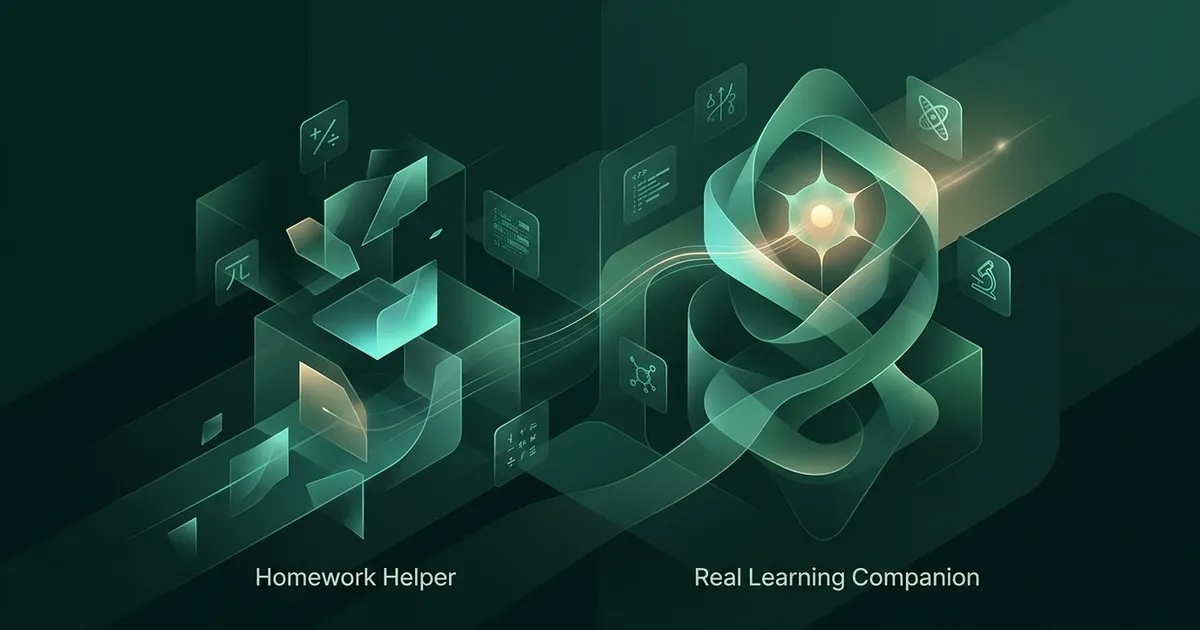
ChatGPT can make studying dramatically easier. Used badly, it also removes the exact struggle that makes knowledge stick. The goal is not to avoid AI. The goal is to make AI force better thinking.
Rule 1: Never Start With 'Give Me the Answer'
The fastest way to weaken a study session is to let ChatGPT complete the central cognitive move. If you are practicing, the effort is the point.
Start with your own attempt. Then ask ChatGPT to critique it, identify gaps, or give one hint at a time.
Use ChatGPT as an Examiner
One of the best study uses is generating questions. Paste your notes and ask for mixed difficulty questions, then answer before revealing explanations.
For exams, ask for questions that test concepts rather than definitions. A concept question exposes weak understanding faster than a flashcard.
Use ChatGPT as a Translator for Difficult Material
When a textbook paragraph is dense, ask for three explanations: simple, technical, and analogy-based. Then write your own fourth version from memory.
That final step is essential. If you only read the improved explanation, you are still consuming.
Use ChatGPT to Find Your Misconceptions
A good prompt is: 'Here is my explanation. What is wrong, missing, or imprecise?' This turns AI into a feedback layer rather than a shortcut.
Ask it to be strict. Friendly AI feedback often flatters weak answers unless you demand precision.
Where NerdSip Fits
ChatGPT is great for a live explanation. NerdSip is better for turning a topic into a repeatable learning loop: short lesson, quiz, takeaway, streak.
Use ChatGPT when you are stuck. Use NerdSip when you want to build the daily habit of learning before you get stuck.
Study Prompts Worth Saving
- Quiz me on this topic one question at a time. Do not show the answer until I try.
- Give me a hint, not the solution.
- Find the weakest assumption in my explanation.
- Turn this chapter into 10 active recall questions.
- Make a 5-minute review plan for tomorrow, three days from now, and one week from now.
The Real Search Intent Behind ChatGPT For Studying
People searching for ChatGPT for studying are usually not asking whether ChatGPT can produce answers. They already know it can. The real question is whether it can help them learn without quietly taking over the thinking. That distinction matters because a tool that removes friction can also remove the struggle that makes memory form.
The useful version of ChatGPT is not a homework shortcut. It is a practice partner: examiner, explainer, misconception finder, and translation layer for difficult material. The weak version gives you polished paragraphs before you have formed your own rough answer. That feels efficient in the moment and becomes expensive later when you cannot reproduce the idea without the chat window.
A good study workflow keeps the learner in the active role. You should answer first, ask ChatGPT to challenge or clarify, then close the tool and retrieve the idea again. If the tool makes you faster at avoiding effort, it is harming the session. If it makes effort smaller, clearer, and more measurable, it can help.
How We Judge the Best Options
A proper evaluation needs more than feature counting. For learning products, the first criterion is active engagement. Reading, watching, or listening can be useful, but retention improves when the learner has to answer, explain, predict, sort, compare, or apply. If an app never asks anything from you, it is probably more of a content app than a learning app.
The second criterion is session design. A good session has a clear beginning and end. Infinite feeds are designed to dissolve time. Good learning apps do the opposite: they package effort into a unit you can finish. That gives the brain closure, which makes the habit easier to repeat.
The third criterion is topic fit. Some apps are excellent for narrow domains and mediocre everywhere else. Brilliant is strong for STEM. NotebookLM is strong when you already have sources. Chatbots are strong for examples and explanations. NerdSip is strong for turning broad curiosity into structured micro-courses. The best choice depends on the bottleneck.
The fourth criterion is memory design. An app that helps you understand an idea but never helps you retrieve it later is only doing half the job. Quizzes, spaced review, summaries you can revisit, and progress cues all matter because forgetting is the default. A serious learning app has to fight that default directly.
Best Use Cases and Trade-Offs
| Need | Best fit | Why |
|---|---|---|
| Start learning a new topic fast | NerdSip | It turns curiosity into a short structured course with quizzes and progress. |
| Understand a confusing explanation | General chatbot or tutor | Flexible back-and-forth helps when the problem is unclear. |
| Study your own documents | Source-based tools | They work best when the source material is already chosen. |
| Build a long-term habit | Gamified microlearning | Short sessions, streaks, and completion loops reduce startup friction. |
NerdSip fits after the explanation stage: once an idea is clear, turn it into short lessons, quizzes, and a habit so the knowledge survives beyond the chat window. That does not make it the only app you should use. It makes it a strong default when the goal is to replace low-value phone time with knowledge that actually sticks.
The Best Alternatives Are Not Interchangeable
Most comparison articles pretend that every app is competing for the same job. That is rarely true. The best product for a student stuck on algebra is different from the best product for an adult who wants to learn enough about economics to follow the news. The best product for reading your own research papers is different from the best product for discovering a new topic during a commute.
- ChatGPT: best explanations and examples.
- NotebookLM: best grounded work with your own sources.
- Anki: best memorization.
- Perplexity or search: best source discovery.
- NerdSip: best structured retention.
The practical approach is to assemble a small learning stack instead of hunting for one perfect app. Use one app for daily breadth, one app for deep specialist practice, and one app for reference or explanation. For many people, NerdSip can be the daily breadth layer because it is designed for short sessions across many topics. A chatbot can be the explanation layer. A specialist platform can be the deep practice layer.
Common Mistakes That Turn ChatGPT Into a Crutch
When people say a learning app did not work, the failure is often not the app alone. It is the workflow around the app. The most common mistake is using a learning product exactly like a social feed: open, consume, feel briefly stimulated, close, forget. That habit pattern does not become learning just because the content is educational.
- Asking for polished notes before trying to understand.
- Highlighting AI output as if highlighting equals learning.
- Skipping the struggle that builds memory.
- Never testing yourself with the screen hidden.
The fix is simple but not always comfortable: add retrieval. After any lesson, ask yourself what you can explain with the app closed. If the answer is nothing, you did not learn it yet. You only encountered it. That distinction sounds harsh, but it is the difference between a useful app and a digital placebo.
A Seven-Day Test Before You Pay
Before committing to any subscription, test the product for one week with a concrete goal. Do not browse the catalog randomly. Choose one topic, one skill, or one outcome. A good learning app should make the first session easy, the second session likely, and the seventh session meaningful.
- Day 1: Ask ChatGPT for a simple explanation.
- Day 2: Close the chat and write the idea from memory.
- Day 3: Ask for a quiz instead of a summary.
- Day 4: Turn weak answers into a micro-lesson.
- Day 5: Review yesterday's answer before asking for new help.
- Day 6: Teach the topic to a real person.
- Day 7: Keep only prompts that produce retrieval, not passive notes.
At the end of the week, do a memory audit. Write five things you remember without opening the app. Then ask whether those ideas are useful, surprising, or connected to anything else you care about. If you remember only the interface, the app entertained you. If you remember ideas and can use them, the app taught you.
Where NerdSip Fits in a Serious Learning Routine
NerdSip is best understood as a daily knowledge engine. It is not trying to replace a textbook, a university course, or a human teacher. It is trying to solve a more common problem: people want to learn, but their available time arrives in small fragments. Five minutes before a meeting. Ten minutes on the train. A few minutes before bed. Those fragments usually disappear into feeds.
The value of NerdSip is that it gives those fragments a shape. A course has a topic. A lesson has a point. A quiz asks you to retrieve. A streak gives the habit continuity. Over weeks, that matters. The person who learns one small concept daily is not just collecting trivia. They are building a wider mental library, and that library changes how they read, talk, decide, and ask questions.
For someone who knows ChatGPT can help, but worries that it may quietly do the learning for them, the ideal workflow is not to abandon every other tool. Use the right tool at the right stage. Use AI to clarify. Use source-based tools when you have documents. Use specialist apps when you need drills. Use NerdSip when you want broad, repeatable learning that fits into real life.
What to Ignore in App Marketing
Ignore claims that sound impressive but do not describe a learning behavior. "Powered by AI" is not a learning method. "Personalized" can mean anything from genuinely adaptive sequencing to a welcome screen with your name on it. "Science-backed" should mean more than a vague reference to neuroscience.
Look instead for mechanics. Does the app test you? Does it tell you when you are wrong? Does it help you come back? Does it make the next step smaller? Does it respect your time? Does it give you an end point? Those are the details that determine whether an app becomes a habit or another forgotten download.
Three Real-World Scenarios
The commuter: This person has fifteen spare minutes twice a day but no patience for a formal course. The wrong app gives them a giant library and asks them to choose from hundreds of options. The right app makes the next session obvious. A short lesson, one quiz, and a finished state matter more than a huge catalog. For this user, the best learning product is the one that turns dead time into a clean loop.
The ambitious generalist: This person wants to understand AI, psychology, money, history, health, and communication well enough to connect ideas. They do not want to become a specialist in everything. They want a broad mental library. For them, variety is not a distraction; it is the point. The danger is passive grazing. The solution is breadth plus recall: many topics, but each one with a small test of memory.
The anxious optimizer: This person reads every comparison article and still cannot choose. They switch tools constantly, which means no app has enough time to become a habit. The fix is to stop optimizing for one week. Pick the app that best matches the current bottleneck, use it daily, and judge only after the seventh session. A slightly imperfect app used consistently beats a perfect app that stays theoretical.
Questions to Ask Before Downloading
Before you download anything, ask five questions. What exact moment of my day will this app replace? What will count as a finished session? How will I know whether I remembered anything? What will make me come back tomorrow? What will I stop using if this app works?
The final question is important. A new app should not simply add more screen time. It should replace lower-value screen time. If ChatGPT becomes the place where answers are born instead of the place where your answers are tested, it will eventually weaken the habit you wanted to build. If it replaces the first ten minutes of passive scrolling with ten minutes of active recall, it has a real chance.
Bottom Line
The best way to use ChatGPT for studying is to make it create effort instead of remove effort. If your goal is deep specialization, choose the strongest specialist tool. If your goal is explanation, use a tutor or chatbot carefully. If your goal is to become broadly sharper and make your phone time useful, start with a daily microlearning loop.
That is where NerdSip belongs: not as another feed, but as a replacement for the moments when you would have opened one. One topic. One short session. One quiz. Repeat that for a month and you have something most apps never create: knowledge you can actually carry into the rest of your life.
Sources and Further Reading
When you finish the explanation phase, open NerdSip and convert the topic into a short course you can revisit.
One More Practical Filter
If ChatGPT for studying still sounds abstract, use this filter: would you recommend the app to someone with only ten tired minutes at the end of a workday? If the answer is no, the app may be good but fragile. Real learning products survive imperfect conditions. They do not require a perfect desk, a perfect mood, or an empty calendar. They make the useful action small enough that it can happen anyway.
That is why short lessons, quizzes, and finished states matter. They respect how learning actually fits into adult life. The goal is not to feel inspired once. The goal is to create a repeatable path from curiosity to memory.
Frequently Asked Questions
Is NerdSip free?
You can download NerdSip for free and explore sample courses. A single paid plan unlocks more AI-generated courses, voice lessons, and extra features.
How does NerdSip help retention?
NerdSip combines short lessons with quizzes, takeaways, streaks, and review cues so screen time becomes active learning instead of passive scrolling.
Who is this guide for?
Curious adults, students, and professionals who want to use AI, learning apps, or better phone habits in a practical way.
Every NerdSip course clears a four-layer fact-checking pipeline before it reaches the app: grounded in live sources, scored nightly, gated on failure, and reviewable by a person at one tap. Articles on this blog are drafted with AI assistance, then researched, verified, and edited by our team.
Editorial responsibility: ai51 UG (haftungsbeschränkt). Responsible editor named in the imprint.
📚 Keep Learning
Explore the NerdSip learning hubs
The blog is our editorial layer. When you want to move from reading into doing, these hubs organize the rest of NerdSip by format, including the app itself and the press that has written about it.
Turn This Into a 5-Minute Learning Habit
Download NerdSip to turn curiosity, AI skills, and screen-time resets into short courses, quizzes, voice lessons, and streaks.
4.7 stars from 380 reviews · 10,000+ learners