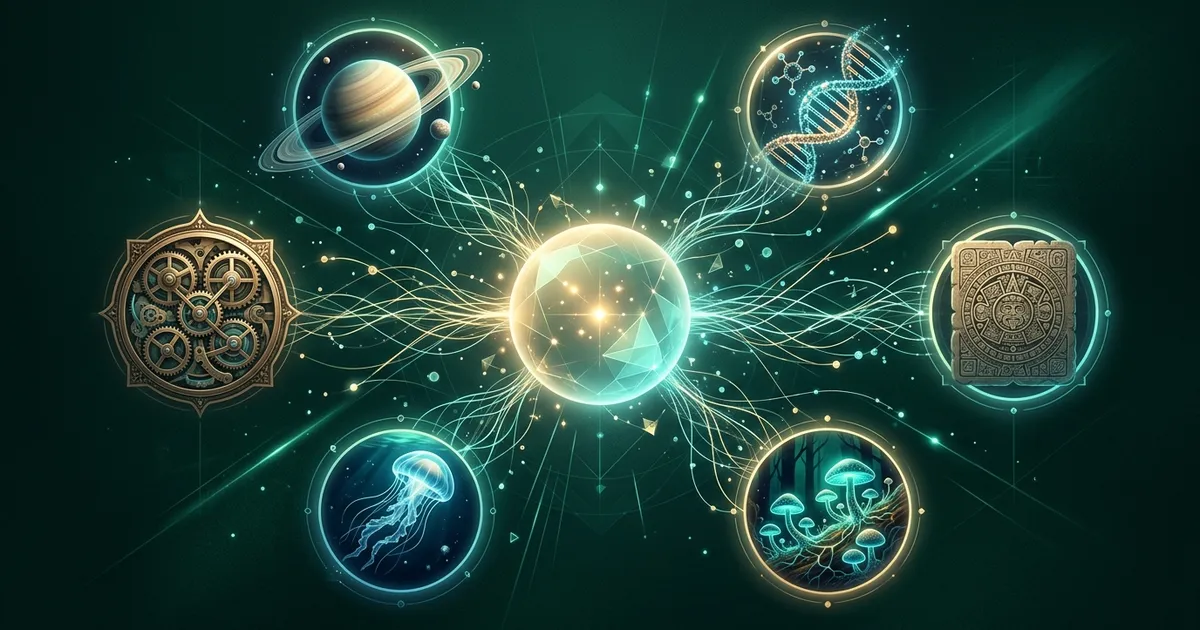
A good rabbit hole starts with a single question. You click one link. Then another. You open a new tab. Then four more. Suddenly it's 2 AM and you're reading about the mating habits of anglerfish or the logistics of building the Great Pyramid. You're not studying. You're not even trying to learn. You're just pulled in.
That feeling is one of the best things the internet has to offer. Here are ten places that reliably produce it.
1. NerdSip Rabbit Holes
What it is: A collection of 12 immersive panoramic experiences on nerdsip.com/rabbithole. Each one drops you into a massive 4K illustration that fills your screen. You scroll horizontally through the panorama while text chapters fade in, revealing the story of a fascinating topic.
Topics include: The Dyson Sphere, the Lost Labyrinth of Egypt, Yellowstone's supervolcano, the Mariana Trench, the Antikythera Mechanism, CERN's Large Hadron Collider, tardigrades, the Library of Alexandria, bioluminescent bays, the Svalbard Seed Vault, the Denmark Strait Cataract, and Göbekli Tepe.
Why it's a great rabbit hole: The format is different from anything else on this list. You are inside the image, scrolling through it like a scene in a movie. The text is written to provoke wonder, not to summarize. Each experience takes about three to five minutes, but the topics are chosen to make you want to look up more afterward. The Antikythera Mechanism experience, for example, will almost certainly send you to Wikipedia within five minutes of finishing it.
Cost: Free. No account. No app download. Works on any device.
Fact-checking: Every course is generated against live search results, scored nightly for content integrity, kept out of the swipe deck if it fails the bar, and reportable in one tap to a queue that real people work through.
2. Wikipedia
What it is: The obvious answer, but it deserves its spot at the top. 60 million articles across 300 languages. The deepest, widest repository of human knowledge ever assembled, maintained by volunteers who care about accuracy more than almost any paid editorial team.
Why it's a great rabbit hole: The hyperlink structure is the engine. Every article links to dozens of others. You start reading about the Roman Empire, click through to Byzantine architecture, somehow end up on the physics of dome construction, and finish on the Wikipedia page for eggshell thickness. The "Random article" button is underrated. The "Did you know" section on the main page is consistently surprising.
Best for: Depth. No other source matches Wikipedia for sheer volume of detail on obscure topics. If you want to know the complete history of a specific bridge in a specific city, Wikipedia probably has it.
Cost: Free. Always has been.
3. Reddit (r/todayilearned, r/AskHistorians, r/AskScience)
What it is: Three subreddits that reliably produce high-quality rabbit holes. r/todayilearned surfaces fascinating facts with sources. r/AskHistorians enforces academic rigor in its answers, producing essay-length responses from verified experts. r/AskScience does the same for scientific questions.
Why it's a great rabbit hole: The community curation is the secret weapon. Thousands of people vote on what's genuinely interesting, which means the front page of these subreddits is a curated feed of wonder. r/AskHistorians in particular is a goldmine. Questions like "What did ordinary Romans eat for breakfast?" get 2,000-word answers from people with PhDs.
Best for: Serendipity. You never know what you'll find. The comment threads often contain even better information than the original post.
Cost: Free.
4. Kurzgesagt (YouTube)
What it is: A German animation studio that produces some of the most visually stunning science explainer videos on the internet. Topics range from black holes and immune cells to the size of the universe and the future of humanity. Each video runs 8 to 15 minutes and represents hundreds of hours of research and animation.
Why it's a great rabbit hole: The production quality makes complex topics feel accessible without dumbing them down. One video on the immune system leads to another on viruses, which leads to one on CRISPR, which leads to one on the ethics of genetic engineering. The animation style is so distinctive and beautiful that watching becomes almost meditative.
Best for: Visual learners. People who want scientific accuracy with cinematic presentation. Anyone who wants to understand something complicated in under 15 minutes.
Cost: Free on YouTube.
5. Veritasium (YouTube)
What it is: Derek Muller's science channel. Unlike Kurzgesagt's animation-heavy approach, Veritasium mixes real-world experiments, interviews with scientists, and explanations filmed on location. Topics include turbulence, the Mpemba effect, why the ocean is salty, and how to make the world's roundest object.
Why it's a great rabbit hole: Veritasium specializes in counterintuitive science. Videos regularly open with a question that seems simple, then reveal layers of complexity you never expected. The video on the world's longest-running experiment (a pitch drop that takes a decade to form a single drop) is a perfect example. You go in curious. You come out rethinking your assumptions.
Best for: People who like being surprised by science. The "I had no idea that worked that way" feeling.
Cost: Free on YouTube.
6. Neal.fun
What it is: A collection of interactive web experiences by Neal Agarwal. Highlights include "The Size of Space" (scroll from an astronaut to the observable universe), "Spend Bill Gates' Money" (try to spend $100 billion), "The Deep Sea" (scroll down through ocean depth zones), and "Draw a Perfect Circle" (exactly what it sounds like).
Why it's a great rabbit hole: Every experience is self-contained, takes five minutes, and teaches you something through interaction rather than reading. "The Deep Sea" in particular is one of the best educational web experiences ever made. You scroll down and see what lives at each depth, from the sunlit zone to the hadal zone. It makes the depth of the ocean visceral in a way that text never could.
Best for: Quick, surprising, interactive learning. Perfect for when you have ten minutes and want to feel awe.
Cost: Free.
7. Radiolab (Podcast)
What it is: A podcast from WNYC Studios that explores scientific and philosophical questions through sound-rich storytelling. Episodes cover topics from the nature of color perception to the ethics of CRISPR to the mathematics of randomness. The show has been running since 2002 and has a massive archive.
Why it's a great rabbit hole: Radiolab treats sound the way NerdSip's Rabbit Holes treat images. The audio production is layered and immersive. Interviews overlap. Sound effects illustrate concepts. Music shifts tone. You feel the story more than you hear it. One episode regularly leads to three more. The archive is deep enough to sustain weeks of listening.
Best for: Audio learners. Commuters. People who want to think about big questions while doing something else with their hands.
Cost: Free.
8. Google Earth
What it is: A 3D model of the entire planet built from satellite imagery, aerial photography, and geographic data. You can zoom from space to street level on almost any location on Earth. The "Voyager" feature includes curated guided tours of natural wonders, historical sites, and cultural landmarks.
Why it's a great rabbit hole: The geographic dimension adds something no text or video source can match. Reading about Machu Picchu is one thing. Dropping into Street View and virtually walking through its terraces is another. Google Earth also lets you view historical imagery, so you can watch cities grow, glaciers retreat, and forests disappear over decades. The Timelapse feature (showing 37 years of satellite data as an animation) is genuinely unsettling.
Best for: Geographic curiosity. Armchair exploration. Understanding how places look and feel, not just what they are.
Cost: Free.
9. The Internet Archive
What it is: A nonprofit digital library with 835 billion web pages archived through the Wayback Machine, plus millions of free books, movies, music recordings, and software. It preserves the history of the internet and makes historical materials freely available.
Why it's a great rabbit hole: The Wayback Machine alone is endlessly fascinating. You can see what any website looked like at any point in its history. Google in 1998. Twitter on its launch day. Your own company's website from ten years ago. Beyond the web archive, the book collection includes out-of-print titles you cannot find anywhere else. The audio archive includes historical recordings, old radio shows, and live concert recordings. You can lose entire weekends in here.
Best for: History lovers. Nostalgia. Researchers. Anyone who wants to see what the internet used to look like.
Cost: Free.
10. Atlas Obscura
What it is: A database of over 25,000 unusual and extraordinary places around the world. From the bone churches of Europe to the Door to Hell in Turkmenistan to a library in Uruguay made entirely from recycled materials. Each entry includes photos, descriptions, visitor information, and the story behind the place.
Why it's a great rabbit hole: Atlas Obscura surfaces places you would never find through normal travel research. It rewards browsing. Click on any region of the map and you'll find something you had no idea existed within driving distance of a city you thought you knew. The editorial voice is consistently engaging, treating every location with genuine curiosity rather than tourist-brochure enthusiasm.
Best for: Travel planning. Armchair exploration. Anyone who believes the world is more interesting than the guidebooks suggest.
Cost: Free.
The Rabbit Hole Comparison Table
| Source | Format | Best For | Time Per Session |
|---|---|---|---|
| NerdSip Rabbit Holes | Immersive panoramics | Visual wonder, quick awe | 3-5 min |
| Wikipedia | Text + links | Depth, obscure topics | ∞ |
| Community threads | Serendipity, discussion | 10-30 min | |
| Kurzgesagt | Animated video | Visual science, complex topics | 10-15 min |
| Veritasium | Video + experiments | Counterintuitive science | 15-20 min |
| Neal.fun | Interactive web | Quick interactive wonder | 5-10 min |
| Radiolab | Podcast | Audio storytelling, big questions | 30-60 min |
| Google Earth | 3D exploration | Geographic curiosity | 10-30 min |
| Internet Archive | Digital library | History, nostalgia, research | ∞ |
| Atlas Obscura | Database + editorial | Unusual places, travel | 10-20 min |
How to Build Your Own Rabbit Hole Routine
The best approach is not to pick one source. It's to rotate.
Start your morning with a NerdSip Rabbit Hole. Three minutes of scrolling through a panoramic illustration of the Svalbard Seed Vault or the Mariana Trench sets a different tone than checking the news. Follow it with a Wikipedia article on whatever the experience made you curious about. Save a Kurzgesagt video for lunch. Queue up a Radiolab episode for the commute home.
The goal is not efficiency. It is wonder. These sources exist to remind you that the world is more interesting than your to-do list suggests.
Want specific topics to chase down these rabbit holes? Start with our list of 50 random interesting topics anyone can learn.
If you want to turn that curiosity into structured learning, NerdSip's course library has 291+ micro-courses across science, history, psychology, and more. Five-minute lessons. Gamified progression. Same curiosity, different format.
Frequently Asked Questions
What are the best rabbit holes on the internet?
The best rabbit holes in 2026 include NerdSip Rabbit Holes (immersive 4K panoramic experiences), Wikipedia (infinite depth on any topic), Reddit communities like r/todayilearned and r/AskHistorians, YouTube channels like Kurzgesagt and Veritasium, interactive sites like Neal.fun, podcasts like Radiolab, Google Earth, the Internet Archive, and Atlas Obscura.
What is a rabbit hole in the context of learning?
A rabbit hole is a topic or experience that pulls you deeper the more you explore it. You start with one question, follow a link or a thread, and suddenly an hour has passed. The best rabbit holes are the ones where that hour feels like ten minutes because the content is genuinely fascinating.
Are there any immersive rabbit hole experiences online?
Yes. NerdSip Rabbit Holes (nerdsip.com/rabbithole) offers 12 immersive panoramic experiences where you scroll through massive 4K illustrations while text reveals the story of fascinating topics like the Dyson Sphere, the Mariana Trench, and Göbekli Tepe. They work on any device and are completely free.
Every NerdSip course clears a four-layer fact-checking pipeline before it reaches the app: grounded in live sources, scored nightly, gated on failure, and reviewable by a person at one tap. Articles on this blog are drafted with AI assistance, then researched, verified, and edited by our team.
Editorial responsibility: ai51 UG (haftungsbeschränkt). Responsible editor named in the imprint.
📚 Keep Learning
Explore the NerdSip learning hubs
The blog is our editorial layer. When you want to move from reading into doing, these hubs organize the rest of NerdSip by format, including the app itself and the press that has written about it.
Fall Into the Rabbit Holes
12 immersive panoramic journeys across science, history, and nature. Free. No app needed. Just scroll.
Courses on this topic
4.7 stars from 380 reviews · 10,000+ learners