We spend most of our time building a micro-learning app. Five-minute lessons. XP systems. Loot drops. Progress bars. All designed to make learning stick. But every now and then, we want to build something that has nothing to do with retention curves or spaced repetition. Something that exists purely to make you stop scrolling and feel something.
That impulse is why we built Rabbit Holes.
What Rabbit Holes Are
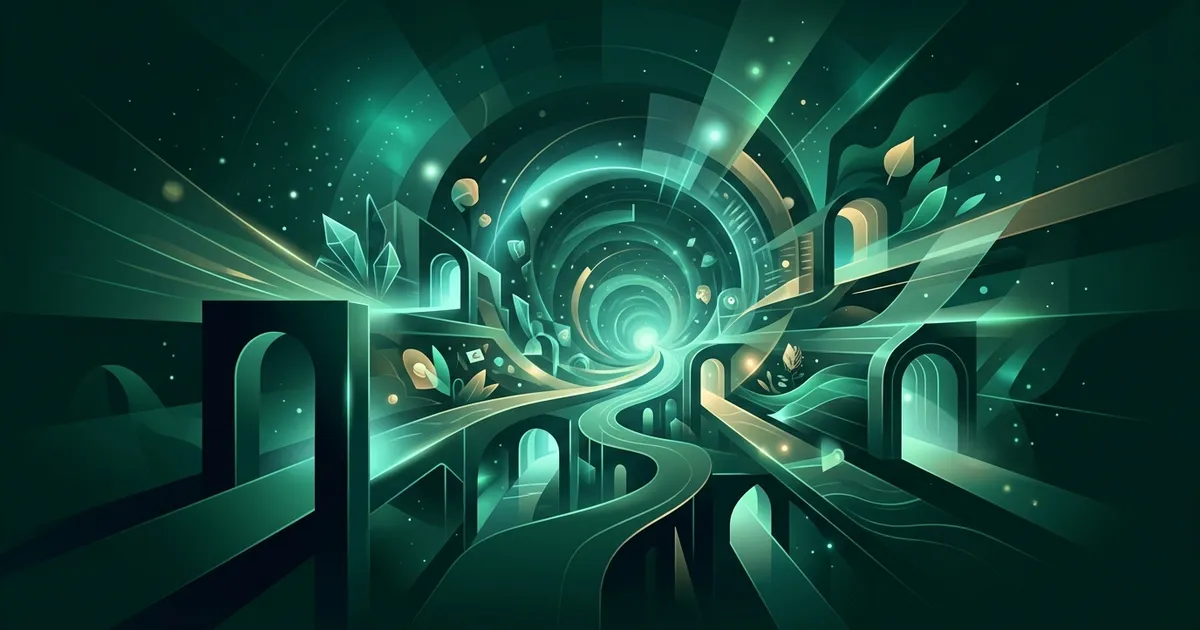
Each Rabbit Hole is an immersive panoramic experience. You land on a page, and a massive illustration fills your entire screen. The image is far wider than your viewport. You scroll horizontally to move through it. As you explore, text chapters fade into view at the bottom, revealing the story of whatever wonder you've fallen into.
The illustrations are 4K panoramics, 6336 pixels wide and 2688 pixels tall, rendered at a cinematic 21:9 aspect ratio. We generate them using Google's Gemini 3.1 Flash image model, pushing it to its maximum resolution. The results are detailed enough to reward slow, careful scrolling.
There are 12 of them right now, spanning science, history, and nature.
The Full Collection
We deliberately chose topics that cross disciplines and resist easy categorization. Each one is a genuine rabbit hole, a topic where the deeper you look, the more there is to find.
Science
The Dyson Sphere. Freeman Dyson's 1960 thought experiment about wrapping an entire star in solar collectors. We cover the Kardashev Scale, Tabby's Star, and what it would actually mean to find evidence of a Type II civilization.
Tardigrades. Half a millimeter long. Eight legs. Survives the vacuum of space, radiation, and temperatures near absolute zero. 500 million years old. The most resilient animal ever discovered, and the molecular biology behind its survival is fascinating.
CERN and the Large Hadron Collider. A 17-mile ring of superconducting magnets that accelerates protons to 99.9999991% the speed of light. We cover the discovery of the Higgs boson, what the LHC is searching for next, and how CERN accidentally gave us the World Wide Web.
The Svalbard Global Seed Vault. Inside a frozen mountain near the North Pole, 1.3 million seed samples from every country on Earth wait in silence. Already used once, when Syria's seed bank was destroyed by civil war.
Nature
Yellowstone. A supervolcano with a magma chamber large enough to fill the Grand Canyon eleven times over. The thermophilic bacteria in its hot springs gave us the enzyme that makes PCR possible.
The Denmark Strait Cataract. The largest waterfall on Earth is 11,500 feet tall and completely invisible. It plunges beneath the North Atlantic between Iceland and Greenland, carrying 175 million cubic feet of water per second.
The Mariana Trench. 36,000 feet of darkness. Pressure that would crush most submarines. Hydrothermal vents where life feeds on the chemistry of the planet itself, with no sunlight needed.
Bioluminescent Bays. In a handful of tropical bays, billions of dinoflagellates light up the water wherever it is disturbed. The chemistry behind the glow is 1.5 billion years old.
History
The Lost Labyrinth of Egypt. Herodotus said it surpassed the pyramids. Three thousand rooms. Built around 1800 BCE. Then it vanished beneath the sand. In 2008, ground-penetrating radar found it still down there.
The Library of Alexandria. 400,000 scrolls. The sum of ancient human knowledge in one building. The popular story says one fire destroyed it. The truth is more complicated and more painful.
The Antikythera Mechanism. A 2,000-year-old analog computer pulled from a shipwreck. 37 interlocking bronze gears that predicted eclipses and tracked planetary motion. Nothing this mechanically complex would be built again for 1,400 years.
Göbekli Tepe. A temple complex in Turkey built 11,600 years ago. Before agriculture. Before pottery. Before writing. It inverts everything we thought we knew about the sequence of human civilization.
How We Built It
The technical challenge was making these panoramic images work across every screen size. A phone held in portrait (9:16) shows a narrow vertical slice of the panorama. A standard desktop monitor (16:9) shows a wide view with moderate horizontal scrolling. An ultrawide monitor (21:9 or wider) can see nearly the entire panorama at once.
All three had to feel good.
The solution was straightforward. The image fills the viewport height. On narrow screens, there's lots of horizontal scroll, and you move through the chapters one at a time. On wide screens, there's less scrolling, and more chapters are visible simultaneously. On ultrawides, the whole panorama is visible at once, and all the text appears together.
The interaction layer handles mouse wheel (mapped to horizontal scroll), click-and-drag, touch swipe, and keyboard arrows. A progress bar at the top shows how far you've scrolled. A "scroll to explore" hint appears for new visitors and fades after the first interaction. On touch devices, the hint automatically switches to "swipe to explore."
The text chapters sit in the bottom portion of the image, in a gradient zone that fades from transparent to dark. This keeps the text readable regardless of what's happening in the panorama above. The chapters fade in as they enter the viewport and fade out as they leave, which gives the experience a cinematic quality.
For images, we use Google's Gemini 3.1 Flash image model at 4K resolution with a 21:9 aspect ratio. Each prompt is crafted to create a single cohesive panoramic scene that tells a visual story from left to right. The raw output is a 6336x2688 JPEG, which we compress at 90% quality, typically landing between 2 and 3.5 MB per image.
We also generate optimized thumbnails (800x500) for the landing page cards and Open Graph images (1200x630) for social sharing. The full panoramic images use eager loading since they are the entire experience. Thumbnails on the landing page use lazy loading.
Why We Built It
NerdSip is a learning app. Most of what we build is designed to be efficient. Five-minute lessons. Clear takeaways. Progress tracking. And that's the right approach for daily learning.
But learning is not only about efficiency. Sometimes a topic deserves more than a five-minute lesson. Sometimes the right response to something extraordinary is not a quiz at the end but a moment of quiet astonishment.
The Denmark Strait Cataract is the largest waterfall on Earth and no human has ever seen it. That fact deserves to land differently than a bullet point in a listicle. It deserves an image you can scroll through slowly, with text that lets the weight of it sink in.
Rabbit Holes exist for the moments when curiosity is not about completing a lesson. It's about falling into a topic and losing track of time.
We wanted something that felt like the best Wikipedia rabbit holes feel, that sensation of clicking from one article to the next at 2 AM, except with the visual immersion turned up to maximum. Something you'd send to a friend not because it's useful but because it's beautiful.
What Comes Next
We have more topics planned. The list of fascinating wonders that deserve the panoramic treatment is effectively infinite. Pompeii. The Voyager Golden Record. The human brain. Deep-sea bioluminescent creatures. The James Webb Space Telescope's first images.
If you have a topic you think would make a great Rabbit Hole, we'd love to hear about it.
For now, the full collection lives at nerdsip.com/rabbithole. Pick one that catches your eye. Scroll slowly. Read carefully. Fall in.
And if the rabbit hole leaves you wanting more, NerdSip has thousands of courses waiting. Same curiosity, different format. Five-minute lessons, gamified progression, and a community of people who think learning should feel like an adventure.
Frequently Asked Questions
What are NerdSip Rabbit Holes?
Rabbit Holes are immersive panoramic experiences on nerdsip.com. Each one features a massive 4K illustration (6336x2688 pixels) that you scroll through horizontally. As you move through the panorama, text chapters reveal the story of a fascinating topic from science, history, or nature.
How many Rabbit Holes are there?
There are currently 12 Rabbit Holes covering topics like the Dyson Sphere, the Library of Alexandria, tardigrades, the Antikythera Mechanism, the Mariana Trench, CERN, the Svalbard Seed Vault, bioluminescent bays, Göbekli Tepe, the Denmark Strait Cataract, the Egyptian Labyrinth, and Yellowstone.
Do Rabbit Holes work on mobile phones?
Yes. Rabbit Holes are designed to work on all screen sizes, from portrait mobile phones (9:16) to standard desktop monitors (16:9) to ultrawide screens (21:9 and beyond). On mobile, you swipe horizontally to explore. On desktop, you can scroll, click and drag, or use arrow keys.
Are NerdSip Rabbit Holes free?
Yes. All Rabbit Holes are completely free to explore at nerdsip.com/rabbithole. No account required, no paywall, no app download needed.
Every NerdSip course clears a four-layer fact-checking pipeline before it reaches the app: grounded in live sources, scored nightly, gated on failure, and reviewable by a person at one tap. Articles on this blog are drafted with AI assistance, then researched, verified, and edited by our team.
Editorial responsibility: ai51 UG (haftungsbeschränkt). Responsible editor named in the imprint.
📚 Keep Learning
Explore the NerdSip learning hubs
The blog is our editorial layer. When you want to move from reading into doing, these hubs organize the rest of NerdSip by format, including the app itself and the press that has written about it.
Fall Into the Rabbit Holes
12 immersive panoramic journeys across science, history, and nature. Scroll, discover, wonder.
4.7 stars from 380 reviews · 10,000+ learners