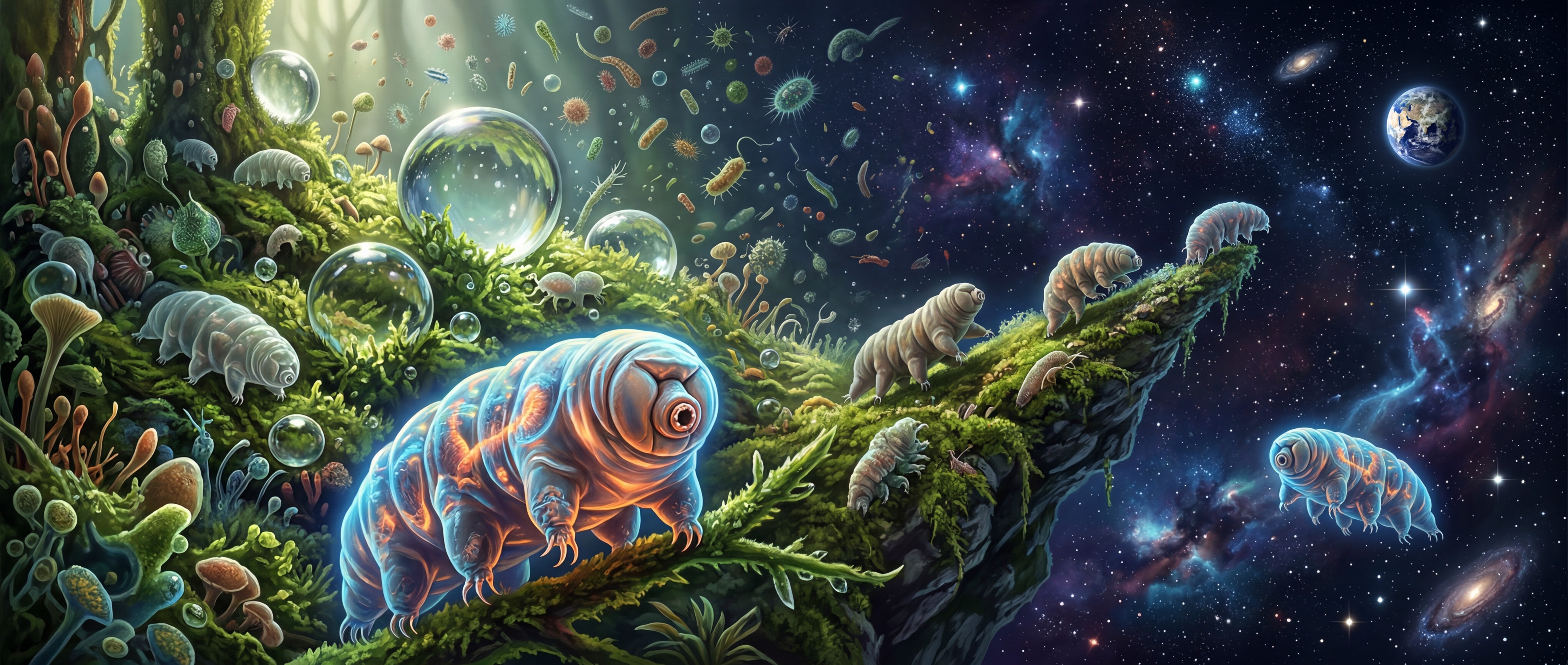
The Animal That Cannot Be Killed
Half a millimeter long. Eight stubby legs. A face like a wrinkled vacuum cleaner. The tardigrade, also called the water bear, is the most resilient animal ever discovered. It survives temperatures from near absolute zero to above boiling. It shrugs off radiation doses that would kill a human a thousand times over. It has been shot into the vacuum of space and came back alive. It has been on this planet for 500 million years. It will almost certainly outlast us.
The Tun State
When conditions turn hostile, the tardigrade does something extraordinary. It pulls in its legs, expels nearly all the water from its body, and enters a state called cryptobiosis. Its metabolism drops to 0.01% of normal. It is, for all practical purposes, neither alive nor dead. It simply waits. Tardigrades have been revived after 30 years in a freezer. In 2019, an Israeli spacecraft crashed on the Moon carrying thousands of dehydrated tardigrades. Scientists believe some may have survived the impact. There may be tardigrades on the Moon right now.
Built Different
Their secret is molecular. Tardigrades produce a unique protein called Dsup, short for damage suppressor, that wraps around their DNA like a shield, absorbing radiation before it can cause harm. They replace water in their cells with a glass-like sugar called trehalose, preventing ice crystals from shredding their insides. They are not tough in the way a tank is tough. They are tough in the way only biology can be: flexible, elegant, and refined over half a billion years of relentless pressure.
Small Beyond Measure, Mighty Beyond Reason
There are over 1,300 known species of tardigrade. They live everywhere. Mountain tops. Ocean trenches. Antarctic ice. Backyard moss. They were here before the dinosaurs, before flowers, before most of the life we consider ancient. And when the Sun eventually swells and boils the oceans dry, tardigrades may be the last animals standing.
Want more rabbit holes?
NerdSip delivers bite-sized wonders to your phone. Every day.