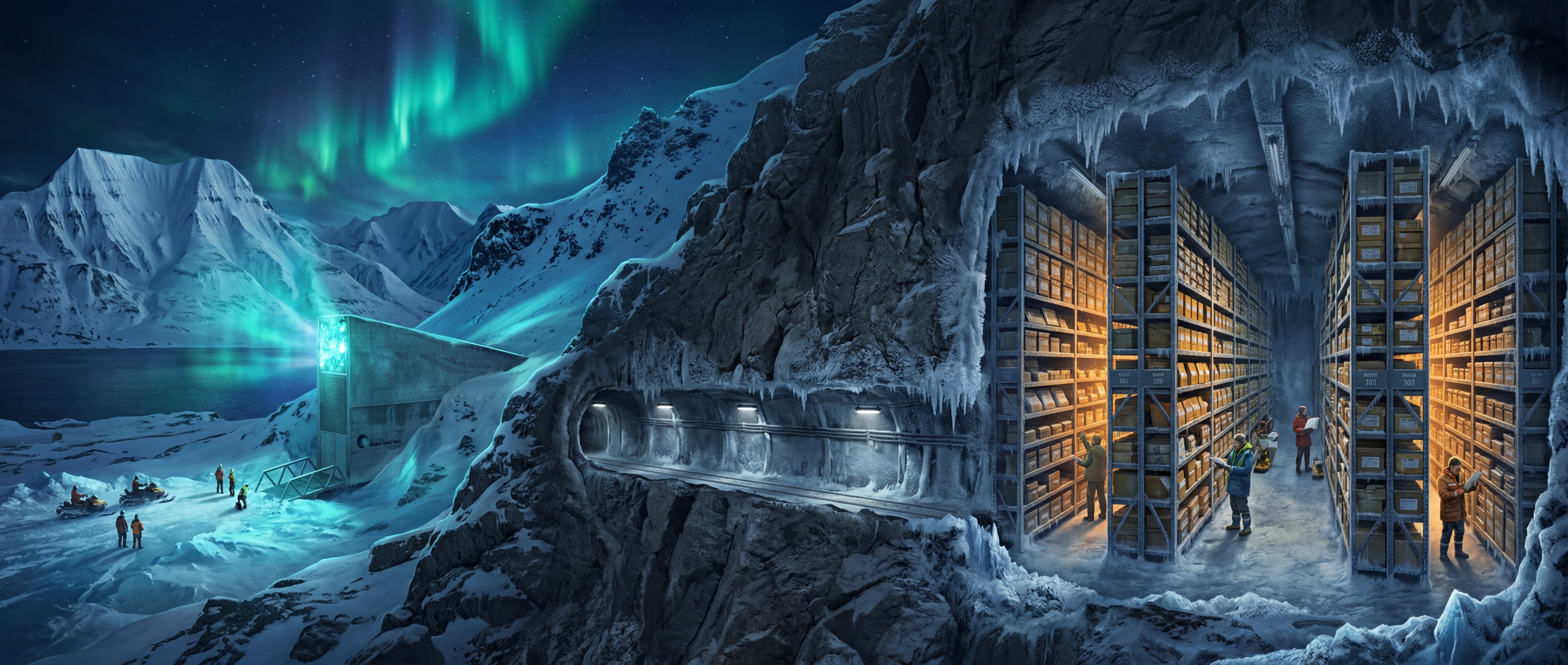
The Vault at the End of the World
On the Norwegian archipelago of Svalbard, 800 miles from the North Pole, a concrete wedge protrudes from the side of a frozen mountain. Inside, a tunnel extends 400 feet into the rock, past two airlocks and a series of blast-proof doors. At the end, three vault rooms hold 1.3 million seed samples from nearly every country on Earth. The temperature never rises above minus 18 degrees Celsius. This is the Svalbard Global Seed Vault. Humanity's insurance policy against the unthinkable.
Why Seeds Matter
Seventy-five percent of the world's crop diversity has been lost in the last century. We grow fewer varieties of rice, wheat, and maize than our grandparents did. That is a problem because genetic diversity is what allows crops to adapt to new diseases, new climates, and new pests. When the Irish potato famine struck in the 1840s, it devastated the country because nearly every farm grew the same variety. One disease. One vulnerability. One catastrophe. The Seed Vault exists to make sure that never happens on a global scale.
Already Used
In 2015, Syria's national seed bank in Aleppo was destroyed by civil war. It held irreplaceable samples of wheat, barley, and lentils adapted to dry Middle Eastern climates over thousands of years. Because duplicates had been deposited in Svalbard, the collection survived. Scientists withdrew seeds from the vault, regrew the crops in Lebanon and Morocco, and sent fresh samples back to Svalbard. It was the first withdrawal from the vault. It will not be the last. The system worked exactly as designed.
Built to Outlast Us
The vault was engineered to survive without human intervention. The permafrost keeps the seeds frozen even if the power fails. The location is geologically stable, high enough above sea level to survive significant ice melt, and remote enough to avoid most conflicts. It accepts seeds from any country, stores them for free, and returns them on request. No politics. No conditions. Just the quiet conviction that the future deserves options. The vault does not solve the problem of disappearing biodiversity. But it buys us time. And time, used well, is everything.
Want more rabbit holes?
NerdSip delivers bite-sized wonders to your phone. Every day.