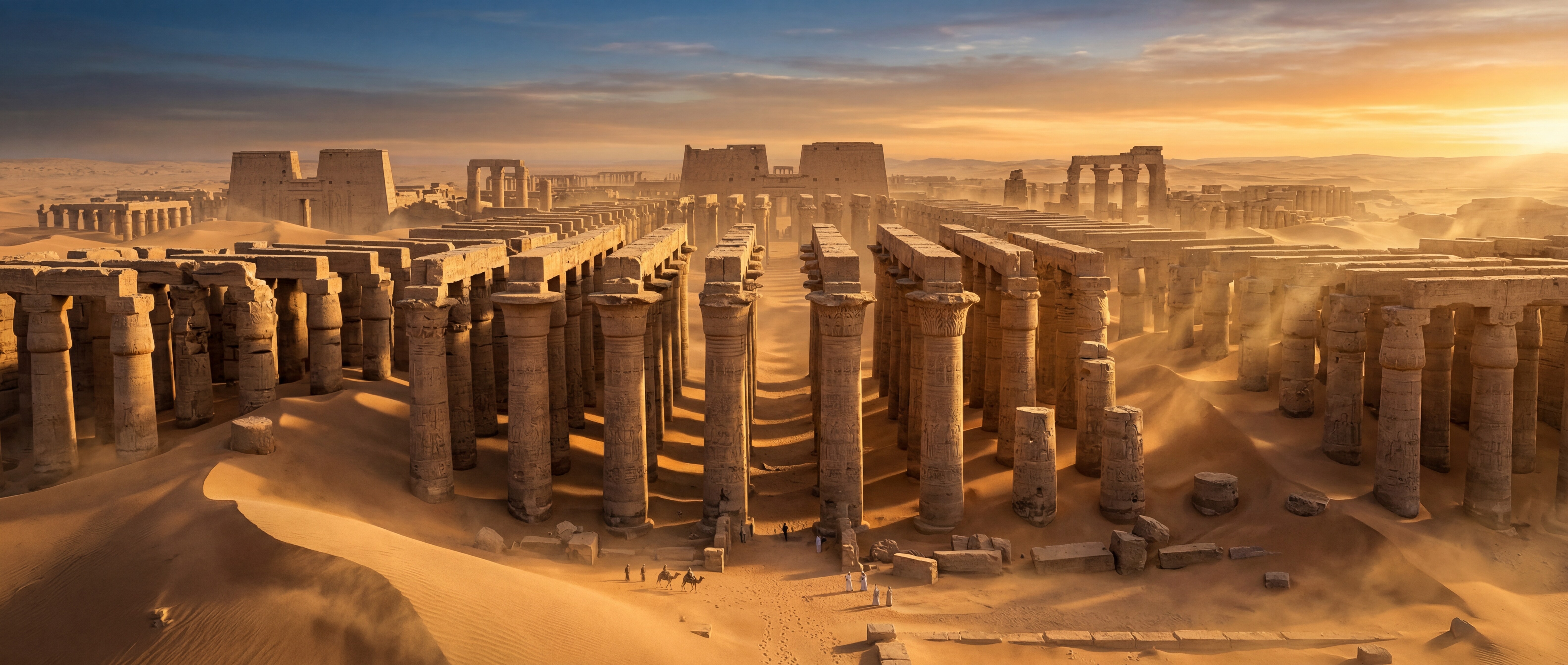
Greater Than the Pyramids
When Herodotus traveled to Egypt around 450 BCE, he had already seen the greatest structures of the ancient world. The pyramids at Giza. The temples of Babylon. But when he walked into the Labyrinth on the shores of Lake Moeris, he wrote that it surpassed them all.
Three Thousand Rooms
Half above ground, half below. Corridors folding into corridors, courts opening into courts, each decorated differently, each more intricate than the last. Built by pharaoh Amenemhat III around 1800 BCE, the Labyrinth at Hawara was no myth. It was the administrative center of an empire. A place where the taxes of forty-two nomes were recorded, where the sacred crocodiles of Sobek were kept in underground chambers, where kings were buried in silence beneath stone no thief could breach.
Vanished, Not Forgotten
Strabo described its halls. Pliny catalogued its dimensions. Diodorus marveled at its engineering. Then the Romans quarried it for limestone. The sands of the Fayum drifted over what remained. For nearly two thousand years, scholars debated whether the Labyrinth had ever truly existed. Or whether Herodotus had simply exaggerated a modest temple into legend.
Still Down There
In 2008, an expedition led by the Mataha Foundation used ground-penetrating radar to scan the site at Hawara. Beneath meters of sand and water, they found a massive grid of walls and chambers matching ancient descriptions. The Labyrinth is real. It is still there. And no one has been inside for over two thousand years.
Want more rabbit holes?
NerdSip delivers bite-sized wonders to your phone. Every day.