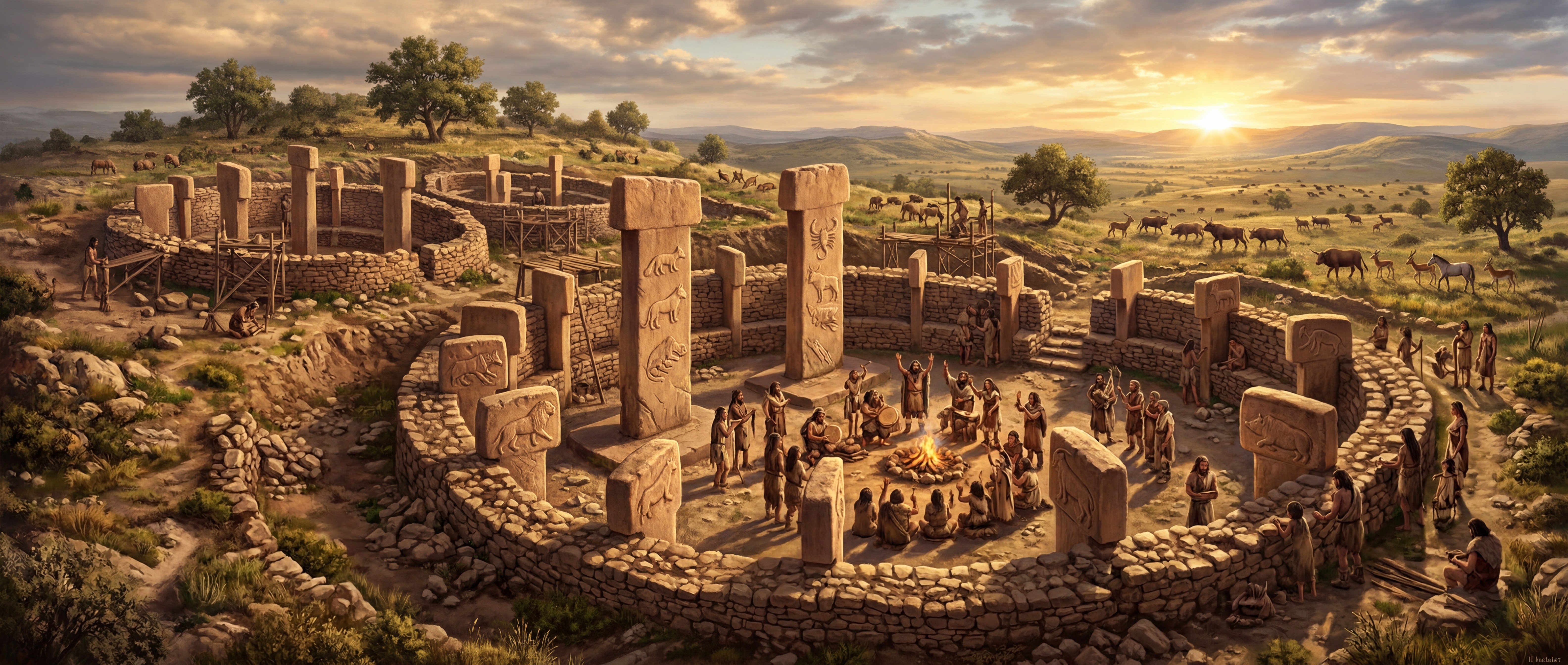
The Temple That Rewrote History
In 1994, German archaeologist Klaus Schmidt walked onto a hilltop in southeastern Turkey and recognized what local farmers had been plowing around for generations: the ruins of the oldest known monumental structure on Earth. Göbekli Tepe was built around 9600 BCE. Six thousand years before Stonehenge. Four thousand years before the earliest known writing. Before agriculture, before pottery, before the wheel. Hunter-gatherers, people we assumed could barely feed themselves, carved and erected pillars weighing up to 20 tons.
Pillars That Speak
The T-shaped limestone pillars stand up to 18 feet tall, arranged in concentric circles. Their surfaces are covered with detailed carvings: foxes, scorpions, vultures, lions, snakes, wild boar. Some pillars have arms and hands carved in low relief, suggesting they represent stylized human figures. The carvings are not decorative. They tell stories we cannot yet read. Some archaeologists believe the animal reliefs encode astronomical observations. Others see evidence of shamanistic ritual. What is clear is that these were not primitive people scratching at stone. This was organized, purposeful, and sophisticated.
Deliberately Buried
Around 8000 BCE, the builders of Göbekli Tepe did something extraordinary. They buried the entire complex. Intentionally. They filled in the stone circles with rubble and earth, sealing the pillars under an artificial hill. Then they built new circles on top and buried those too. This process repeated over centuries. Why would people who invested generations of labor in a monument choose to bury it? Was it a ritual of closure? A response to changing beliefs? We do not know. But the burial preserved the site perfectly for 10,000 years, which is why we can study it at all.
The Question That Changes Everything
Before Göbekli Tepe, archaeologists believed civilization followed a strict sequence: first farming, then settlement, then religion. Göbekli Tepe inverts this. A monumental temple complex built by nomadic hunter-gatherers suggests that the desire to gather, to worship, to build something larger than survival, may have come first. Perhaps it was religion that drove people to settle. Perhaps the need to feed the workers who built these temples pushed humans to domesticate wheat, which grew wild on the surrounding hills. Perhaps civilization did not create temples. Perhaps temples created civilization.
Want more rabbit holes?
NerdSip delivers bite-sized wonders to your phone. Every day.