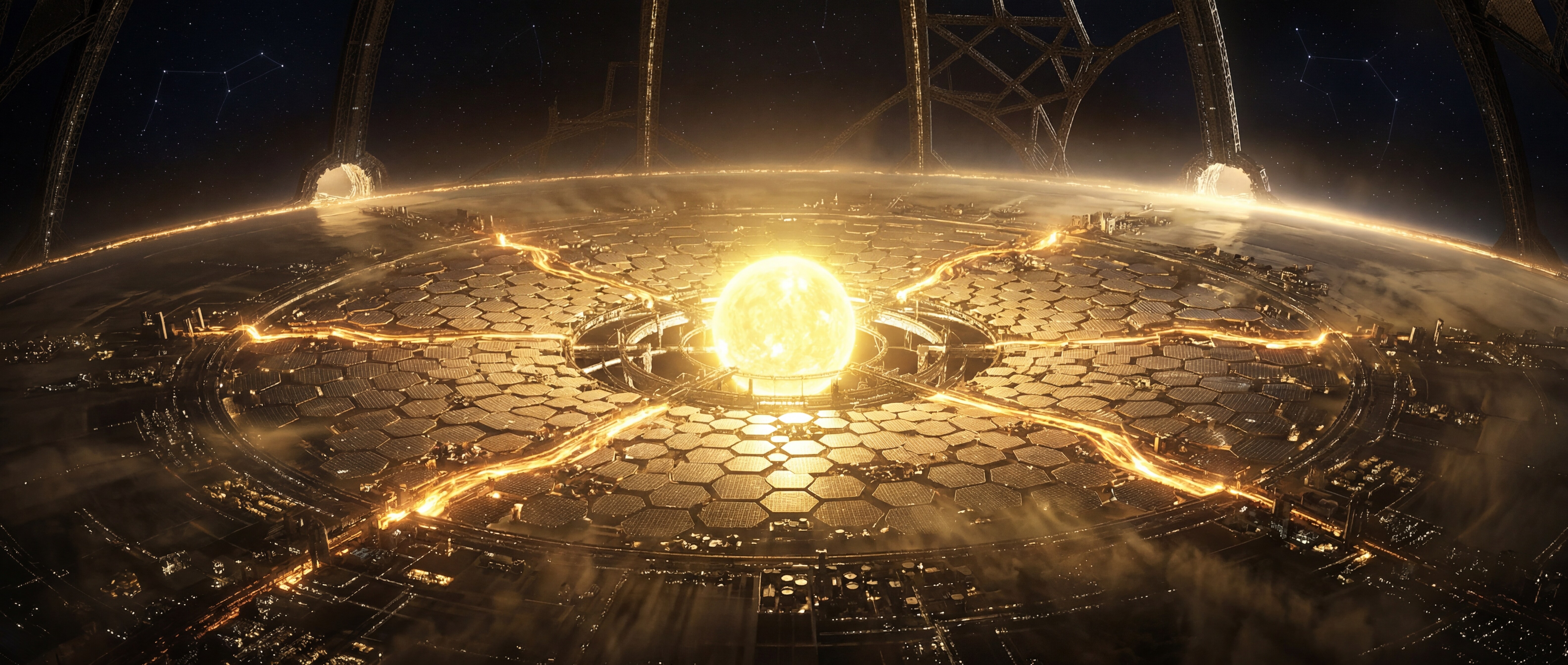
What If You Could Wrap a Star?
Not mine a planet. Not split an atom. What if a civilization grew so powerful, so hungry for energy, that it built a shell around its own sun? Every photon captured. Every ray of light converted into usable power. An entire star, turned into a battery.
The Physicist's Dream
In 1960, Freeman Dyson published a two-page paper that changed how we search for intelligent life. He argued that any sufficiently advanced civilization would eventually outgrow its planet's energy supply. The logical next step? Surround the star with solar collectors. Millions of them, orbiting in a swarm so vast it would be invisible to optical telescopes. But not to infrared.
The Kardashev Scale
We classify civilizations by energy consumption. Type I harnesses a planet. Type II, a star. Type III, an entire galaxy. Humanity sits at roughly 0.73. But somewhere out there, orbiting a star we have not named, a civilization may already be Type II. The evidence would look like a star dimming in patterns no natural phenomenon could explain. In 2015, astronomers found exactly that.
The Universe Rewards the Curious
Tabby's Star. KIC 8462852. Its light dips irregularly, deeply, in ways dust and comets cannot fully explain. Probably not a Dyson sphere. Probably. But the fact that we can ask the question at all is the real wonder.
Want more rabbit holes?
NerdSip delivers bite-sized wonders to your phone. Every day.