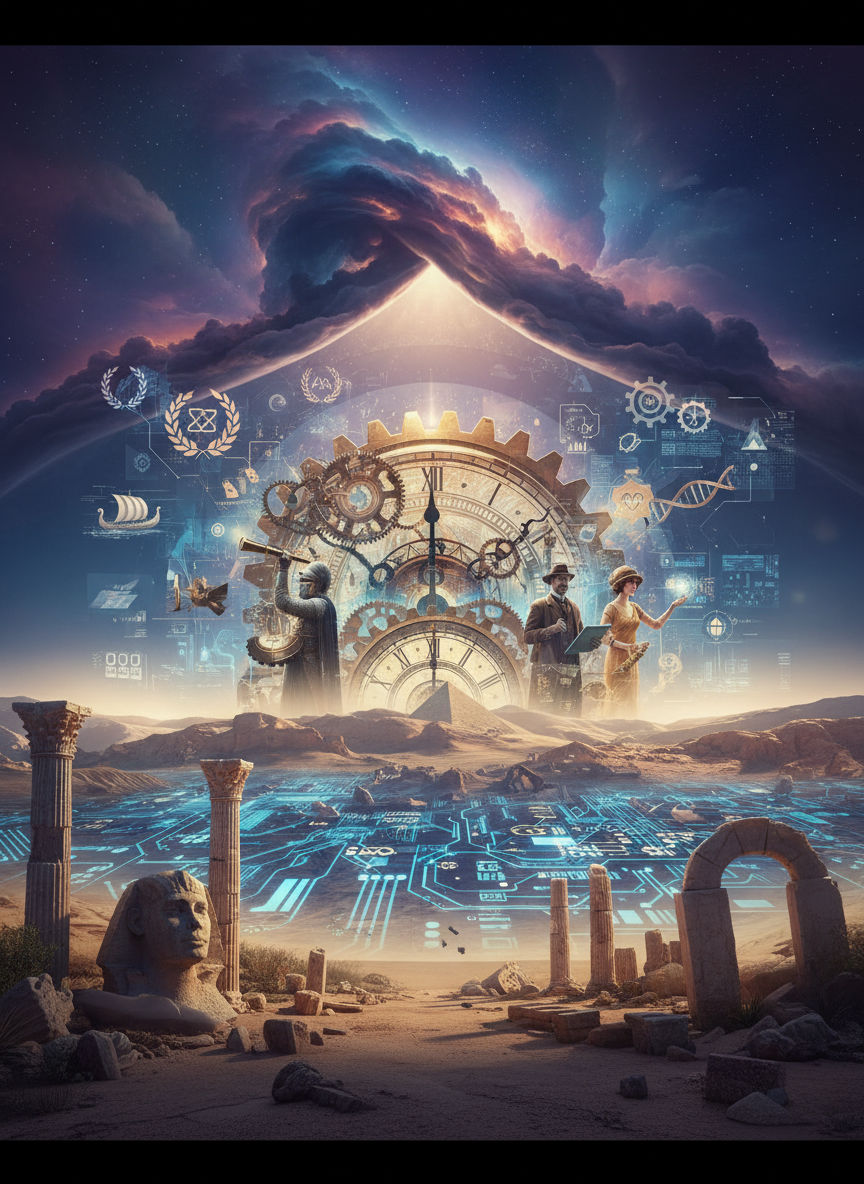
How did we go from hunting mammoths to scrolling on smartphones?
Prompted by A NerdSip Learner
Grasp the 5 biggest historical turning points.
For roughly 95% of human history, we were hunter-gatherers. We moved constantly across the landscape, following migrating animal herds and foraging for seasonal wild plants. If you think about it, it was a lifestyle of perpetual, high-stakes camping! We lived in small, tight-knit tribes and possessed only what we could carry on our backs.
Then, somewhere between 10,000 and 12,000 years ago, humanity experienced what might be its most significant turning point. We slowly figured out how to plant seeds, harvest crops, and domesticate wild animals like wolves and wild boars. This monumental shift is known by historians as the Agricultural Revolution.
Because we could suddenly grow our own food on demand, we no longer had to constantly pack up and move. Humans began building permanent structures and settling into villages. This allowed us to accumulate tools, store surplus food, have larger families, and eventually create the complex societies we know today. Farming wasn't just a new way to eat; it was the foundation of the modern world.
Key Takeaway
Inventing agriculture allowed humans to stop wandering and build permanent, complex societies.
Test Your Knowledge
Why did the Agricultural Revolution change human lifestyle so drastically?
Once the Agricultural Revolution allowed humans to produce surplus food, society changed dramatically. Because there was extra food to go around, not everyone had to spend their days farming or hunting. This extra time allowed people to specialize in entirely new skills. For the first time, we had full-time bakers, builders, priests, and warriors.
These small, permanent farming villages eventually swelled into the world's very first cities and empires. They sprouted up primarily in fertile river valleys, in places like modern-day Iraq, Egypt, India, and China, where water was abundant and crops thrived.
Living together in crowded spaces required a whole new set of rules. To keep these complex new societies organized, humans had to invent amazing conceptual tools. We created written language to keep track of trade, complex laws to maintain social order, and currency to make buying and selling easier. Civilization was officially born!
Key Takeaway
Surplus food from farming led to specialized jobs, massive cities, and the invention of writing.
Test Your Knowledge
What was a primary reason written language was invented by early civilizations?
As ancient cities and empires grew more stable, they started looking outward. Rulers and merchants quickly realized that their distant neighbors had incredible things they wanted—rare spices, luxurious silk, precious metals, and entirely new philosophies.
This strong desire for foreign goods birthed massive, sprawling trade networks. The most famous of these was the Silk Road. Contrary to its name, this wasn't a single paved highway. Instead, it was a sprawling, dangerous web of desert trails, mountain passes, and sea routes that connected Asia, the Middle East, and Europe.
The merchants traveling these routes didn't just swap physical goods; they actively traded ideas, religions, and technology. Game-changing innovations like paper, gunpowder, and advanced mathematics slowly spread across the globe. You can think of these ancient trade routes as history's first version of the internet, connecting distant cultures for the very first time.
Key Takeaway
Ancient trade routes connected distant empires, spreading not just physical goods, but crucial ideas and technologies.
Test Your Knowledge
The Silk Road is best described as what?
Fast forward to the 18th century in Europe. For thousands of years prior, almost everything humanity used was painstakingly made by hand, powered by human muscle, horses, or wind. Then came the Industrial Revolution, a period that radically altered the speed of human life.
It all started when clever inventors figured out how to use burning coal to boil water and power heavy steam engines. Suddenly, massive, tirelessly working machines could do the physical work of a hundred people in a fraction of the time. Society transitioned from weaving cloth by hand in small rural cottages to mass-producing goods in gigantic, smoking urban factories.
This mechanical shift fundamentally changed the rhythm of everyday life. Trains and steamships drastically shrank the time it took to travel the world, cities exploded in population size, and the ticking clock—rather than the rising sun—began to firmly dictate our daily schedules.
Key Takeaway
The shift to machine-powered manufacturing completely transformed how humans worked, traveled, and lived.
Test Your Knowledge
How did the Industrial Revolution change daily life?
The final massive leap in human history brings us directly to today. Starting in the mid-20th century, the global economy began shifting away from heavy industry and physical manufacturing toward one heavily based on information, computing, and digital communication.
The invention of the tiny silicon microchip meant that massive, room-sized computers could eventually shrink down to fit comfortably in our pockets. The creation of the internet meant that a person sitting in a café in Tokyo could instantly share a video, an idea, or a sum of money with a person in Toronto.
This Information Age has created a truly hyper-globalized world. While our early hunter-gatherer ancestors only knew the few dozen people in their immediate nomadic tribe, we are now constantly, instantly connected to billions of people, ideas, and historic events across the entire planet.
Key Takeaway
The Information Age connected the entire planet instantly, shifting society's focus from physical industry to digital knowledge.
Test Your Knowledge
What best characterizes the Information Age?
Track your progress, earn XP, and compete on leaderboards. Download NerdSip to start learning.