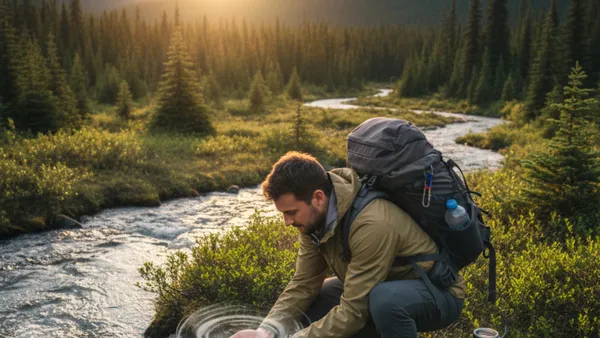
If you were lost today, would you know how to turn a mud puddle into life-saving drinking water?
Prompted by A NerdSip Learner
Master the art of finding, filtering, and purifying water in the wild without modern equipment.
In wilderness survival, there is a widely recognized 'Rule of Threes.' You might survive three weeks without food, but you will generally only last three days without water. In extreme situations, dehydration is a silent killer, sneaking up on you long before starvation becomes a serious threat.
When you are lost, your body loses water rapidly through sweat, breathing, and the biological stress of the situation. The first signs of dehydration include a dry mouth, lethargy, and a mild headache. If you wait until you are feeling extremely thirsty, your body is already in a state of dehydration.
Because finding water can take time, conserving the water you already have in your body is critical. This means actively staying out of direct sunlight, limiting your physical exertion during the hottest parts of the day, and making a conscious effort to breathe through your nose to minimize moisture lost through exhaling.
Key Takeaway
Water conservation is your first line of defense; resting in the shade and nose-breathing drastically slow dehydration.
Test Your Knowledge
What is an effective immediate strategy to conserve body water in a survival situation?
Water always obeys the laws of gravity. To find it, you need to learn how to read the landscape and head downhill. Valleys, deep ravines, and the bases of large cliffs are natural collection points for rainwater and runoff.
If the ground appears dry, look for indicator plants. Vegetation like willows, cottonwoods, and cattails require a significant amount of moisture to thrive. Spotting these green oases is an excellent sign that the water table is just beneath the surface, meaning you might be able to dig for it.
Animal behavior offers vital clues as well. Birds circling a specific spot or dense insect swarms—particularly bees and mosquitoes—rarely stray far from a water source. Furthermore, following animal tracks that converge and head downhill often leads straight to a hidden watering hole.
Key Takeaway
Follow gravity downhill and look for rich, green vegetation or insect swarms to locate hidden water sources.
Test Your Knowledge
Which of the following is considered a reliable natural indicator of nearby water?
Plants act like natural water pumps, drawing moisture from deep underground and releasing it through their leaves. You can capture this invisible moisture using a simple wilderness technique called a transpiration bag.
To do this, take a clear plastic bag and tie it tightly around a leafy, sun-exposed branch of a non-poisonous tree. As the sun heats the leaves inside the bag, they release water vapor. This vapor condenses on the cooler inside surface of the plastic and pools at the bottom for you to drink.
Another simple morning trick is collecting dew. Tie an absorbent piece of cloth, like a cotton t-shirt or bandana, around your ankles and walk through tall grass before the sun rises. Once the cloth is thoroughly soaked, you can wring the fresh water directly into your container.
Key Takeaway
You can collect clean drinking water by capturing plant vapor in a plastic bag or soaking up morning dew with clothing.
Test Your Knowledge
How does a transpiration bag collect water?
When surface water is virtually non-existent, a solar still allows you to pull moisture directly from the earth. Because it requires significant digging, you must carefully weigh the water gained against the sweat and energy spent building it.
Start by digging a hole roughly three feet wide and two feet deep in a sunny location. Place a collection container exactly in the center of the hole. Cover the entire hole with a clear plastic sheet, sealing the edges completely with heavy dirt or rocks to trap the air inside.
Place a small pebble in the center of the plastic sheet, directly over the collection container. The sun will heat the trapped air, causing soil moisture to evaporate, condense on the underside of the plastic, and drip down the slope into your cup. You can even add chopped, non-poisonous vegetation inside the hole to increase the moisture output.
Key Takeaway
A solar still uses the sun's heat to evaporate and condense soil moisture into a central collection cup.
Test Your Knowledge
Where should you place the small pebble when constructing a solar still?
Finding water is only half the battle; drinking dirty or stagnant water can cause severe gastrointestinal illness, worsening your dehydration. If you find a murky puddle, your first step is filtering out mud, debris, and some larger parasites.
You can build an improvised filter using a plastic bottle with the bottom cut off, a piece of clothing, or even a hollowed-out piece of bark. Effective filtration relies heavily on proper layering.
Start by placing a cloth or a plug of grass at the very bottom. Next, add a thick layer of crushed charcoal from your campfire—charcoal is excellent for absorbing impurities and improving taste. Above the charcoal, add a layer of fine sand, followed by coarse sand, and finally small pebbles at the top to catch the largest debris.
Key Takeaway
Layering pebbles, sand, and crushed charcoal creates a functional filter that removes dirt and absorbs impurities from stagnant water.
Test Your Knowledge
What is the primary purpose of the crushed charcoal layer in an improvised filter?
While filtering removes dirt and large particles, it does not reliably kill microscopic pathogens like bacteria and viruses. Without modern chemical tablets or UV light pens, heat remains your most reliable and absolute purifier.
Bringing water to a rolling boil is the ultimate way to make it safe to drink in the wilderness. At sea level, maintaining a rolling boil for just one minute is generally sufficient to neutralize harmful organisms.
If you lack a fireproof metal pot, you can utilize the hot rock boiling method. Heat solid, dry rocks in a fire—being careful to avoid wet river rocks, which can violently explode due to rapidly expanding trapped moisture. Once the rocks are glowing hot, carefully transfer them into a wooden bowl, a hide, or a thick plastic container filled with water until it reaches a boil.
Key Takeaway
A rolling boil is the most reliable wilderness method for killing microscopic pathogens, and hot rocks can boil water even without a pot.
Test Your Knowledge
Why is it important to avoid using rocks gathered directly from a riverbed for hot rock boiling?
Precipitation offers some of the cleanest natural water available, but it comes with its own set of wilderness rules. Rainwater can usually be collected directly in clean containers, tarps, or wide leaves and consumed without purification.
In winter environments, snow and ice are abundant, but eating them directly is a dangerous mistake. Consuming raw snow drastically lowers your core body temperature, putting you at immediate risk for hypothermia. Furthermore, your body expends precious energy melting the snow internally, which actually increases your overall dehydration.
Always melt snow or ice before consuming it. If you have limited fire fuel, prioritize melting ice over snow. Ice yields significantly more water by volume and requires less thermal energy to melt. If you have absolutely no fire, you can melt snow in a sealed container kept between your clothing layers, using your passive body heat.
Key Takeaway
Never eat raw snow; always melt it first to avoid lowering your core body temperature and risking hypothermia.
Test Your Knowledge
Why should you prioritize melting ice over snow if your campfire fuel is limited?
Track your progress, earn XP, and compete on leaderboards. Download NerdSip to start learning.