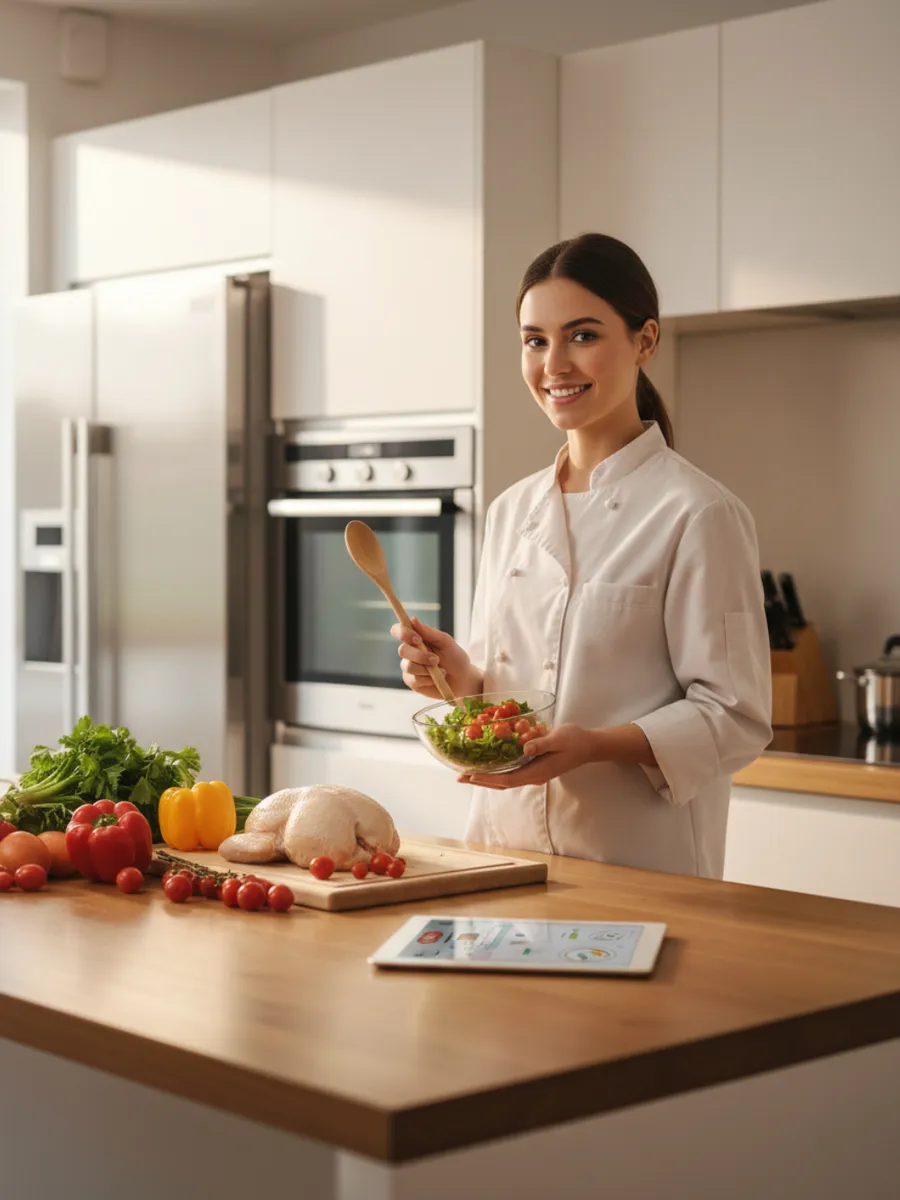
Is your kitchen just an expensive decoration for your microwave?
Prompted by A NerdSip Learner
Master 5 essential meals and chef-level knife skills today.
Welcome to the kitchen! Before we even touch a stove, we need to learn the absolute golden rule of professional chefs: *Mise en place* (meez-ahn-plahs). It sounds fancy, but it just means 'everything in its place.' Think of cooking like assembling IKEA furniture. If you're looking for the screwdriver while holding a heavy shelf, you're going to drop it.
In the kitchen, if you are frantically chopping onions while your garlic is already sizzling in the pan, that garlic will burn, and your dinner is ruined. The fix? Chop, measure, and unwrap everything before you turn on the heat. Put your ingredients in little piles or bowls. Once the heat is on, you want to be the conductor of the orchestra, not the guy running around trying to find his trumpet!
Key Takeaway
Always chop and measure all your ingredients before you turn on the stove.
Test Your Knowledge
Why should you prep all ingredients before cooking?
Knives can be intimidating, but a sharp knife is actually safer than a dull one because you don't have to force it. Let's talk about the grip. Don't hold the handle like a tennis racket with your index finger pointing out. Instead, pinch the base of the blade between your thumb and index finger. This gives you total control, like an extension of your arm.
Now, what about the hand holding the food? We call this 'The Claw.' Curl your fingertips inward so your fingernails are tucked away, and rest your knuckles against the side of the knife blade. As you chop, the knife glides against your knuckles, and your fingertips stay safe and sound. It feels weird at first, but it saves your fingers!
Key Takeaway
Pinch the blade for control and use 'The Claw' to protect your fingertips.
Test Your Knowledge
How should your non-knife hand hold the vegetable?
Think of your stove dial like the gas pedal of a car. You wouldn't drive 100mph in a parking lot, right? Beginners often make the mistake of blasting everything on 'High' to cook it faster. That usually leads to a burnt outside and a raw inside. High heat is for searing (getting that nice brown crust on a steak or veggies).
Low to Medium heat is for actually cooking the food through. If you are cooking a thick piece of chicken, you might start on medium-high to get it brown, then turn it down to low to let the heat reach the center without turning the outside into charcoal. Listen to the pan—a gentle sizzle is good; a violent pop and smoke means ease off the gas!
Key Takeaway
High heat is for browning; medium-low heat is for cooking through.
Test Your Knowledge
You have a thick chicken breast. What happens if you cook it entirely on High heat?
Ever wonder why restaurant food tastes 'poppier' than home cooking? It's usually salt and acid. Salt isn't just to make things salty; it's a flavor amplifier. Think of it like the focus ring on a camera—it makes fuzzy flavors clear. If you taste your soup and it's boring, add a pinch of salt and taste again. You'll be amazed.
But what if the food tastes 'heavy' or 'muddy'? That’s when you need Acid. A squeeze of lemon juice or a splash of vinegar cuts through fat and brightens everything up. It’s the treble to the bass of the fat. Cooking is a balancing act. Taste your food as you go! If it's dull, salt it. If it's heavy, splash some acid.
Key Takeaway
Salt amplifies flavor; Acid (lemon/vinegar) brightens and balances heavy dishes.
Test Your Knowledge
You made a creamy pasta sauce but it tastes heavy and bland. What should you add?
For your first few cooks, treat the recipe like a GPS in a strange city: follow it exactly. Don't try to improvise yet! But here is the trick 90% of beginners miss: Read the entire recipe before you start. There is nothing worse than reading step 4: 'Marinate overnight' when you wanted to eat dinner in 20 minutes.
Look for keywords. If it says 'dice,' that means small cubes. If it says 'simmer,' that means small bubbles, not a rolling boil. If you don't know a word, Google it immediately. Cooking is a language, and you are just learning the alphabet. Pick a simple recipe (like Scrambled Eggs or Pasta Aglio e Olio) and stick to the script!
Key Takeaway
Read the whole recipe start-to-finish before doing anything else.
Test Your Knowledge
What is the most common mistake beginners make with recipes?
Track your progress, earn XP, and compete on leaderboards. Download NerdSip to start learning.