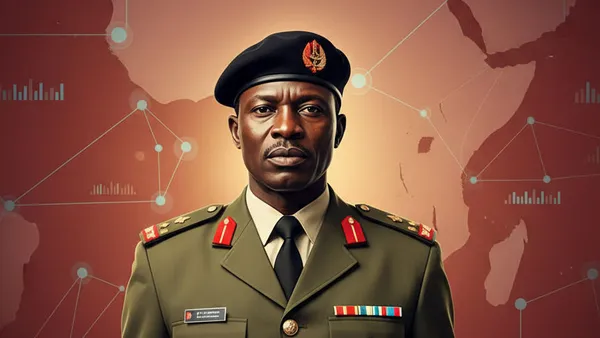
Who was the 'African Che Guevara'?
Prompted by NerdSip Explorer #6116
Discover Thomas Sankara's revolutionary legacy.
In 1983, a 33-year-old military captain named Thomas Sankara took power in the West African nation of Upper Volta following a popular uprising. Young, charismatic, and heavily inspired by Marxist and Pan-Africanist ideals, he quickly became one of the continent's most dynamic leaders.
Often referred to as the 'African Che Guevara,' Sankara didn't just want to change the government; he wanted to completely transform society. He envisioned a nation entirely free from the shadows of French colonialism and Western imperialism.
His administration immediately launched an ambitious, radical agenda. Sankara sought to dismantle traditional feudal systems, eradicate corruption, and build a self-reliant economy driven by the people themselves.
Key Takeaway
Thomas Sankara was a Marxist and Pan-Africanist who took power in 1983 to radically transform his nation.
Test Your Knowledge
What nickname is frequently given to Thomas Sankara?
One of Sankara's most deeply symbolic acts occurred on August 4, 1984, the first anniversary of his revolution. He officially changed the country's colonial name, Upper Volta, to Burkina Faso.
The new name was a powerful rejection of the nation's colonial past. In the local Mooré and Dyula languages, Burkina Faso translates to the 'Land of Upright People' (or 'Land of Honest Men').
This renaming was part of a broader effort to decolonize the nation's institutions and culture. Sankara wanted his citizens to feel a profound sense of national pride and unity, stripping away the artificial borders and identities imposed by European powers.
By reshaping the country's very identity, Sankara signaled that the Burkinabé people were no longer subjects of a foreign empire, but proud architects of their own destiny.
Key Takeaway
Sankara renamed Upper Volta to Burkina Faso to reject colonialism and inspire national pride.
Test Your Knowledge
What does the name 'Burkina Faso' translate to?
When Sankara took office, Burkina Faso faced severe public health crises, with one of the highest infant mortality rates in the world. He immediately made healthcare a top priority for his revolutionary government.
In an astonishing logistical feat, his administration launched a mass vaccination campaign. In a matter of just a few weeks, the government successfully vaccinated approximately 2.5 million children against meningitis, yellow fever, and measles.
This massive effort was praised by the World Health Organization and achieved largely without relying on foreign aid. Furthermore, his government became the first in Africa to publicly acknowledge the HIV/AIDS epidemic, recognizing it as a major threat to the continent.
During his four years in power, the infant mortality rate plummeted. Sankara proved that with political will, a mobilized population could achieve extraordinary public health victories.
Key Takeaway
Sankara’s government vaccinated 2.5 million children in weeks and was the first in Africa to officially recognize the AIDS epidemic.
Test Your Knowledge
Which of these public health achievements occurred under Sankara's leadership?
Decades before intersectional feminism became a global talking point, Thomas Sankara placed women’s liberation at the absolute center of his revolution. He famously declared that true social transformation was impossible without the active participation of women.
His government took unprecedented steps to dismantle patriarchal structures. Sankara outlawed female genital mutilation (FGM), forced marriages, and polygamy. He also mandated that girls be allowed to stay in school even if they became pregnant.
Beyond legal protections, Sankara actively brought women into the halls of power. He appointed women to high-level government positions—including crucial ministerial roles—and recruited them into the military.
He even encouraged men to go to the market and prepare meals to experience the domestic labor typically forced upon women, pushing for a fundamental shift in gender relations across Burkinabé society.
Key Takeaway
Sankara advanced women's rights by banning FGM and forced marriages, and appointing women to high government roles.
Test Your Knowledge
How did Sankara aim to change traditional gender roles in daily life?
Long before climate change became a mainstream global issue, Sankara recognized the existential threat of environmental degradation. Burkina Faso, located in the Sahel region, was severely threatened by desertification—the process by which fertile land turns into desert.
Understanding that a dying environment meant starvation for his people, Sankara launched an aggressive reforestation initiative. In just 15 months, the nation mobilized to plant over 10.5 million trees to hold back the encroaching Sahara desert.
He didn't stop there. The government banned the practice of random logging and the uncontrolled roaming of cattle, which were devastating to the fragile local ecology.
Tree planting became deeply embedded in Burkinabé culture, highly encouraged during celebrations like birthdays and weddings. Sankara’s visionary ecological policies made him one of the world’s pioneer environmentalist heads of state.
Key Takeaway
Sankara fought desertification by spearheading a campaign that planted over 10.5 million trees in 15 months.
Test Your Knowledge
Why did Sankara prioritize planting millions of trees?
A cornerstone of Sankara’s ideology was absolute economic self-reliance. He was deeply suspicious of the International Monetary Fund (IMF), the World Bank, and foreign aid, famously stating, 'He who feeds you, controls you.'
To break free from neo-colonial dependency, Sankara initiated sweeping agrarian reforms. He stripped feudal landlords of their land and redistributed it directly to the peasant farmers who worked it.
The results were staggering. By focusing on local agricultural production, promoting cooperatives, and improving irrigation, Burkina Faso almost doubled its wheat production in just a few years.
Within his short time in office, a country that had previously relied on international food handouts became essentially food self-sufficient. Sankara proved that African nations could thrive by utilizing their own resources and labor.
Key Takeaway
Through agrarian reform and refusing foreign aid, Sankara led Burkina Faso to food self-sufficiency.
Test Your Knowledge
What was Sankara's famous quote regarding foreign aid?
When Sankara took power, the vast majority of the Burkinabé population had been completely neglected by the state's educational system. The national literacy rate sat at a dismal 13%, severely limiting the country's economic potential.
Viewing education as a fundamental human right, Sankara launched a massive, nationwide literacy campaign. He mobilized teachers, students, and volunteers to travel deep into rural areas, where illiteracy was most rampant.
The government also invested heavily in building schools and expanding adult education programs, ensuring that learning was not restricted just to children.
According to historical estimates, these intense efforts yielded incredible results. The national literacy rate skyrocketed to roughly 73% by 1987. By empowering his citizens with the ability to read and write, Sankara laid the groundwork for a more engaged and capable society.
Key Takeaway
Sankara’s nationwide education campaigns drastically increased the country's literacy rate in just four years.
Test Your Knowledge
Which demographic was specifically targeted to help boost literacy rates in Burkina Faso?
Sankara despised the lavish lifestyles of typical political elites, which he viewed as an insult to the impoverished masses. To combat corruption, he implemented a culture of radical simplicity within the government.
He slashed the salaries of all public servants, including his own. As president, his salary was roughly $450 a month, and his personal possessions were famously limited to a car, a refrigerator, and a few bicycles.
He sold off the government's fleet of luxury Mercedes-Benz cars and made the Renault 5—the cheapest car available in the country at the time—the official vehicle for all state ministers.
Sankara also forbade the use of government chauffeurs and banned first-class airline tickets for public officials. By leading by example, he demanded that the state serve the people, rather than enrich the politicians.
Key Takeaway
Sankara fought government corruption by slashing elite privileges, cutting salaries, and living a remarkably modest lifestyle.
Test Your Knowledge
What vehicle did Sankara make the official car for state ministers to cut costs?
Beyond agriculture, Sankara wanted the entirety of the Burkinabé economy to directly benefit its citizens. To achieve this, he nationalized key industries, including the country's mineral wealth.
By taking control of these resources, the government ensured that profits were not extracted by foreign corporations, but were instead reinvested into national development. This funded the construction of crucial infrastructure, including railways, roads, and almost 7,500 primary health posts across the country.
In the capital city of Ouagadougou, Sankara converted an exclusive army provisioning store into a state-owned supermarket. It became the first supermarket in the country and was open to everyone, not just the military elite.
These bold economic shifts aimed to create a more egalitarian society, where national wealth was used to build up local communities rather than line the pockets of foreign investors or domestic bureaucrats.
Key Takeaway
Sankara nationalized industries and redistributed wealth to fund local infrastructure, healthcare, and public resources.
Test Your Knowledge
What did Sankara do with an exclusive army provisioning store in the capital?
Sankara's radical policies won him the fierce love of the poor, but they deeply alienated powerful vested interests. The traditional tribal leaders, the wealthy middle class, and former colonial power France all felt threatened by his revolution.
On October 15, 1987, tragedy struck. Thomas Sankara was assassinated in a violent coup d'état led by his former colleague and close friend, Blaise Compaoré. Compaoré quickly reversed many of Sankara's policies and aligned the country back with Western interests.
Just a week before his murder, Sankara famously declared, 'While revolutionaries as individuals can be murdered, you cannot kill ideas.'
Today, decades after his death, Sankara remains a potent symbol of integrity, Pan-Africanism, and anti-imperialism. His vision of a self-reliant, ecologically conscious, and egalitarian Africa continues to inspire activists and leaders around the world.
Key Takeaway
Though assassinated in 1987, Sankara's legacy as a visionary leader for African sovereignty and equality endures.
Test Your Knowledge
Who led the 1987 coup that resulted in Thomas Sankara's assassination?
Track your progress, earn XP, and compete on leaderboards. Download NerdSip to start learning.