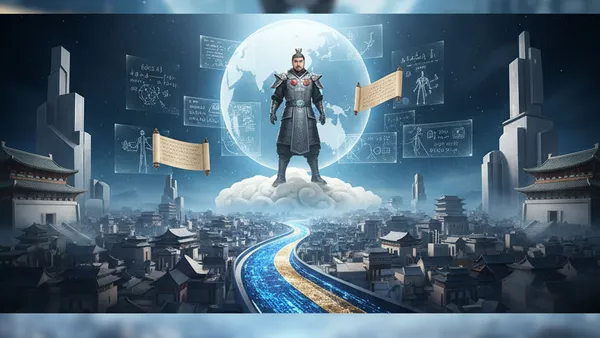
How did nomadic warriors build the world's most powerful empire?
Prompted by NerdSip Explorer #4868
Understand the Mongol era of China.
Imagine a hostile corporate takeover, but instead of business suits, the new bosses are fearsome warriors on horseback. This is exactly what happened in 13th-century China. The Mongols, a fiercely nomadic people from the northern steppes, conquered the massive territory and established a brand new era.
Instead of just plundering and destroying what they had conquered, the Mongol leader decided to create a permanent, unified Chinese dynasty. He named it the Yuan Dynasty, which translates beautifully to "origin" or "universe." This was a massive historical shift because it was the very first time that all of China was ruled entirely by non-Han Chinese foreigners.
To the everyday people living there, it was an enormous culture shock. The new rulers had completely different customs, languages, and laws. But rather than forcing everyone to become Mongols, the new leadership cleverly blended their mighty military power with traditional Chinese ways of governing to keep their incredibly wealthy, massive new prize under control.
Key Takeaway
The Yuan dynasty was established when Mongol conquerors took over China and adopted Chinese dynastic traditions to rule.
Test Your Knowledge
What was a major historical "first" achieved by the rulers of the Yuan Dynasty?
The mastermind behind the creation of the Yuan Dynasty was a man named Kublai Khan. He was the grandson of the legendary conqueror Genghis Khan, but Kublai was less interested in just burning cities and much more interested in building a lasting, highly profitable empire.
Think of Kublai as a brilliant, if sometimes ruthless, CEO who just acquired a massive, wealthy company. To effectively manage his sprawling new empire, he moved the royal capital to a city called Dadu—which you almost certainly know today as modern Beijing.
Kublai quickly realized he couldn't rule millions of settled Chinese farmers the exact same way he ruled nomadic warriors on the plains. He created a strict social hierarchy to keep his own people securely in power, placing Mongols at the very top. However, he also cleverly hired talented foreigners from the Middle East and Europe to help run the government. He was a master of using outside talent to bypass local nobles who might secretly plot against his rule.
Key Takeaway
Kublai Khan founded the Yuan Dynasty and moved his capital to Beijing, using a mix of Mongol and foreign officials to govern.
Test Your Knowledge
Where did Kublai Khan establish his new capital, which remains the capital of China today?
Have you ever ordered something online and effortlessly tracked it across the globe? The Yuan Dynasty actually created the medieval version of this global supply chain. This fascinating period in history is often called the Pax Mongolica, or "Mongol Peace."
Because the Mongol Empire was so unimaginably massive—stretching all the way from Eastern Europe right to the shores of Korea—they essentially controlled the entire ancient highway of trade known as the Silk Road. For the very first time in history, a merchant could travel thousands of miles under the unified protection of a single, highly organized empire.
This incredible peace and unprecedented stability meant that new ideas, rare spices, luxurious silk, and groundbreaking technologies flowed freely between the East and the West. It was like laying down the fiber-optic cables of the ancient world. Cultural exchange absolutely skyrocketed as merchants, monks, and bold explorers safely crossed massive continents that were previously far too dangerous to navigate alone.
Key Takeaway
The "Pax Mongolica" created a peaceful, unified Silk Road that allowed massive global trade and cultural exchange.
Test Your Knowledge
What was the main benefit of the "Pax Mongolica"?
During this incredible era of safe global travel, a young, ambitious merchant from Venice named Marco Polo made his way all the way to China. He was absolutely blown away by what he witnessed. Compared to Europe at the time, the Yuan Dynasty looked like a futuristic utopia of unimaginable wealth and advanced technology.
One of the absolute most mind-bending things Polo discovered was the everyday use of paper money. Back in Europe, merchants were still lugging around incredibly heavy, dangerous bags of silver and gold coins. But in the Yuan Dynasty, Kublai Khan had created an advanced system of lightweight, official paper currency backed entirely by the government.
Polo wrote a wildly popular book about his travels, describing massive, sparkling cities, exotic spices, and the sheer everyday magic of buying hot bread with a simple piece of paper. Many Europeans thought he was completely making it up! But Marco Polo's fascinating stories ultimately inspired entire generations of future explorers.
Key Takeaway
The Yuan Dynasty utilized paper money, amazing foreign visitors like Marco Polo who brought stories of its wealth back to Europe.
Test Your Knowledge
What economic innovation in the Yuan Dynasty completely shocked the European explorer Marco Polo?
So, if the Yuan Dynasty was truly so incredibly wealthy and culturally powerful, why did it fall apart less than a century later? Like many massive empires throughout history, it ultimately collapsed from a devastating mix of bad luck and very bad management.
First came a crippling financial crisis. The government started aggressively printing way too much of that brilliant paper money to pay for severely failed military campaigns, which inevitably led to massive inflation. The money quickly became absolutely worthless, cruelly wiping out people's life savings.
Then came a deeply devastating series of natural disasters, including severe, deadly floods along the Yellow River and outbreaks of plague. The starving, desperate citizens began to deeply believe the Mongol rulers had completely lost the "Mandate of Heaven"—the traditional divine right to rule over China. Desperate and furious, the everyday common people rose up in massive, unstoppable rebellions, eventually pushing the Mongols entirely out of China and proudly paving the way for the famous Ming Dynasty.
Key Takeaway
The Yuan Dynasty collapsed due to terrible hyperinflation, devastating natural disasters, and massive peasant rebellions.
Test Your Knowledge
What major economic mistake heavily contributed to the downfall of the Yuan Dynasty?
Track your progress, earn XP, and compete on leaderboards. Download NerdSip to start learning.