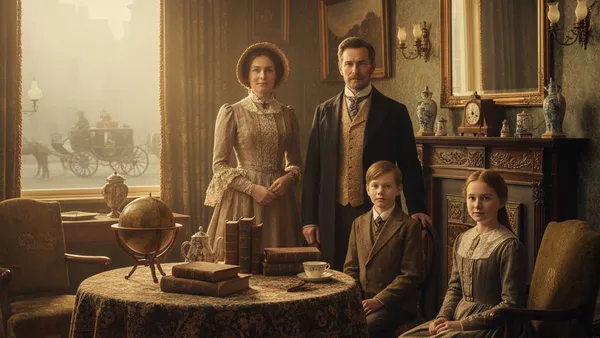
How did early Victorians invent commutes, weekends, and living rooms?
Prompted by A NerdSip Learner
Understand how early Victorians created the modern middle-class lifestyle.
Before the 1800s, British society was mostly divided into two groups: the wealthy aristocrats who owned massive estates, and the poor laborers who worked the land. But the Industrial Revolution changed everything! Factories, railways, and global trade created a massive new opportunity for making money.
Suddenly, doctors, factory owners, bankers, and clerks were becoming wealthy. They weren't born into royalty, but they didn't work with their hands in the dirt either. They sat right in the middle—hence the middle class.
Think of them as the original "new money." Because they didn't have fancy titles to prove their worth, they had to prove it another way: through incredibly strict rules about how to dress, act, and live. They wanted the world to know they had truly made it!
Key Takeaway
The early Victorian middle class gained their wealth through new industries and professions, rather than royal birth.
Test Your Knowledge
Why did the middle class grow so quickly during the early Victorian period?
Today, leaving your house to go to an office feels completely normal. But before the Victorian era, most people lived exactly where they worked! A shopkeeper lived above their shop, and a farmer lived on their farm.
The new Victorian middle class wanted to escape the smoke, noise, and smell of the crowded city centers. Thanks to new railways and horse-drawn buses, they could finally afford to build houses on the greener edges of the city. We call these areas the suburbs.
This created a brand-new concept: the commute. For the first time in history, the "home" and the "workplace" became two completely separate locations. The home was no longer a place of business; it became a quiet, private sanctuary away from the stress of the city.
Key Takeaway
The middle class separated work from home, leading to the creation of suburbs and the daily commute.
Test Your Knowledge
What new daily habit was created by the middle class moving to the suburbs?
Because work and home were now in different physical locations, Victorians developed a famous idea called "Separate Spheres." This was the deep belief that men and women were naturally meant to exist in completely different worlds.
The man's sphere was the public world. It was loud, competitive, and dirty. It included business, politics, and money-making. Victorians believed men were naturally tough enough to handle this chaotic environment.
The woman's sphere was the private world of the home. It was meant to be peaceful, beautiful, and highly organized. A man was supposed to battle all day in the tough public sphere, then return to his quiet home to recharge.
This division became the golden rule of middle-class life. To cross into the wrong sphere was seen as highly improper!
Key Takeaway
Victorians believed men belonged in the competitive public world, and women belonged in the peaceful private home.
Test Your Knowledge
In the Victorian idea of 'Separate Spheres', what did the man's world consist of?
If the home was a peaceful sanctuary, then the woman in charge of it was seen as almost magical. The Victorians actually had a famous nickname for the perfect middle-class wife: the "Angel in the House."
Her job wasn't just to make sure the house was clean. Her main duty was to be the moral compass for her family. Victorians believed women were naturally more pure, gentle, and religious than men.
By creating a warm, highly moral environment, the wife protected her husband from being corrupted by the greedy business world. She also ensured her children grew up with perfect manners and good values.
While it sounds like a compliment, this standard was impossible to live up to. Women were expected to be completely self-sacrificing, always putting their husband's and children's needs before their own.
Key Takeaway
The ideal Victorian middle-class woman was expected to be a pure, self-sacrificing moral guide for her family.
Test Your Knowledge
What was the main duty of the 'Angel in the House'?
How did you prove to your neighbors that you were officially part of the middle class? You didn't buy a flashy car. Instead, you hired a domestic servant.
Keeping at least one servant—usually a young woman called a "maid-of-all-work"—was the absolute minimum requirement to be considered middle class. If the wife had to scrub her own floors or wash her own laundry, the family risked being seen as working class.
These servants did incredibly backbreaking work. They woke up before dawn to light the heavy coal fires, hauled buckets of hot water up the stairs, and cooked the meals.
Having servants wasn't just about avoiding chores; it was about appearances. The middle-class wife was supposed to look like she effortlessly glided through the day. The messy, sweaty work of running a house had to be hidden behind the scenes!
Key Takeaway
Hiring at least one servant was the mandatory status symbol that proved a family was truly middle class.
Test Your Knowledge
Why was having a servant so important to the middle class?
Because the middle class didn't have noble titles like Dukes or Earls, they needed a different way to prove they were "better" than the poor. Their secret weapon was Respectability.
Being respectable meant following incredibly strict rules of behavior. It meant going to church every single Sunday, rarely drinking alcohol, and absolutely never causing a public scene.
Honesty, hard work, and good manners were prized above all else. Victorians strongly believed in self-improvement. They thought that if you were poor, it was probably because you lacked discipline or morals. If you were wealthy, it was seen as a reward for your good character.
This pressure to look perfectly moral meant that keeping up appearances was exhausting. Scandals, debt, or bad behavior had to be hidden at all costs to protect the family's respectable name.
Key Takeaway
'Respectability' was a strict code of good morals and hard work that the middle class used to prove their worth.
Test Your Knowledge
What did the Victorian middle class believe was the main reason for a person's success?
The easiest way to show off your new respectability was through your furniture. Middle-class Victorian homes were famously stuffed with objects.
The most important room was the parlor (what we might call a living room). This was the room where guests were entertained, so it was essentially a showroom for the family's wealth.
Victorians loved heavy mahogany furniture, thick velvet curtains, boldly patterned wallpapers, and massive pianos. Every flat surface was covered with framed photos, clocks, and little statues called knick-knacks.
To our modern eyes, it would look incredibly cluttered and dark. But to an early Victorian, an empty space meant you were too poor to buy things! A crowded room proved you were a successful, modern consumer who could afford nice things.
Key Takeaway
Middle-class Victorians filled their front rooms with heavy furniture and decorations to display their financial success.
Test Your Knowledge
Why did Victorian middle-class families put so much furniture and decorations in their parlors?
Despite all the velvet curtains and servants, the early Victorian middle class lived with a dark, hidden terror: the fear of falling.
Unlike the aristocrats who inherited huge fortunes that lasted generations, middle-class families relied entirely on the father's paycheck or business profits. There was no government safety net—no unemployment benefits, and no free healthcare.
If the father got sick, or if his business went bankrupt, the family could lose everything in an instant. They would have to fire their servants, sell their beautiful furniture, and move into a slum.
Going into debt was seen as a massive moral failure, not just bad luck. Because of this deep financial insecurity, middle-class fathers worked obsessively, and mothers were highly stressed about managing the household budget perfectly.
Key Takeaway
Because they lacked inherited wealth, the middle class lived in constant fear of bankruptcy and losing their social status.
Test Your Knowledge
What was the greatest hidden fear of the Victorian middle class?
Life in the Victorian middle class was like playing a giant board game where the rules were incredibly complicated. We call these rules etiquette.
Socializing was strictly controlled. For example, you couldn't just knock on a neighbor's door! You had to leave a small printed "calling card" with the servant. If the neighbor left a card in return, it meant they accepted your friendship.
The ultimate test of etiquette was the dinner party. These were massive, expensive meals with multiple courses that lasted for hours. There were strict rules about who you walked into the dining room with, which fork you used, and what topics were polite to discuss.
These events weren't really about having fun. They were high-pressure tests to prove to your peers that you knew the unwritten rules of polite society.
Key Takeaway
Complex rules of etiquette, like calling cards and formal dinner parties, were used to test if someone truly belonged in the middle class.
Test Your Knowledge
What was the main purpose of a formal Victorian dinner party?
Despite all the strict rules and hard work, the Victorians actually gave us the modern concept of leisure time.
As the middle class became wealthier and their work hours became more predictable, they suddenly had a few hours a week to simply relax. They essentially helped invent the concept of the "weekend."
Because the home was so highly valued, most leisure was focused on the family. Evenings were spent gathered around the piano singing songs, playing card games, or reading novels out loud together.
They also loved improving their minds. They took up hobbies like collecting ferns, pressing flowers, or visiting new museums. Later in the era, taking a train to the seaside for a family holiday became the ultimate middle-class treat!
Key Takeaway
The middle class pioneered modern leisure time, focusing on family activities, hobbies, and seaside holidays.
Test Your Knowledge
How did middle-class Victorians prefer to spend their new leisure time?
Track your progress, earn XP, and compete on leaderboards. Download NerdSip to start learning.