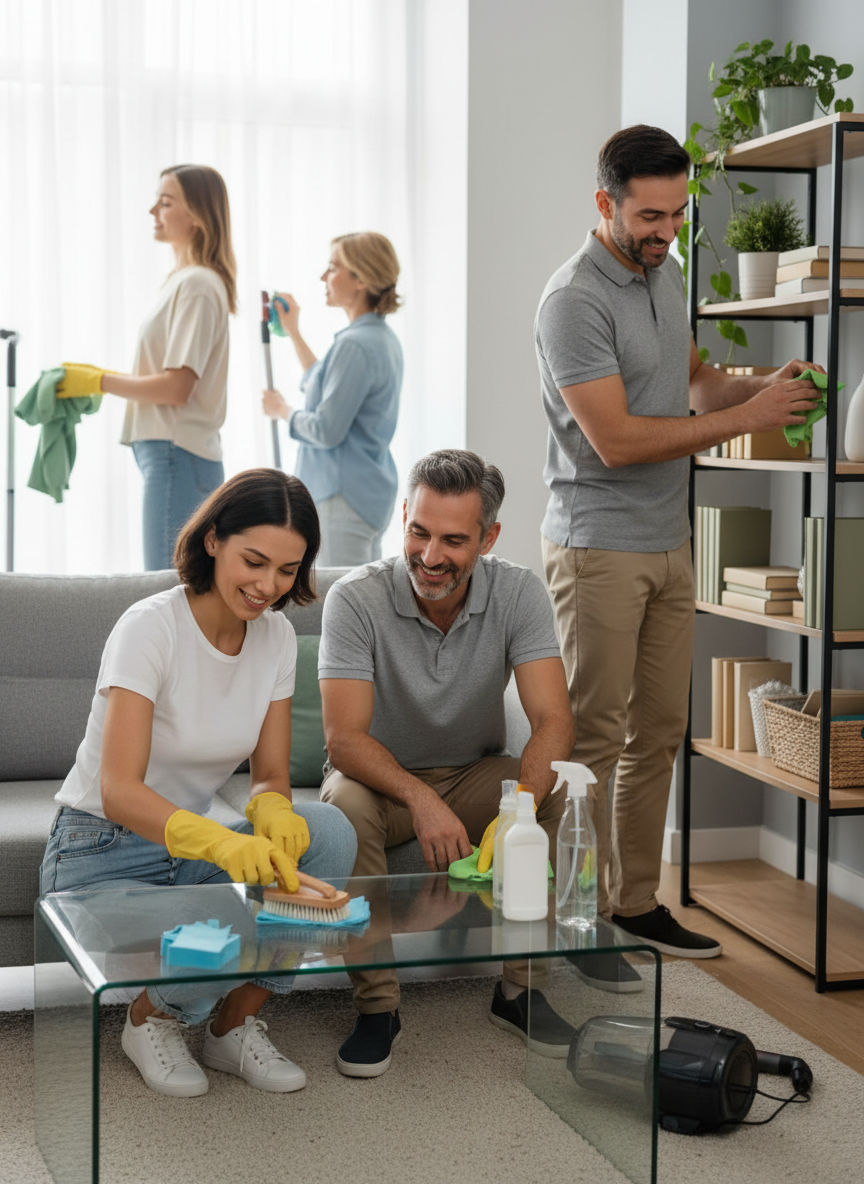
Why does cleaning sometimes feel like you’re just moving dirt around?
Prompted by A NerdSip Learner
Clean your entire home in half the time.
Ever feel like your floors get dirty again immediately after cleaning? The secret is simple: work with gravity, not against it. Professional cleaners always use the top-to-bottom method. If you clean the floors first and then dust your ceiling fan, all that dust falls right back onto your clean floor!
To be even more efficient, add the left-to-right rule. Pick a starting point in any room and move in a consistent circle. This prevents 'darting around'—that habit of cleaning one spot, seeing another, and losing track of where you've been.
Finally, remember to dry before wet. Use a duster or dry cloth to remove loose debris before you spray any liquid. If you spray a dusty surface immediately, you just create 'cleaning mud,' which is much harder to wipe away.
Key Takeaway
Always clean from the highest point to the lowest point to avoid re-dirtying your surfaces.
Test Your Knowledge
What is the most efficient direction to clean a room?
You don't need a cabinet full of fifty different chemicals. For 90% of your home, you only need three things: an all-purpose cleaner, a disinfectant, and a glass cleaner. Your best friend is the microfiber cloth—it's scientifically designed to trap dirt rather than just pushing it around like paper towels.
However, safety is priority number one. Never mix cleaning chemicals. Specifically, never mix bleach with vinegar or ammonia. This can create toxic gases that are dangerous to breathe. If you aren't sure what's in a bottle, don't mix it with anything else!
Keep your tools organized in a small caddy or bucket. Being able to carry your supplies from room to room saves you from constant trips back to the kitchen, keeping your momentum high and your frustration low.
Key Takeaway
Microfiber cloths are the best cleaning tool, and you should never mix different cleaning chemicals together.
Test Your Knowledge
Why is it dangerous to mix bleach with ammonia or vinegar?
Most people spray a surface and immediately wipe it off. This is a mistake! To clean like a pro, you need to use dwell time. This is the 5-10 minutes you let a cleaning product sit on a surface so the chemistry can break down grease, soap scum, and bacteria for you.
In the kitchen, spray your stovetop and counters first, then walk away to empty the dishwasher or take out the trash. When you come back, the grime will wipe away with almost zero scrubbing. This works even better in the bathroom on tough shower tile.
Don't forget the high-touch zones. These are items you touch dozens of times a day but rarely clean, like fridge handles, light switches, and doorknobs. A quick wipe with disinfectant here goes a long way in keeping your home healthy.
Key Takeaway
Let cleaning products sit for a few minutes to let the chemicals do the hard work for you.
Test Your Knowledge
What does 'dwell time' refer to in cleaning?
Mirrors and windows are the 'jewelry' of your home. If they sparkle, the whole room feels cleaner. To avoid those annoying streaks, use the 'Z' pattern. Start at the top left, wipe across to the right, then zig-zag down the surface. This ensures you cover every inch without overlapping too much.
Avoid using too much product. Most people over-spray, which leads to drips and residue. A light mist is all you need. If you're still seeing streaks, it might be your cloth. Always use a fresh, dry microfiber cloth for the final buff.
Pro tip: Avoid cleaning windows on a very sunny day. The sun dries the cleaner too quickly, which is the main cause of those stubborn white streaks. Save the windows for an overcast day or when the glass is in the shade.
Key Takeaway
Use a 'Z' pattern and minimal spray to get streak-free mirrors and windows.
Test Your Knowledge
Which wiping pattern is best for mirrors?
The hardest part of cleaning is 'the catch-up.' If you wait until the house is a disaster, it feels overwhelming. The solution is the 10-minute tidy. Set a timer every evening to clear surfaces, fluff pillows, and put away stray items. This prevents 'clutter creep.'
Adopt the one-touch rule: if you pick something up, put it exactly where it belongs right then. Don't set it on the counter 'for now.' Those 'for now' items quickly turn into 'for forever' piles.
Focus on high-impact areas. If your bed is made and your kitchen sink is empty, your brain perceives the house as much cleaner. Consistency is the secret to never having to spend your entire Saturday cleaning again!
Key Takeaway
Small daily habits and the 'one-touch rule' prevent messes from becoming overwhelming.
Test Your Knowledge
What is the 'one-touch rule'?
Track your progress, earn XP, and compete on leaderboards. Download NerdSip to start learning.