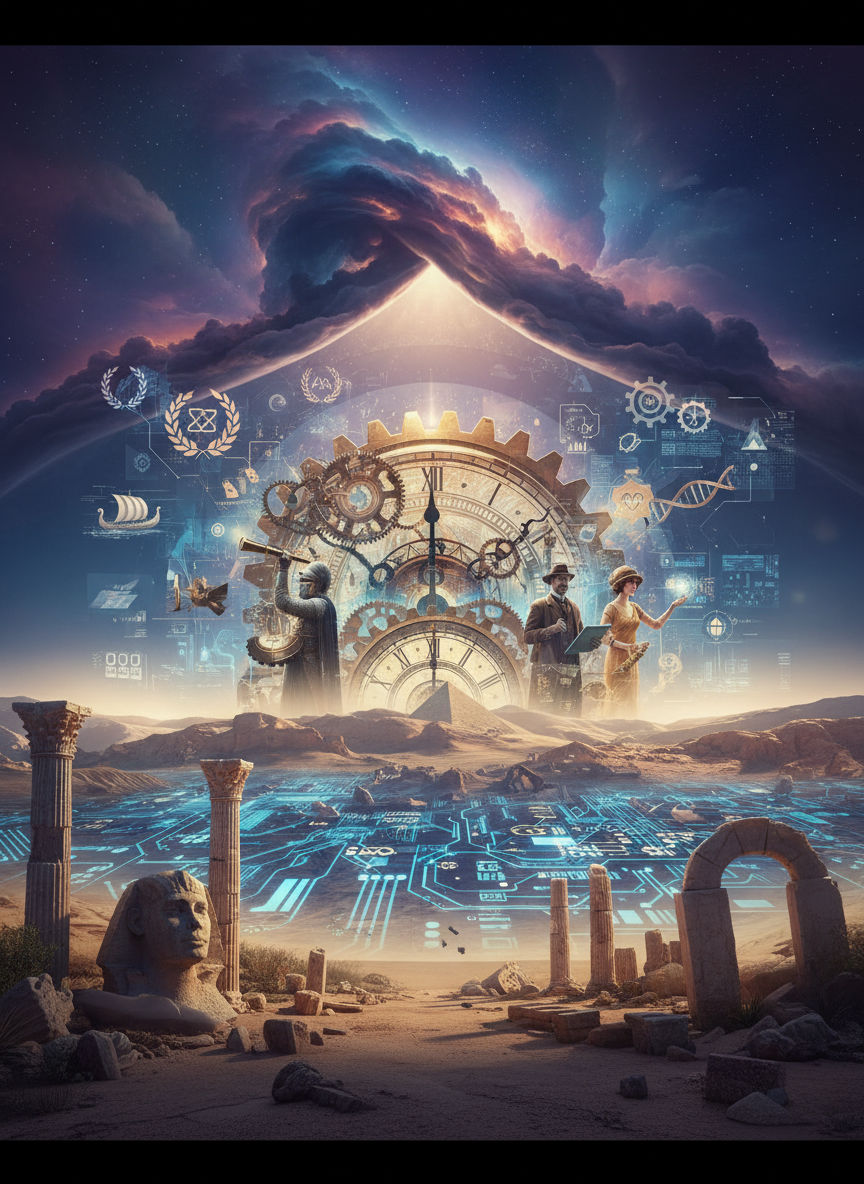
How did humanity go from campfires to smartphones?
Prompted by NerdSip Explorer #9790
Grasp the 5 eras of human history.
Imagine packing up your entire life every few weeks. For the vast majority of human history, this is exactly what we did! Early humans were hunter-gatherers, constantly on the move to follow animal herds and seasonal plants.
We didn't have permanent homes, kings, or money. Instead, we lived in small, tight-knit family groups. Survival depended entirely on teamwork, understanding nature, and sharing whatever food was found. This incredible era spanned hundreds of thousands of years, making up over 90% of our human story!
The ultimate game-changer during this time was the mastery of fire. Fire wasn't just a tool for warmth; it allowed us to cook meat, which gave our brains the massive burst of calories needed to grow and evolve. It also created the very first social gathering spot—the campfire!
Key Takeaway
Early humans lived as nomadic hunter-gatherers, using teamwork and fire to survive and evolve.
Test Your Knowledge
What was the main reason early humans were constantly moving?
Around 12,000 years ago, humanity made the biggest lifestyle change in its history. We stopped chasing our dinner and started growing it! This shift is known as the Agricultural Revolution.
Instead of roaming, humans discovered how to plant seeds and domesticate wild animals like sheep and cows. Imagine the relief of knowing exactly where your next meal was coming from. Because crops needed constant care, people finally had a reason to stay in one place. Tents were replaced by sturdy houses, and nomadic bands turned into the very first villages.
Farming created a magical thing called a surplus—having more food than you need to survive. Because not everyone had to spend all day looking for food, people could specialize. Some became potters, others became toolmakers, and human innovation suddenly skyrocketed!
Key Takeaway
Discovering agriculture allowed humans to settle down, creating food surpluses that sparked new inventions.
Test Your Knowledge
What did a "surplus" of food allow early villagers to do?
As villages grew into massive cities, life got a lot more complicated. Imagine trying to organize thousands of people without cell phones or rules! To keep order, humanity invented government and writing.
In places like ancient Mesopotamia, Egypt, and China, powerful leaders emerged to manage resources and build massive projects like pyramids and protective walls. We call these huge, organized societies Empires. These ancient metropolises were bustling hubs of activity, filled with markets, temples, and diverse groups of people living side-by-side.
To keep track of taxes and trade, we had to invent written language. Writing changed everything! For the first time, ideas, laws, and stories could be saved and passed down to future generations without relying purely on memory. History was officially being recorded.
Key Takeaway
As populations grew, humans invented writing and government to organize massive cities and empires.
Test Your Knowledge
Why was writing initially invented in early cities?
Fast forward a few thousand years, and the world started getting smaller. Empires weren't just fighting each other; they were trading! Famous routes like the Silk Road connected East and West, acting like a slow-motion ancient internet.
Traders didn't just exchange spices, silk, and gold; they exchanged ideas, math, and technology. This mixing of cultures paved the way for the Renaissance—a massive "rebirth" of art, science, and curiosity in Europe that pulled society out of the slower periods of the Middle Ages.
During this era, inventions like the printing press made books cheap and accessible. Suddenly, knowledge wasn't just for wealthy kings or monks. Everyday people could learn to read, sparking global exploration and proving that when cultures collaborate, human progress accelerates!
Key Takeaway
Global trade routes shared goods and ideas, leading to an explosion of art, science, and accessible knowledge.
Test Your Knowledge
What was the most important result of inventions like the printing press?
For almost all of human history, everything was powered by muscle—either human or animal. But in the 18th century, we learned how to unlock the hidden energy inside coal. Welcome to the Industrial Revolution!
Inventors created powerful steam engines that could do the work of a hundred horses. Factories popped up, producing goods faster and cheaper than ever before. People flocked from peaceful country farms into bustling, smoky cities to find factory jobs. Suddenly, a journey that used to take agonizing months by horse could be completed in just a few days by train.
This rapid shift changed exactly how we live today. It gave us electricity, modern medicine, and eventually the internet! It connected the world at lightning speed, creating the modern, fast-paced life we now consider completely normal.
Key Takeaway
The invention of machines powered by fossil fuels transformed human life from farming-based to modern and fast-paced.
Test Your Knowledge
What was the main source of power before the Industrial Revolution?
Track your progress, earn XP, and compete on leaderboards. Download NerdSip to start learning.