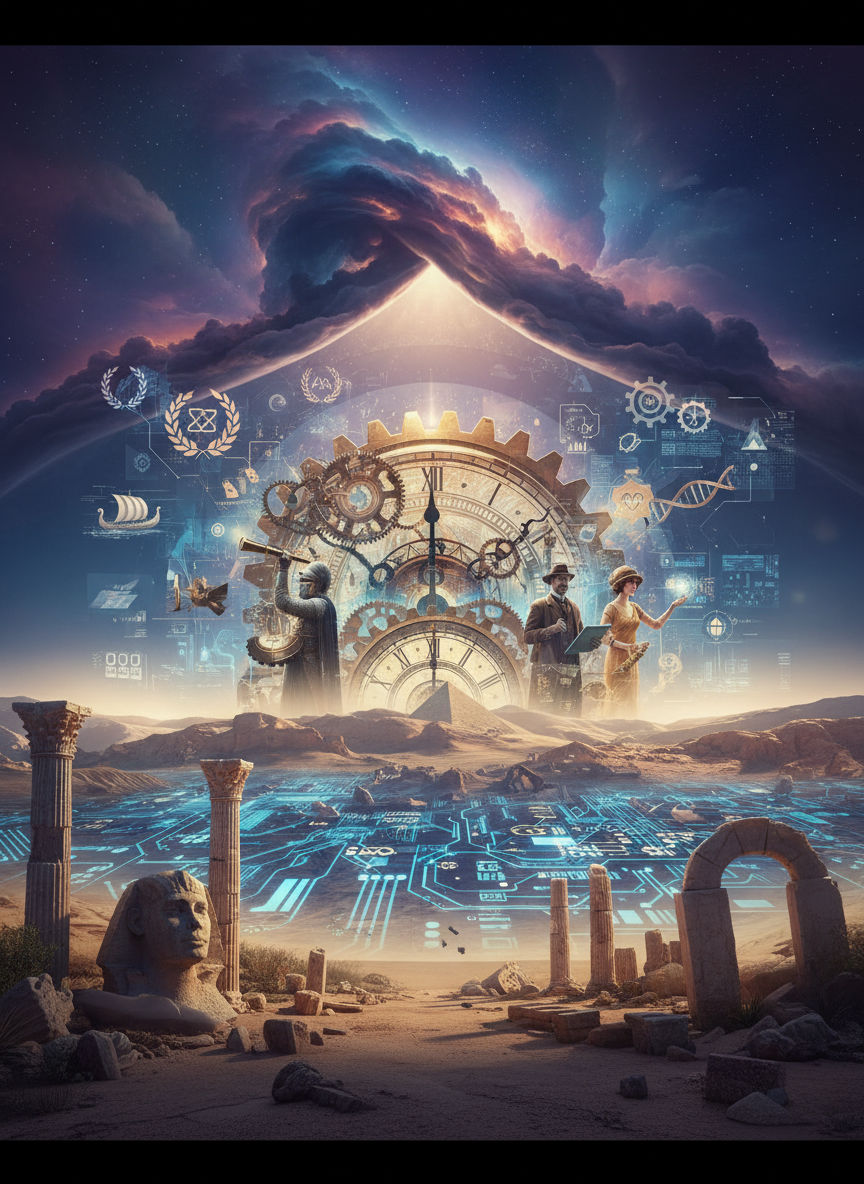
How did we get from cavemen to smartphones?
Prompted by A NerdSip Learner
Understand the big picture of human history.
Imagine our human story as a massive, 1,000-page book. Believe it or not, the first 990 pages are completely dedicated to us living as hunter-gatherers! For hundreds of thousands of years, early humans were constantly on the move, mastering the wild.
These ancient ancestors didn't have permanent homes or cities. Instead, they survived by hunting wild animals, fishing, and gathering fruits, nuts, and roots. This lifestyle meant they had to live in small, tight-knit groups, packing light and migrating wherever the food was plentiful.
During this incredibly long and challenging period, humans slowly spread out from Africa, populating almost every corner of the globe. They mastered the use of fire, created complex spoken languages, and engineered the very first tools out of stone and wood.
Even though they didn't leave behind written records or massive stone ruins, these early pioneers laid the ultimate foundation for everything that followed. They proved that humans are the ultimate adapters, capable of surviving anywhere from freezing ice ages to scorching deserts.
Key Takeaway
For the vast majority of our history, humans survived as nomadic hunter-gatherers, slowly spreading across the globe.
Test Your Knowledge
Why didn't early hunter-gatherers build permanent towns or cities?
Around 10,000 years ago, humanity made the biggest upgrade in its history. Someone, somewhere, realized: "What if we plant the seeds instead of endlessly searching for them?" This single thought sparked the Agricultural Revolution.
Instead of chasing herds of wild animals, humans learned to tame them—a process called domestication. They also started planting dependable crops like wheat, corn, and rice. Because they had to wait for these crops to grow and harvest them, they stopped moving around and built the very first permanent villages.
For the first time ever, humans produced a surplus of food. This was a total game-changer because it meant not everyone had to be a farmer. People could finally specialize in other jobs, becoming dedicated toolmakers, builders, and eventually leaders.
These small farming villages slowly grew into larger towns, and then eventually into the world's very first cities. Farming completely rewired human society, providing the stable food supply needed to build civilization as we know it today.
Key Takeaway
Learning to farm and domesticate animals allowed humans to settle down, creating a food surplus that led to the first cities.
Test Your Knowledge
What was the most important result of humans creating a "food surplus"?
As early cities grew larger and wealthier, powerful leaders emerged and began conquering their neighbors. This ambition birthed the Age of Empires. Think of legendary civilizations like ancient Egypt, the Roman Empire, or the Han Dynasty in China.
Managing millions of people across vast territories was a massive challenge. To keep order, empires had to invent some of the most important administrative tools we still use today. They created the first written languages primarily to keep track of taxes and trade, and they wrote down organized codes of law.
Empires also built mind-blowing infrastructure. They constructed thousands of miles of paved roads, huge defensive walls, and complex aqueducts to bring fresh running water into crowded, bustling cities.
While these empires were often built on harsh conquest and extreme inequality, they also created long periods of stability within their borders. This peace allowed art, deep philosophy, and early science to flourish, leaving behind breathtaking ruins that still inspire us to this day.
Key Takeaway
Early empires invented writing, laws, and massive infrastructure to manage their large and complex societies.
Test Your Knowledge
According to the lesson, what was the original primary purpose of inventing written languages?
For a long time, the world's great empires were mostly isolated from each other in their own bubbles. But eventually, people started to boldly explore. They created massive, winding trade networks, like the famous Silk Road, which connected Europe, the Middle East, and Asia.
Merchants traveling these dusty roads didn't just carry physical luxury goods like silk, spices, and gold. As they traveled, they acted like an ancient version of the internet. They shared new ideas, groundbreaking inventions, and compelling stories. The mathematical concept of zero, the invention of paper, and major world religions all spread along these very routes.
However, this newfound connection had a dark side, too. Just as ideas traveled easily, so did deadly diseases. The most famous example is the Black Death, a plague that swept along trade routes and devastated populations across multiple continents.
Despite the massive risks, this era of exploration changed the world forever. It transformed isolated pockets of humanity into a truly interconnected global web.
Key Takeaway
Ancient trade routes connected isolated empires, allowing for the exchange of goods, ideas, technology, and diseases.
Test Your Knowledge
How were ancient merchants similar to the modern internet?
If the whole of human history is a timeline, the last 300 years are just a tiny fraction of a millimeter at the very end. Yet, this is when almost everything we consider "normal" was invented. This sudden sprint forward started with the Industrial Revolution.
Humans discovered how to use fossil fuels, like coal and oil, to power massive machines. Instead of making clothes or tools slowly by hand, gigantic factories began churning them out by the thousands. Steamboats and steam trains replaced horses and sailboats, drastically shrinking the world.
Following the machines came the rapid Technological Revolution. In just a few generations, we harnessed electricity, discovered modern medicine to double human lifespans, walked on the moon, and invented the internet.
Today, we live in an era of unprecedented speed and connection. By looking back at how we got here—from hunting in the wild to scrolling on smartphones—we can better understand exactly who we are, and decide where humanity should go next.
Key Takeaway
The Industrial and Technological Revolutions rapidly transformed society from handmade goods to an interconnected, high-speed modern world.
Test Your Knowledge
What major shift defined the start of the Industrial Revolution?
Track your progress, earn XP, and compete on leaderboards. Download NerdSip to start learning.