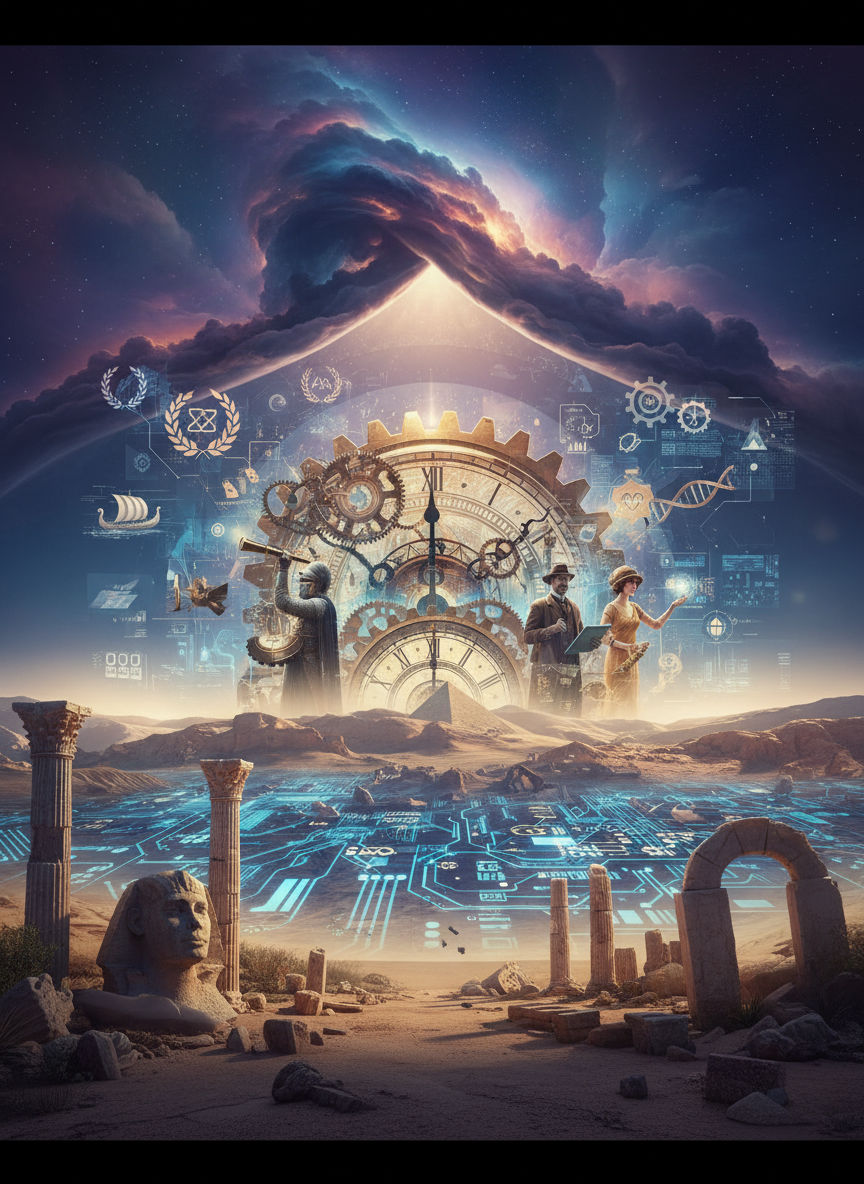
How did we go from hunting in the wild to building spaceships?
Prompted by NerdSip Explorer #4456
Master the 5 turning points of human history.
Start the clock around 300,000 years ago. Homo sapiens—our species—emerged in Africa. We weren't the strongest, biggest, or fastest animals on the savanna, but we had a secret superpower: cooperation and communication.
For over 90% of human existence, we lived as hunter-gatherers. Picture this era like an endless, high-stakes camping trip. We moved around constantly in small tribes, following animal herds and seasonal plant cycles just to survive. We didn't build permanent houses or hoard wealth.
Then, around 70,000 years ago, a massive shift occurred, often called the Cognitive Revolution. We started creating complex tools, intricate art, and shared stories. This newfound ability to share complex ideas and myths allowed humans to cooperate in much larger numbers. It was this communication network that allowed early humans to spread out of Africa and adapt to every environment across the globe, setting the stage for all of human history.
Key Takeaway
Early humans survived and dominated the globe because of their unique ability to communicate and cooperate in large groups.
Test Your Knowledge
What was the 'superpower' that allowed early humans to survive and spread across the globe?
For tens of thousands of years, humans never stayed in one place for long. Then, roughly 10,000 to 12,000 years ago, everything completely transformed due to the Agricultural Revolution. Instead of constantly chasing our food, we finally figured out how to grow it.
Imagine going from living out of a backpack to finally putting down roots and building a permanent house. By planting crops like wheat and domesticating animals like sheep, pigs, and cows, humans created a reliable food surplus. We suddenly had more calories than we could eat in a single day.
This surplus meant we could finally settle down. These permanent settlements grew into small villages, which eventually blossomed into bustling towns. Because not everyone had to spend their entire day hunting or foraging, some people could become specialists—like toolmakers, builders, or leaders. This single shift birthed human society as we recognize it today.
Key Takeaway
Farming created a reliable food surplus, allowing humans to stop wandering, build permanent settlements, and develop specialized jobs.
Test Your Knowledge
What was the major result of the Agricultural Revolution?
Once people settled down and populations exploded, life became much more complicated. How do you keep track of who owns which sheep, or who paid their taxes? The solution was one of humanity's greatest inventions: writing.
Around 5,000 years ago, early civilizations in places like Mesopotamia and Egypt started using physical symbols to record information. Writing was an absolute game-changer. It allowed leaders to write down laws, organize large armies, and manage massive groups of people who had never even met.
With this new level of organization, villages expanded into massive cities, and ambitious leaders began conquering their neighbors to form sprawling empires. Think of an empire as a giant political umbrella, bringing different cultures, languages, and lands under one central government. These empires built incredible roads, monumental pyramids, and writing systems that laid the foundation for the modern nation-states we live in today.
Key Takeaway
The invention of writing allowed human societies to organize on a massive scale, leading to the creation of cities and empires.
Test Your Knowledge
Why was the invention of writing so crucial for early civilizations?
For a long time, different parts of the world developed in total isolation. But eventually, people wanted exotic things they couldn't find in their own backyards. This desire birthed massive trade routes, like the famous Silk Road, which linked Asia, the Middle East, and Europe.
Trade wasn't just about moving silk, spicy seasonings, or gold. It was a massive, continuous exchange of ideas, technologies, and even diseases. Imagine these ancient trade routes as an early version of the internet, physically connecting distant cultures and spreading innovations like paper and gunpowder.
Later, starting in the 1400s, European explorers took to the oceans to find faster routes to Asia. This 'Age of Discovery' permanently connected the Eastern and Western hemispheres. It kicked off an era of globalization where money, new crops like potatoes, and people began moving across the entire planet, forever changing the trajectory of human history.
Key Takeaway
Global trade routes connected isolated civilizations, sparking a massive exchange of goods, ideas, technologies, and cultures.
Test Your Knowledge
Aside from physical goods like silk and gold, what else was heavily exchanged along early trade routes?
Fast forward to the mid-1700s. For centuries, almost everything was made slowly by human hands, and most energy came from human or animal muscle. Then came the incredible Industrial Revolution.
Humans finally learned how to harness fossil fuels, like coal, to power massive machines. Picture replacing a slow, horse-drawn cart with a roaring, steam-powered locomotive; the sudden leap in speed and raw power was truly unimaginable. Factories quickly replaced small home workshops, and people flocked from quiet farms to crowded cities looking for factory work.
This era shifted our entire way of life, forcing us to live by the mechanical clock rather than the sun. It brought incredible technological advancements, leading straight to our modern world of electricity, airplanes, and computers. However, it also introduced massive new challenges, including harsh labor conditions and severe, lasting impacts on our natural environment.
Key Takeaway
The Industrial Revolution shifted humanity from muscle power to machine power, rapidly modernizing the world while creating new societal and environmental challenges.
Test Your Knowledge
What was the major shift in energy use during the Industrial Revolution?
Track your progress, earn XP, and compete on leaderboards. Download NerdSip to start learning.