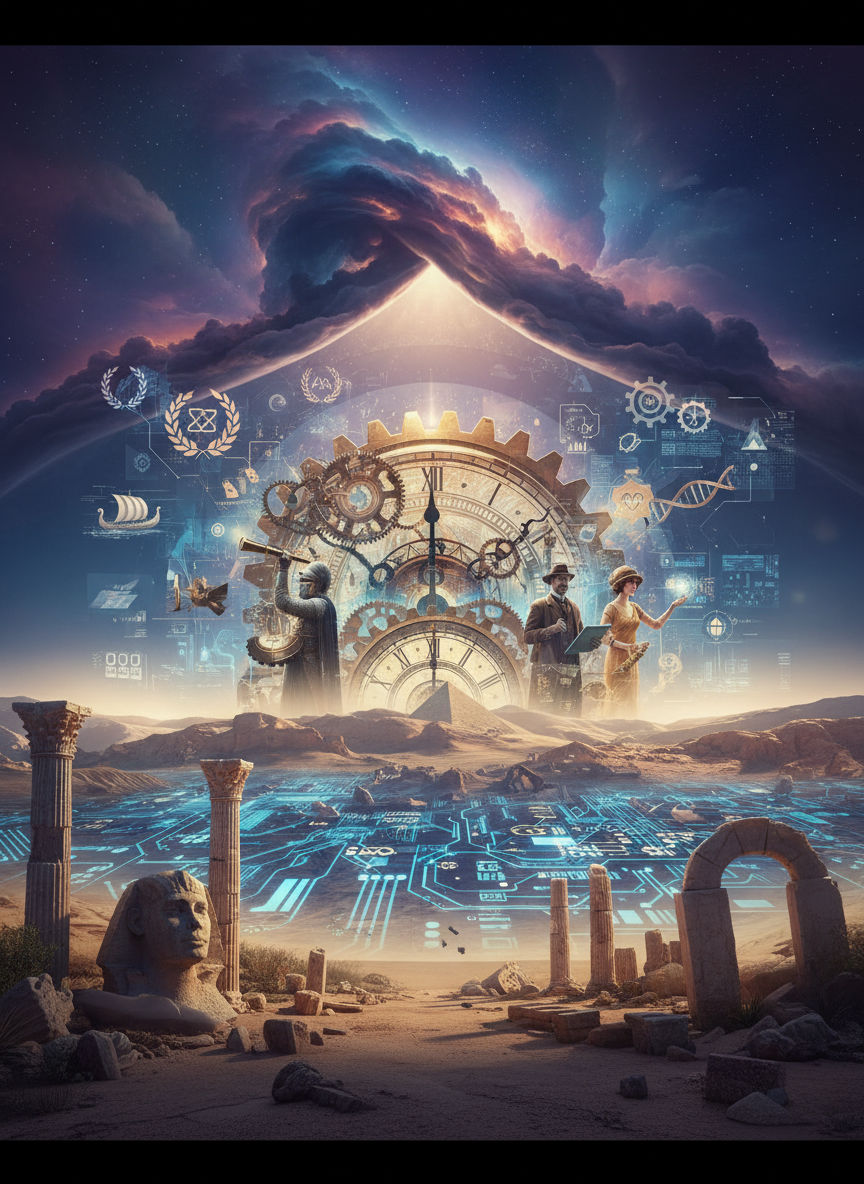
How did humans go from living in caves to carrying supercomputers in our pockets?
Prompted by A NerdSip Learner
Understand the 5 major eras of human history.
Imagine spending every single day of your life just looking for your next meal. For the vast majority of human history, that is exactly what we did! Early humans were hunter-gatherers, living in small nomadic tribes and endlessly following wild animal herds just to survive the winter.
Then, roughly 12,000 years ago, everything completely changed. We discovered that instead of constantly chasing our food, we could actually grow it ourselves. This massive shift in human behavior is called the Agricultural Revolution.
By planting seeds and taming wild animals, humans didn't have to move around anymore. We could finally settle down in one permanent place. Farming meant we had a surplus of food for the very first time. Instead of everyone needing to hunt, some people could become toolmakers, builders, or community leaders.
This single invention—farming—is the crucial seed from which all of modern history grew. Without it, there would be no permanent cities, no written languages, no internet, and ultimately, no you!
Key Takeaway
The discovery of farming allowed humans to stop wandering, settle down, and build the very first communities.
Test Your Knowledge
What was the main benefit of the Agricultural Revolution?
Once humans settled down to farm, our tiny villages slowly grew into bustling cities. The very first true civilizations popped up in places with great rivers, like Mesopotamia (modern-day Iraq) and Ancient Egypt. These fertile river valleys were like the world's first incubators for human progress, providing endless fresh water for drinking and growing crops.
As these cities grew into populations of thousands, daily life got highly complicated. People desperately needed a way to keep track of trade, taxes, and laws. So, they invented something truly revolutionary: writing.
Early writing didn't look anything like our modern alphabet. It started as simple pictures and symbols stamped into wet clay tablets. But it changed the world forever. For the first time, human knowledge could be permanently recorded and passed down to future generations without relying solely on memory.
With writing, organized religion, and central governments, humanity leveled up. We went from simple farming communities to organized societies capable of building massive pyramids and epic monuments!
Key Takeaway
Early civilizations formed near rivers and invented writing to organize their increasingly complex societies.
Test Your Knowledge
Why did humans originally invent writing?
As early civilizations grew richer and more powerful, they began to expand outwards, conquering their neighbors to form massive empires. The Classical Era of history was dominated by legendary, world-shaping superpowers like Ancient Greece, the Roman Empire, and the Han Dynasty in China.
But this era wasn't just about big armies and conquering land. It was a remarkable golden age for human thought and creativity. In Greece, brilliant thinkers invented philosophy and the earliest forms of democracy. In China and India, early scientists mapped the stars and invented new mathematics.
The Roman Empire, at its absolute peak, controlled massive stretches of Europe, North Africa, and the Middle East. They were master engineers, building incredibly straight roads, towering aqueducts for fresh water, and massive colosseums that still stand today.
These empires eventually fell—often due to a messy mix of outside invasions, internal corruption, and economic collapse—but they left behind foundational laws, languages, and ideas that heavily shape our modern world.
Key Takeaway
The Classical Era produced massive empires that laid the foundation for modern engineering, philosophy, and government.
Test Your Knowledge
Besides military conquest, what was the Classical Era famous for?
When the mighty Roman Empire collapsed, Europe entered a difficult period known as the Middle Ages. Without a giant central empire keeping order, society completely fractured. People relied on a rigid system called feudalism, where poor peasant farmers worked the land for wealthy knights and lords in exchange for physical protection.
It was an incredibly tough time to be alive. Life was deeply controlled by the Church, and terrifying, unpredictable events like the Black Death—a brutal plague that wiped out a massive portion of the population—made survival an everyday challenge.
But humanity always bounces back! By the 14th century, a stunning cultural explosion began in Italy called the Renaissance (which literally means "rebirth"). People enthusiastically rediscovered the lost arts, sciences, and literature of the ancient Greeks and Romans.
Geniuses like Leonardo da Vinci flourished. Science began to challenge old superstitions, and the amazing invention of the printing press meant books could finally be mass-produced, spreading revolutionary knowledge to everyday people.
Key Takeaway
After the struggles of the Middle Ages, the Renaissance sparked a massive rebirth of art, science, and learning in Europe.
Test Your Knowledge
What invention during the Renaissance helped spread knowledge to everyday people?
For thousands of years of human history, almost everything was painstakingly made by hand, using human or animal muscle. But in the late 1700s, humanity hit the fast-forward button with the Industrial Revolution.
We finally discovered how to harness incredible, world-altering power from burning coal and steam. Suddenly, massive metal machines could easily do the physical work of a hundred men. Sprawling factories sprang up overnight, and millions of people permanently left their quiet farms to work in crowded, soot-filled cities.
This monumental shift changed the daily rhythm of human life forever. It quickly led to speeding trains, steamships, and eventually the magic of electricity. While early factory conditions were often brutal and highly dangerous, this era also created the foundation for modern medicine, incredible technology, and higher living standards.
Today, we live in a completely interconnected, fast-paced globalized world—all built entirely on the back of these early steam-powered machines. History is just one long, exciting relay race of human innovation!
Key Takeaway
The Industrial Revolution replaced human muscle with machine power, rapidly creating the modern, technological world we live in today.
Test Your Knowledge
How did the Industrial Revolution change where people lived?
Track your progress, earn XP, and compete on leaderboards. Download NerdSip to start learning.