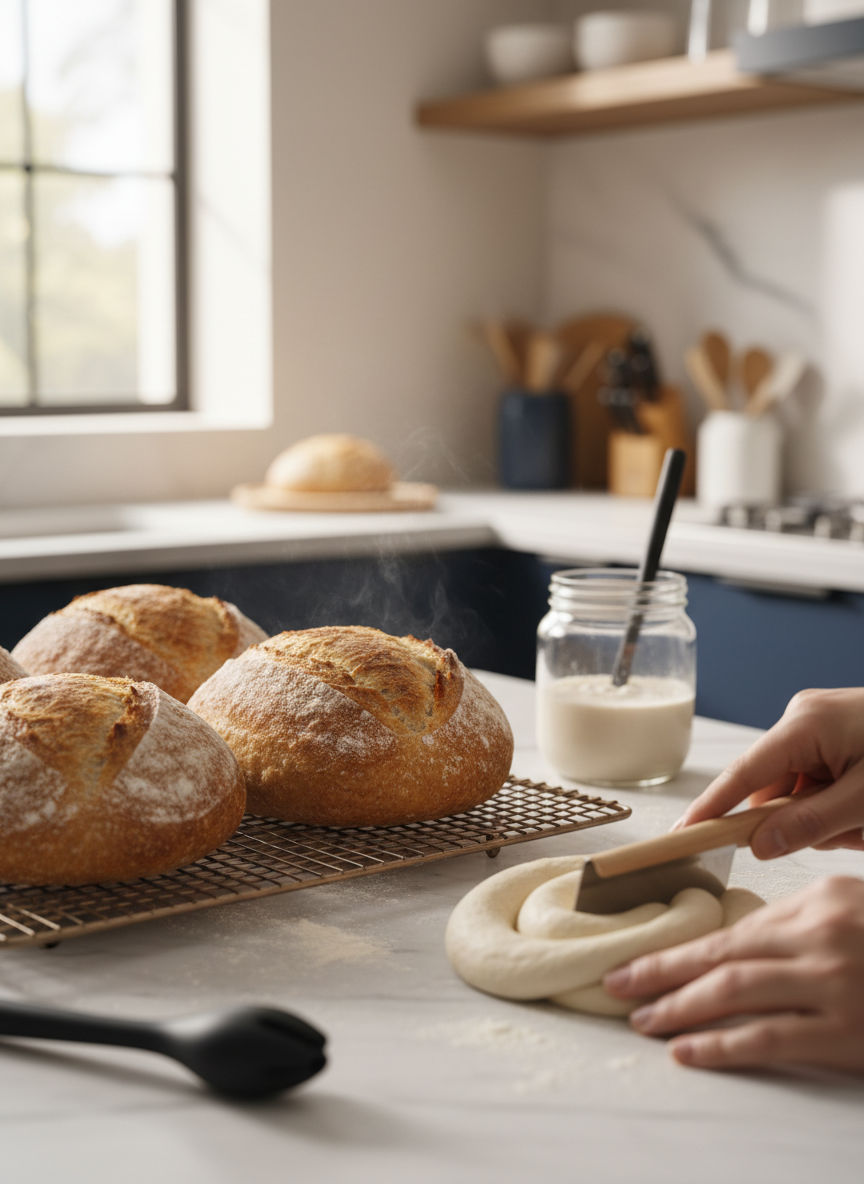
Ever wonder why a little flour and water can explode into a fluffy loaf?
Prompted by A NerdSip Learner
Bake consistent, professional-quality bread using baker's science.
Think of your dough as a living city. The citizens of this city are yeast, tiny fungi that eat the starches in your flour and burp out carbon dioxide (CO2) gas. This gas is what creates those beautiful air bubbles in your bread.
To keep your yeast happy, you have to be the ultimate landlord. Yeast is incredibly sensitive to temperature. If the water is too cold (below 70°F), they go to sleep and won't rise. If it’s too hot (above 135°F), they actually die—rest in peace, bread. The 'sweet spot' for fermentation is usually between 75°F and 85°F.
While they eat, yeast also produce alcohol and organic acids. This is where that delicious, 'bready' smell comes from! Give them enough time—a process called proofing—and they will inflate your dough until it's light, airy, and ready for the heat.
Key Takeaway
Yeast is a living organism that needs the right temperature to produce the CO2 gas that makes bread rise.
Test Your Knowledge
At what temperature does yeast typically begin to die, preventing your bread from rising?
If yeast provides the breath, gluten provides the body. Gluten is a protein found in wheat. When you add water to flour, two proteins (glutenin and gliadin) link up to form a stretchy web.
Think of gluten like a balloon. The yeast blows gas into the dough, and the gluten web stretches to hold that gas inside. Without strong gluten, the gas would just leak out, leaving you with a dense, flat brick. To build this strength, we knead the dough or perform 'folds.' This aligns the protein strands into a powerful network.
You can check if your 'net' is strong enough using the Windowpane Test. Take a small piece of dough and gently stretch it out. If you can stretch it thin enough to see light through it without it tearing, your gluten is perfectly developed!
Key Takeaway
Gluten acts as a stretchy network that traps gas bubbles, giving bread its structure and height.
Test Your Knowledge
What is the purpose of the 'Windowpane Test' in bread making?
Pro bakers don't use 'cups'—they use Baker's Percentages. In this system, the Flour is always 100%. Every other ingredient is measured as a weight ratio compared to the flour. This allows you to scale a recipe for one loaf or a hundred perfectly.
The most important ratio is Hydration (the amount of water). A 'high-hydration' dough (75% water or more) is sticky and hard to handle, but it rewards you with those giant, 'instagrammable' holes in the crust. Low-hydration dough is easier to shape and results in a tighter, sandwich-style crumb.
When the dough hits the hot oven, it experiences Oven Spring. This is a final, frantic burst of yeast activity and gas expansion. To maximize this, we add steam to the oven. Steam keeps the outside of the loaf soft for the first few minutes, allowing it to expand fully before the crust hardens and browns.
Key Takeaway
Baker's math treats flour as 100%, and hydration levels determine whether your bread will be dense or airy.
Test Your Knowledge
In Baker's Math, if you have 1000g of flour and 700g of water, what is the hydration percentage?
Track your progress, earn XP, and compete on leaderboards. Download NerdSip to start learning.