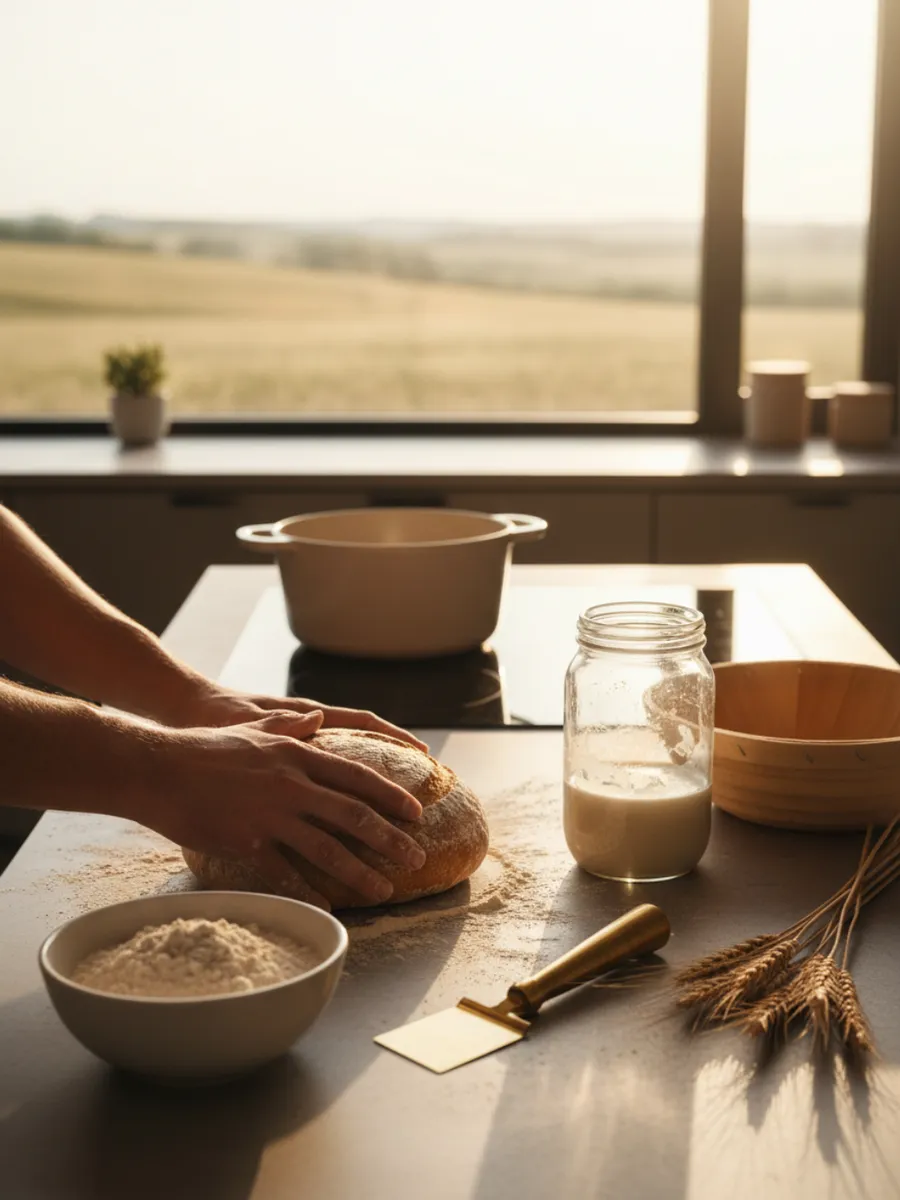
How do four simple ingredients transform into a crusty, golden masterpiece?
Prompted by A NerdSip Learner
Master the 'poke test' and the science of gluten.
Mixing flour and water isn't just making a paste; it's a chemical reaction! Flour contains two specific proteins—glutenin and gliadin. When they meet water, they link up to form a complex protein network known as gluten. This is the literal backbone of your bread.
Think of gluten like a million tiny rubber bands. When you knead the dough, you are stretching and aligning these bands into a strong, organized web. Without this web, the gas from your yeast would just bubble away. A strong gluten network acts like a balloon, trapping air to give your bread its structure and signature 'chew.'
To check if your gluten is strong enough, try the Windowpane Test. Pull a small piece of dough and stretch it thin between your fingers. If it stretches until it's translucent without tearing, your 'rubber band' web is perfectly developed and ready for the next step. If it snaps, keep kneading!
Key Takeaway
Kneading develops a gluten network that acts like a balloon to trap air bubbles.
Test Your Knowledge
What are the two proteins that combine to form gluten?
Meet your hardest worker: Yeast. It’s a tiny, living fungus that stays dormant until it hits warm water. To get the best results, aim for the 'Goldilocks' zone: roughly 105°F to 115°F (40°C–46°C). This is warm enough to wake them up but not so hot that it kills them.
Once active, the yeast begins a process called fermentation. These tiny organisms eat the natural starches and sugars in your flour, and as a byproduct, they release carbon dioxide gas and ethanol. While the gas makes the dough rise, the alcohol and organic acids provide that incredible 'yeasty' aroma and complex flavor found in artisan loaves.
If you aren't sure if your yeast is still alive, try blooming it. Mix it with warm water and a tiny pinch of sugar. If it becomes frothy and bubbly within five minutes, your 'micro-chefs' are ready to work. If the water stays flat, your yeast has likely expired and won't be able to lift your dough.
Key Takeaway
Yeast is a living organism that converts sugar into carbon dioxide to leaven the bread.
Test Your Knowledge
What happens if your water temperature is over 140°F (60°C)?
After you shape your dough, it needs a final rest called proofing. This is the most critical wait time. If you bake it too early, the bread will be dense; if you wait too long, the gluten structure gets tired and the loaf will collapse in the oven.
How do you know it's ready? Use the Finger-Poke Test! Gently press a floured finger about half an inch into the dough. If the indent springs back slowly and leaves a small visible mark, it’s perfectly proofed. If it snaps back instantly, it needs more time. If the indent stays deep and the dough feels deflated, it's over-proofed.
When the dough finally hits the hot oven, the gas inside expands rapidly in a final burst called oven spring. Professional bakers often add steam to the oven during these first few minutes. This keeps the surface of the dough moist and flexible, allowing it to stretch even further before the Maillard reaction kicks in and turns the crust a beautiful golden brown.
Key Takeaway
The poke test helps you determine if the dough has enough trapped gas to be baked.
Test Your Knowledge
During the 'poke test,' what does it mean if the dough snaps back instantly?
Track your progress, earn XP, and compete on leaderboards. Download NerdSip to start learning.