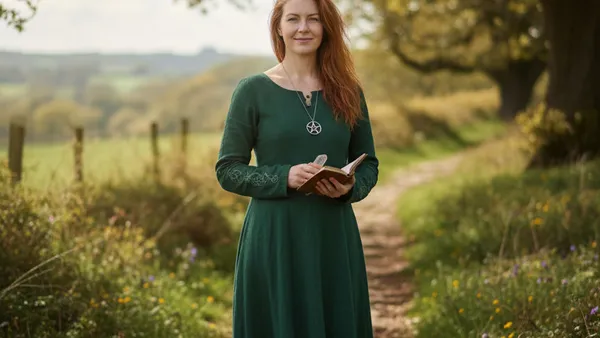
Ever wonder where modern witchcraft actually comes from?
Prompted by A NerdSip Learner
Understand the hidden history and rituals of British Traditional Wicca.
British Traditional Wicca (often abbreviated as BTW) didn't emerge from ancient mists exactly as we see it today. Its modern incarnation was largely shaped in the mid-20th century by a fascinating British civil servant and amateur anthropologist named Gerald Gardner.
Returning to England after years abroad, Gardner claimed to have been initiated into a secretive group called the New Forest coven in 1939. Following the repeal of England’s antiquated Witchcraft Act in 1951, he was finally legally able to publish books like *Witchcraft Today*, effectively introducing this nature-based religion to the public eye.
Gardner combined regional folk magic, ceremonial magic, and influences from other occultists to create a structured, initiatory tradition. This foundational system, now known as Gardnerian Wicca, became the bedrock for modern witchcraft around the world, transforming scattered occult practices into a cohesive, mystery religion.
Key Takeaway
Gerald Gardner popularized modern Wicca in the 1950s by blending folklore, ceremonial magic, and nature worship.
Test Your Knowledge
What was the name of the region where Gerald Gardner claimed to have been initiated into a coven?
At the theological heart of British Traditional Wicca is a profound respect for nature and a belief in divine duality. Unlike many monotheistic religions, BTW centers on two primary deities: the Mother Goddess and the Horned God.
The Goddess is often associated with the moon, the earth, and the cycles of fertility and intuition. She is frequently viewed in three distinct aspects—the Maiden, the Mother, and the Crone—which directly represent the stages of human life and the shifting lunar phases.
The Horned God, conversely, is linked to the sun, the deep forests, and the wild hunt. He represents the untamed forces of nature, the changing seasons, and the eternal cycle of life, death, and rebirth.
Together, they represent the harmonious balance of masculine and feminine energies in the universe. Wiccans believe that both aspects are essential, working in tandem to maintain the equilibrium of the natural world.
Key Takeaway
British Traditional Wicca centers on the balanced duality of the Mother Goddess and the Horned God.
Test Your Knowledge
In Wiccan theology, what do the Maiden, Mother, and Crone primarily represent?
Time in Wicca isn’t viewed as a straight line; it is conceptualized as an endless circle. British Traditional Wiccans celebrate the changing seasons through an annual calendar known as the Wheel of the Year.
This wheel consists of eight seasonal festivals called Sabbats, which track the sun's journey and the agricultural cycle. Four of these are based on astronomical events: the Winter and Summer Solstices, alongside the Spring and Autumn Equinoxes.
The other four are the "cross-quarter" days, which are deeply rooted in Celtic and British folklore. These include Samhain (the harvest's end and honoring ancestors), Imbolc (the first stirrings of spring), Beltane (a fiery celebration of fertility), and Lughnasadh (the first harvest).
By observing these Sabbats, Wiccans intentionally align their lives with the rhythms of nature, pausing roughly every six weeks to honor the shifting, transformative energies of the earth.
Key Takeaway
Wiccans celebrate eight seasonal Sabbats that honor the solar and agricultural cycles.
Test Your Knowledge
What are the Sabbat festivals in Wicca primarily based on?
While the seasonal Sabbats follow the sun's journey, Wiccan practice is equally intertwined with the moon. In British Traditional Wicca, regular working meetings held by a coven are known as Esbats.
Esbats typically coincide with the full moon, meaning a coven will gather roughly thirteen times a year for these specific lunar events. Because the Mother Goddess is strongly associated with lunar energy, the full moon is considered a time of peak spiritual power.
During an Esbat, Wiccans perform rituals, practice magical workings (such as healing or protective spells), and handle the internal administrative business of the coven. It is a dedicated time for communion with the divine and strengthening the bonds between coven members.
By balancing the solar Sabbats with the lunar Esbats, the Wiccan calendar honors the full spectrum of celestial movements and natural rhythms.
Key Takeaway
Esbats are regular coven gatherings that usually coincide with the full moon to practice magic and ritual.
Test Your Knowledge
How many times a year does an Esbat roughly occur?
If you've ever watched a movie about witches, you've probably seen a dusty, ancient-looking spell book. In British Traditional Wicca, this text is very real and is known as the Book of Shadows.
The Book of Shadows is essentially a coven's core grimoire and ritual workbook. Gerald Gardner created the first widely known version in the mid-20th century, containing the rituals, spells, and philosophical texts of his tradition. Prominent figures like Doreen Valiente later refined its poetry and prose.
In traditional initiatory Wicca, the Book of Shadows is traditionally hand-copied by a new initiate from their High Priest or High Priestess. It is treated as a sacred, oath-bound document that is fiercely protected.
While core rituals remain consistent within a specific tradition to maintain the "lineage," individual witches often add their own personal notes, recipes, and reflections over time.
Key Takeaway
The Book of Shadows is a sacred, hand-copied text containing the core rituals and teachings of a coven.
Test Your Knowledge
How does a new initiate traditionally obtain their Book of Shadows in British Traditional Wicca?
British Traditional Wicca is strictly an initiatory religion. This means you cannot simply declare yourself a Gardnerian or Alexandrian Wiccan; you must be formally initiated into a coven by an existing practitioner.
A coven is a small, close-knit group of working witches, traditionally limited in size to ensure intimacy and trust. They operate under a formal Degree System, much like medieval artisan guilds.
- First Degree: You are recognized as a witch and a priest/priestess. - Second Degree: You have achieved a higher level of study, capable of taking on leadership roles within rituals. - Third Degree: You are recognized as an Elder, often a High Priest or High Priestess.
Once a witch reaches the Third Degree, they have the authority to "hive off" and form their own autonomous coven, ensuring the lineage continues to grow organically over time.
Key Takeaway
BTW requires formal initiation into a coven and uses a three-degree system to mark spiritual progression.
Test Your Knowledge
What does it mean when a Third Degree witch decides to "hive off"?
With access to magical practice comes the need for an incredibly strong ethical framework. The moral compass of British Traditional Wicca is best summarized by a traditional phrase known as the Wiccan Rede.
The core maxim of the Rede is simple but profound: *"An it harm none, do what ye will."* (In modern English: As long as it doesn't harm anyone, do what you want.)
This ethical guideline encourages immense personal freedom and self-determination, but it deliberately pairs that freedom with strict personal responsibility. Wiccans are tasked with carefully considering the long-term consequences of their actions and magical workings.
Many Wiccans also believe in the Law of Return (or the Rule of Three), which suggests that whatever energy you put into the world—whether positive or negative—will return to you. This creates a strong deterrent against using magic for malicious purposes.
Key Takeaway
The Wiccan Rede promotes personal freedom alongside strict responsibility, emphasizing that actions must not cause harm.
Test Your Knowledge
What is the core ethical principle of the Wiccan Rede?
Walk into a British Traditional Wiccan ritual, and you will see an altar arranged with specific, highly symbolic tools. These items aren't inherently magical themselves; rather, they help the practitioner focus their psychological energy and intention.
The most iconic tool is the Athame (pronounced ah-THAH-may), a black-handled, double-edged knife. It is never used for physical cutting, but instead is used to direct spiritual energy and formally cast the magical circle.
Other key tools correspond directly to the classical elements: - The Wand is often used for invocation and traditionally represents Air (or Fire, depending on the specific lineage). - The Chalice (cup) holds ritual wine or water and represents the element of Water. - The Pentacle, a flat disc inscribed with a five-pointed star, represents Earth and the physical body.
Together, these tools create a balanced framework for Wiccans to interact with the natural elements.
Key Takeaway
Ritual tools like the athame and chalice are used to focus energy and represent the natural elements.
Test Your Knowledge
What is the primary purpose of an athame in Wiccan rituals?
While Gerald Gardner laid the groundwork for British Traditional Wicca in the 1950s, the religion soon evolved into different branches, often called "traditions." One of the most famous offshoots is Alexandrian Wicca.
Founded in the 1960s by Alex Sanders (who boldly styled himself the "King of the Witches") and his wife Maxine, the Alexandrian tradition shares much of its DNA with Gardnerian Wicca. In fact, many of their core rituals are nearly identical.
However, Alexandrian Wicca is often described as slightly more eclectic. It places a stronger emphasis on ceremonial magic, the Qabalah, and intricate, dramatic ritual techniques compared to its Gardnerian predecessor.
Today, Gardnerian and Alexandrian Wicca are considered the two main pillars of British Traditional Wicca. While they operate independently, they recognize each other's historical lineages, and many modern covens blend practices from both.
Key Takeaway
Alexandrian Wicca, founded by Alex Sanders, is a major branch of BTW that emphasizes ceremonial magic.
Test Your Knowledge
Which of the following is considered a primary difference between Alexandrian and Gardnerian Wicca?
Wiccans don't usually worship in purpose-built churches or grand temples. Instead, they create their own temporary sacred space wherever they gather by casting a circle.
In British Traditional Wicca, casting a circle is a formal, highly energetic process. Using an athame or wand, the High Priest or Priestess traces an invisible boundary around the coven. This circle serves two vital purposes: it acts as a protective barrier against unwanted energies, and it acts as a container to hold the magical energy raised during the ritual.
Once the circle is cast, the practitioners "call the quarters," inviting the protective energies of the four cardinal directions (North, East, South, West) and their corresponding elements (Earth, Air, Fire, Water).
When the ritual or Esbat concludes, the energy is intentionally grounded, the quarters are thanked, and the circle is formally closed, cleanly returning the space to the mundane world.
Key Takeaway
Casting a circle creates a temporary, sacred space that protects the coven and contains magical energy.
Test Your Knowledge
What are the two main purposes of casting a magical circle?
Track your progress, earn XP, and compete on leaderboards. Download NerdSip to start learning.