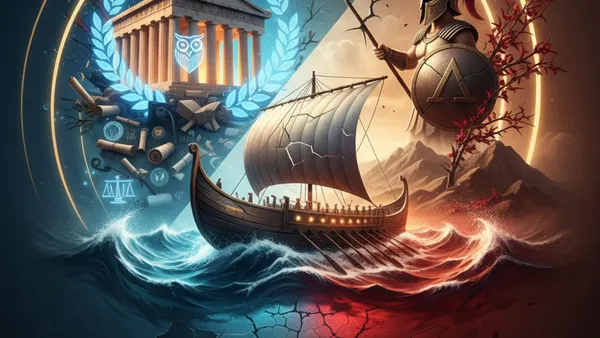
What happens when two ancient superpowers collide in a fight to the death?
Prompted by NerdSip Explorer #7870
Understand the rivalry that broke Ancient Greece.
Imagine a world dominated by two superpowers with completely different ways of life. Sounds like the Cold War, right? But this happened over 2,400 years ago in Ancient Greece.
The Peloponnesian War (roughly 431 to 404 BC) was the ultimate showdown between two legendary city-states: Athens and Sparta.
Think of it as the classic battle between the "Whale" and the "Elephant." Athens ruled the seas with an unmatched navy, while Sparta dominated the land with the most feared army in history.
They had briefly teamed up to defeat the Persian Empire, but once the common enemy was gone, their radical differences made coexistence impossible. This war would ultimately drag in almost every Greek city, reshaping the ancient world forever.
Key Takeaway
The Peloponnesian War was a devastating decades-long conflict between the naval power Athens and the land power Sparta.
Test Your Knowledge
Which modern analogy best describes the setup of the Peloponnesian War?
To understand the war, you have to understand the fighters. Let's look at Athens, the "Whale."
At the time, Athens was the cultural and intellectual capital of the world. It was a buzzing, wealthy democracy where citizens voted directly on laws. It was the home of famous philosophers, stunning architecture like the Parthenon, and booming trade.
But Athens wasn't just peaceful artists. They had built a massive, unstoppable navy. Following the earlier wars with Persia, Athens formed a protective alliance called the Delian League. Over time, they transformed this voluntary alliance into an empire, forcing other cities to pay them tribute.
This growing wealth and aggressive expansion made Athens incredibly powerful—and made everyone else incredibly nervous. Their leader, a brilliant politician named Pericles, believed Athens was the rightful ruler of Greece.
Key Takeaway
Athens was a wealthy, democratic naval power that aggressively turned its allies into subjects.
Test Your Knowledge
What was the main source of Athenian military power?
On the opposite side of the ring was Sparta, the "Elephant."
Sparta was a deeply conservative, militaristic society. While Athens debated philosophy, Sparta focused on discipline, toughness, and war. From the age of seven, Spartan boys were taken from their homes to endure brutal military training.
Instead of a democracy, Sparta was ruled by two kings and a council of elders. They didn't care about trade, art, or building empires overseas. Their lifestyle was sustained by a massive enslaved population known as "helots," who worked the land while Spartan citizens focused solely on combat.
Sparta commanded a network of allies called the Peloponnesian League. They viewed the rapidly expanding, fast-talking, democratic Athenians with deep suspicion and fear. To Sparta, Athens was a ticking time bomb threatening the traditional Greek way of life.
Key Takeaway
Sparta was a conservative, land-based military powerhouse deeply threatened by Athenian expansion.
Test Your Knowledge
Why were Spartan citizens able to focus entirely on military training?
So, how do two massive alliances actually go to war? Rarely by fighting each other directly at first.
The Peloponnesian War started like a bar fight that spiraled out of control. Several smaller city-states, allied with either Athens or Sparta, started squabbling over trade routes and regional control.
Sparta's allies went to them, essentially saying, "If you don't stop Athens now, they will eventually consume all of us." The fear of Athens growing too strong was the true, underlying cause of the conflict.
After intense debates, Sparta issued an ultimatum to Athens: back down, dissolve your empire, or face war. Athens, guided by their leader Pericles, refused to be bullied. The negotiations broke down, and the armies began to march.
Key Takeaway
The war was sparked by smaller proxy conflicts and Sparta's underlying fear of Athens' growing power.
Test Your Knowledge
What was the root cause of Sparta declaring war?
When the war officially kicked off, the Athenian leader Pericles had an unusual strategy. Since Sparta's land army was invincible, he told all Athenians to hide behind the city's massive, unbreakable walls.
The plan was simple: let the Spartans burn the countryside. Athens would just use its navy to import food and launch surprise coastal attacks. For a while, the "hide behind the walls" strategy worked perfectly.
But cramming tens of thousands of refugees into a crowded city during the hot summer had disastrous consequences. A horrific plague broke out inside the walls of Athens.
The disease wiped out roughly a quarter to a third of the population, including Pericles himself. Suddenly, Athens was severely weakened, grieving, and leaderless, turning a calculated war into a desperate struggle for survival.
Key Takeaway
Athens tried to hide behind its walls, but a devastating plague decimated their population and killed their leader.
Test Your Knowledge
What was a major flaw in Pericles' strategy to hide inside the city walls?
Fast forward a decade. Both sides had been punching each other relentlessly. Athens had won some stunning naval victories; Sparta had devastated the Athenian countryside.
Both superpowers were exhausted, bleeding money, and losing a generation of young men. Recognizing a stalemate, they signed a treaty known as the Peace of Nicias, meant to last 50 years.
They agreed to return captured territories and prisoners, essentially hitting the "reset" button to how things were before the war started.
But it was a "fake peace." The underlying distrust hadn't gone away. Hardliners on both sides were furious about compromising. Over the next few years, instead of fighting directly, they engaged in sneaky proxy wars and political sabotage, just waiting for an excuse to start swinging again.
Key Takeaway
A temporary peace treaty paused the war, but deep mutual distrust meant the fighting would inevitably resume.
Test Your Knowledge
Why did the Peace of Nicias fail to create lasting peace?
The peace officially shattered because of an incredibly arrogant blunder by Athens.
Looking for a quick win and loads of wealth, Athens decided to launch a massive naval invasion of Sicily (an island near Italy). It was incredibly far from home, and the target—the powerful city of Syracuse—was a Spartan ally.
It was the ancient equivalent of a dangerous, unnecessary vanity project. The expedition was plagued by bad leadership, hesitation, and logistical nightmares.
The result was an absolute catastrophe. The entire Athenian fleet was trapped and destroyed. Tens of thousands of Athenian soldiers were killed or captured and sold into slavery. In one greedy move, Athens lost its aura of invincibility and a huge chunk of its military power.
Key Takeaway
Athens launched an overly ambitious invasion of Sicily that resulted in the total destruction of their fleet and army.
Test Your Knowledge
Why was the Sicilian Expedition such a turning point?
With Athens bleeding after the Sicilian disaster, Sparta saw its chance to end the war forever. But there was a catch.
To beat Athens, Sparta needed to destroy its navy. To build a navy, Sparta needed massive amounts of money. Who had the deepest pockets in the ancient world? Their old enemy, the Persian Empire.
In a shocking "deal with the devil," Sparta accepted Persian gold to fund a brand new, state-of-the-art fleet. In exchange, Sparta promised to let Persia take back control of certain Greek cities in Asia.
Suddenly, the rules of the game changed. The "Elephant" (Sparta) had bought itself "fins" and could now fight the "Whale" (Athens) on its home turf: the sea. Athens was now fighting a two-front war against Spartan soldiers and Persian bank accounts.
Key Takeaway
Sparta secured funding from the Persian Empire to build a navy, fundamentally changing the balance of the war.
Test Your Knowledge
How did Sparta finally manage to challenge Athens at sea?
The climax of this nearly 30-year war came down to a single, decisive moment at a place called Aegospotami.
By this time, both sides were fighting fiercely on the seas. A cunning Spartan commander named Lysander managed to catch the Athenian fleet completely off guard while they were beached and gathering supplies.
In a devastating surprise attack, the Spartan navy destroyed almost the entire Athenian fleet without a major battle. Without its ships, Athens' empire instantly collapsed.
The Spartans then sailed directly to Athens and blockaded the port. Starving, surrounded, and with no way to import food, the great city of Athens finally surrendered in 404 BC. The long, brutal war was over.
Key Takeaway
A surprise naval attack by Sparta destroyed the last Athenian fleet, starving the city into surrender.
Test Your Knowledge
What ultimately forced Athens to surrender?
Sparta had won. They tore down the great walls of Athens and installed a brutal puppet government. But their victory lap was short-lived.
The Peloponnesian War was a disaster for all of Ancient Greece. It devastated the economy, killed countless young men, and bred a culture of cruelty and civil war that hadn't existed before.
Sparta proved to be terrible rulers. Their arrogance quickly caused their own allies to turn against them, leading to even more decades of infighting.
Because the Greek city-states spent so much time destroying each other, they failed to notice a rising power to the north: Macedonia. Just a few decades later, King Philip II (and his son, Alexander the Great) would easily sweep down and conquer a weakened, exhausted Greece.
Key Takeaway
The war exhausted all of Greece, paving the way for outside powers like Alexander the Great to conquer them.
Test Your Knowledge
What was the long-term result of the Peloponnesian War for Ancient Greece?
Track your progress, earn XP, and compete on leaderboards. Download NerdSip to start learning.