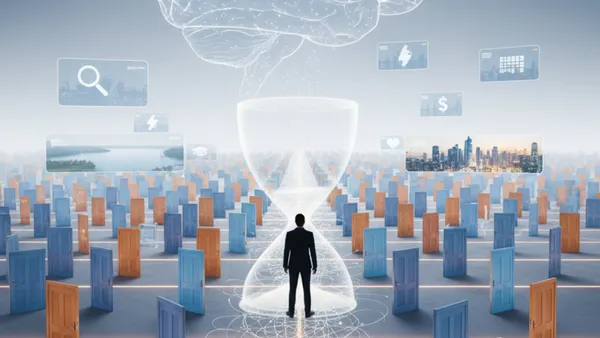
Did you know that having too many flavors of jam can actually prevent people from buying any?
Prompted by NerdSip Explorer #7304
Why having more options makes us less happy and how to decide faster.
Have you ever walked into a supermarket, stared at a massive wall of cereal, and felt completely overwhelmed? You are not alone. In fact, there is a famous psychological experiment that perfectly illustrates this phenomenon, widely known as the 'Jam Study.'
Researchers set up a tasting booth in a grocery store. On one day, they offered 24 flavors of gourmet jam. On another day, they offered only 6. As you might guess, the massive display of 24 jams attracted a larger crowd. People naturally love the idea of having endless options.
However, when it came time to actually buy a jar, something surprising happened. Customers who saw the smaller selection of 6 jams were roughly ten times more likely to purchase one. The massive 24-jam display caused 'choice overload.' The sheer volume of options paralyzed the shoppers, causing most to walk away empty-handed.
This reveals a fundamental flaw in how we think about options. We assume more choices will make us happier and lead to better outcomes. Instead, an abundance of choice often leads to decision fatigue, anxiety, and ultimate paralysis.
Key Takeaway
While having many options can initially attract our attention, it often leads to decision paralysis and fewer actions taken.
Test Your Knowledge
What was the main finding of the grocery store 'Jam Study'?
Psychologists divide decision-makers into two main camps: Maximizers and Satisficers. Understanding which one you are is the key to minimizing decision fatigue.
Maximizers are people who want the absolute best. If a Maximizer is buying a coffee maker, they will read every review, compare dozens of models, and obsess over specifications. They fear making a suboptimal choice. While they might occasionally end up with a slightly better product, the exhaustive process leaves them drained, and they often doubt their final decision.
Satisficers, on the other hand, operate differently. They decide what criteria they need beforehand—for example, 'a coffee maker under $50 that brews quickly.' As soon as they find an option that meets these standards, they buy it and move on. They do not care if there might be a marginally better one out there.
Studies show that Satisficers are generally much happier with their choices and experience far less stress. To navigate a world of endless options, we need to train ourselves to act less like Maximizers and more like Satisficers.
Key Takeaway
Striving for the absolute perfect choice can make you miserable; it is often much healthier to settle for an option that meets your core criteria.
Test Your Knowledge
How does a 'Satisficer' approach making a decision?
In economics, there is a fundamental concept called 'opportunity cost.' It simply means the value of the next best alternative that you give up when making a choice. If you choose to stay in and read a book, the opportunity cost is the fun you might have had going to the movies with friends.
When we have limited options, opportunity costs are easy to manage. But what happens when you have hundreds of options? Every time you select one item from a massive menu, you are actively rejecting dozens of other potentially great dishes.
The psychological weight of all those rejected alternatives accumulates. You start imagining the delicious features of the meals you didn't pick, which subtracts from the enjoyment of the meal you actually ordered. This is the root cause of FOMO, or the Fear Of Missing Out.
When choices multiply, the combined opportunity costs grow so large that even a genuinely great choice can feel disappointing. Recognizing this trap is the first step to freeing yourself from the nagging feeling that you made the wrong call.
Key Takeaway
Having many choices increases the opportunity cost of the option you pick, which subconsciously reduces your overall satisfaction.
Test Your Knowledge
In the context of decision-making, what is an 'opportunity cost'?
Another hidden psychological trap created by too many choices is 'anticipated regret.' When you only have two options, it is relatively easy to make a call. If it turns out poorly, you can easily blame the lack of good alternatives. It simply wasn't your fault!
However, when you have dozens of options, the burden of responsibility shifts entirely onto you. If you pick the wrong laptop out of fifty available models, you feel like you only have yourself to blame. Because there were so many choices, the 'perfect' one must have been in there somewhere.
This fear of future regret paralyzes us in the present. We delay choosing, obsessively research, or simply give up—just like the shoppers in the jam study. We become so afraid of feeling disappointed later that we choose not to decide at all.
Understanding anticipated regret helps explain why you might spend forty-five minutes scrolling through a streaming service, only to turn off the TV. The fear of wasting two hours on a mediocre movie stops you from watching anything.
Key Takeaway
The fear of making the wrong choice from a large selection often causes us to freeze, feel entirely responsible, and make no choice at all.
Test Your Knowledge
Why does having dozens of options often lead to 'anticipated regret'?
Let's imagine you finally overcome decision paralysis. You spend weeks researching, you brave the opportunity costs, and you buy the absolute 'perfect' smartphone. For the first few days, you are absolutely thrilled.
But fast forward a month. That incredible, life-changing device is now just... your phone. This phenomenon is known as 'hedonic adaptation,' or the hedonic treadmill. Human beings are remarkably good at getting used to things, both good and bad. The intense joy of a new purchase or a perfect decision fades surprisingly quickly as it becomes our new baseline normal.
Why does this matter for the paradox of choice? It shows us that agonizing over the 'perfect' option is usually a poor investment of our time and emotional energy.
Because we will inevitably adapt to whatever we choose, the long-term difference in happiness between the 'absolute best' choice and a 'good enough' choice is incredibly small. Remembering the hedonic treadmill can take the immense pressure off our daily decisions.
Key Takeaway
Because we quickly adapt to new things, agonizing over finding the absolute 'perfect' choice is usually a waste of time and energy.
Test Your Knowledge
What does 'hedonic adaptation' teach us about agonizing over the perfect choice?
Now that we understand the traps of endless choice, how do we fight back? The most effective strategy is to become the architect of your own limits. By introducing artificial constraints, you can hack your environment to make decisions faster and easier.
One powerful method is setting a strict time limit. If you need to buy a pair of running shoes, give yourself exactly twenty minutes to make the purchase. When the timer goes off, you must pull the trigger. This forces you to switch from an exhausting maximizing mindset to an efficient satisficing one.
Another strategy is limiting your options upfront. If you are looking for a restaurant on a delivery app, filter the results to show only places with a 4.5 rating or higher that deliver in under thirty minutes.
By intentionally shrinking your pool of options, you dramatically reduce opportunity cost and anticipated regret. Artificial constraints give you back your time and mental bandwidth, proving that freedom actually thrives within boundaries.
Key Takeaway
Creating your own rules and boundaries, like time limits or strict filters, helps reduce the overwhelming number of choices in your daily life.
Test Your Knowledge
How can 'artificial constraints' help you make faster decisions?
The ultimate antidote to the paradox of choice is learning to truly embrace the concept of 'good enough.' In a culture that constantly pushes us to optimize our lives, settle for nothing but the best, and chase perfection, 'good enough' sounds like a failure. But it is actually a superpower.
Embracing 'good enough' means recognizing that your time, energy, and peace of mind are far more valuable than the slight upgrade you might get from an extra hour of research. It means finding an option that meets your core needs and then intentionally turning your back on the alternatives.
Once a decision is made, practice the art of non-reversibility. Tell yourself the choice is final. Do not look back at the reviews, and do not wonder about the other paths you could have taken.
By lowering the stakes of your everyday choices and confidently acting like a Satisficer, you will free up enormous amounts of mental energy. You will discover that having fewer choices—and agonizing less over them—is the secret to genuine peace.
Key Takeaway
Actively choosing to be satisfied with 'good enough' is a superpower that reclaims your time and mental energy.
Test Your Knowledge
Why is embracing 'good enough' considered a helpful strategy?
Track your progress, earn XP, and compete on leaderboards. Download NerdSip to start learning.