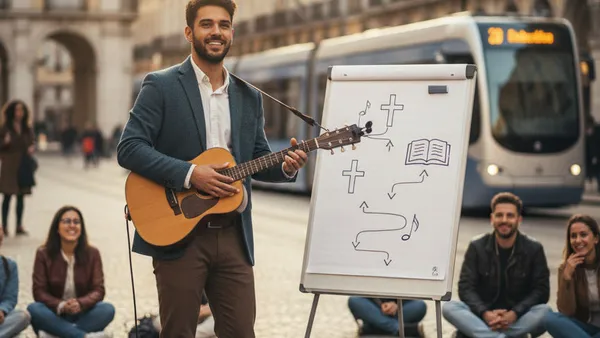
Ready to turn street preaching into a seamless, professional busking art form?
Prompted by A NerdSip Learner
Master advanced crowd psychology and apologetic staging.
As an advanced street performer, knowing you have 'free speech' isn't enough. You must deeply understand the intersection of First Amendment rights, noise ordinances, and solicitation laws.
While preaching is highly protected in public spaces in many democratic nations, *busking*—the act of asking for donations—often falls under different local regulations. Some cities require a specific busking permit if you are actively passing a hat, even if your underlying message is religious.
Furthermore, noise ordinances dictate *how* you can deliver your message. A local ordinance might strictly protect unamplified speech but ban battery-powered PA systems without a commercial permit.
To avoid interruptions, research your city's specific legal distinction between 'expressive speech' and 'commercial solicitation.' Keep digital copies of local ordinances on your phone. When approached by authorities or security guards, always remain calm, respectful, and legally informed.
Key Takeaway
Understand the legal differences between free speech, amplified noise, and commercial solicitation in your specific city.
Test Your Knowledge
Why might a street preacher need a specific permit if they decide to put out a hat for tips?
Busking inherently involves collecting tips, which can create friction with the Christian ethos of 'freely you have received, freely give.' How do you balance this as a preacher-busker?
The key is separating the spiritual message from the performance art. Many advanced preacher-buskers use a high-level artistic medium—like spoken word poetry, grand illusion, acoustic music, or speed painting—to draw the crowd and convey their theology.
When it comes time to 'pass the hat,' you are asking the audience to support the *artistic performance*, not paying for the Gospel. Frame your hat line carefully: 'I hope this art brought you joy and challenged your perspective. I am a full-time street artist, and your tips keep me out here.'
Alternatively, offer physical items like books or art prints for free, with a clearly marked donation box nearby. This honors the transactional nature of busking without compromising your spiritual integrity.
Key Takeaway
Frame your requests for tips around supporting your artistic performance, rather than paying for spiritual truth.
Test Your Knowledge
What is an ethical way for a Christian busker to frame the collection of tips?
Street preaching is often most effective as a team sport. While one person commands the stage, the other works the perimeter. This is known as the Wingman Dynamic.
The primary speaker's job is to gather the crowd, deliver the routine, and cast a wide net. They cannot stop the show to answer every deep, personal question a bystander might have without losing the audience's momentum.
Enter the wingman. Stationed subtly at the edge of the crowd, the wingman watches for individuals showing genuine emotional engagement or curiosity. When the main routine ends, the wingman gently approaches these specific individuals for one-on-one follow-up.
This tag-team approach ensures the performance maintains its rhythm and energy while still providing the deep, pastoral care and conversational space that effective Christian ministry requires.
Key Takeaway
Use a partner to handle one-on-one conversations so the main speaker can focus on managing the crowd.
Test Your Knowledge
What is the primary role of the 'wingman' in a street preaching routine?
To elevate your storytelling, borrow a literary device frequently used in ancient Hebrew poetry and the Bible itself: Chiastic Structure.
A chiasmus is a mirrored narrative structure that follows an A-B-C-B-A pattern. You introduce an idea (A), build on it (B), hit the central climax or turning point (C), and then mirror the build-up (B) before returning to the original idea with a new perspective (A).
For example: (A) We all search for satisfaction; (B) We buy things that break; (C) *True peace comes from within, not without*; (B) Our broken things no longer matter; (A) Our search is finally satisfied.
This structure is neurologically satisfying to the human brain. It creates a sense of profound completeness and makes your street parables deeply memorable, elevating them from simple anecdotes to powerful, poetic experiences.
Key Takeaway
Use the mirrored A-B-C-B-A storytelling structure to make your parables feel profound and deeply memorable.
Test Your Knowledge
What does a Chiastic Structure look like in storytelling?
If you have a permit to use a portable PA system, how you equalize (EQ) your sound dramatically impacts crowd perception.
Many amateur street preachers use basic megaphones, which strip away the bass and drastically boost the high-mid frequencies. Psychologically, this mimics the sound of an alarm or a shouting match, triggering a fight-or-flight response in the listener. It sounds inherently aggressive.
To draw people in, aim for a 'radio broadcast' or 'podcast' tone on your portable amp. Boost the low-end frequencies slightly to give your voice warmth and authority. Roll off the harsh high frequencies so your voice doesn't pierce the ears of passersby.
Adding a very subtle touch of reverb (echo) can also make your voice sound larger and more musical, subconsciously signaling to the brain that they are listening to a *performance* rather than being yelled at.
Key Takeaway
EQ your sound system with warm bass and low treble to create an inviting 'podcast' tone rather than an aggressive alarm.
Test Your Knowledge
Why is using a standard megaphone often counterproductive for drawing a friendly crowd?
Advanced street communicators practice Cultural Contextualization. This means translating insider theological jargon into terms that resonate with a secular, post-modern audience.
Words like 'sin,' 'repentance,' or 'salvation' carry heavy cultural baggage. In a street environment, they can instantly trigger defensive walls or cause an audience to tune out before you've even made your point.
Instead of abandoning the concepts, translate them. 'Sin' can be framed as 'the brokenness we all contribute to.' 'Repentance' becomes 'the courage to turn our lives in a completely new direction.' 'Salvation' transforms into 'finding ultimate rescue and lasting purpose.'
By using accessible language, you bypass preconceived biases. You force the audience to grapple with the *actual concepts* of your message, rather than allowing them to dismiss you based on religious buzzwords.
Key Takeaway
Translate heavy religious buzzwords into accessible concepts to keep secular audiences engaged.
Test Your Knowledge
What is the primary benefit of Cultural Contextualization in street preaching?
Not everyone in a street crowd is listening for the same reason. As a Level 6 performer, you must learn to read advanced micro-expressions to identify the genuine 'seekers' in your audience.
While hecklers make themselves known vocally, seekers communicate through subtle body language. Look at their feet: if their toes are pointed directly at you, they are fully engaged. If they are pointed toward the street, they are subconsciously looking for an exit.
Watch for the slow nod and relaxed facial muscles, which indicate deep cognitive processing. Conversely, squinting and tight lips often indicate internal disagreement or skepticism.
By identifying the true seekers in the crowd, you can subtly direct your eye contact toward them during the most poignant moments of your routine. This creates a powerful, individualized connection within a public setting.
Key Takeaway
Read the crowd's subtle body language, like foot direction and slow nodding, to identify genuinely receptive listeners.
Test Your Knowledge
According to body language cues, what does it mean if an audience member's toes are pointed directly at you?
Sometimes your message will spark a debate—not between you and a heckler, but between two members of your audience. Left unchecked, this can ruin your set, alienate the rest of the crowd, and create a safety hazard.
When a third-party conflict erupts, you must instantly reclaim your role as the master of ceremonies. Do not take sides. Instead, use your amplified voice or stage presence to interrupt the tension with a calm, authoritative redirection.
A highly effective tactic is the 'praise and pivot.' You might say, 'I love that this topic brings out such passionate opinions in both of you, but let's zoom out for a second...'
By validating their engagement while physically stepping between their lines of sight and shifting the topic, you absorb the tension and regain control of the performance space.
Key Takeaway
When audience members argue, use the 'praise and pivot' technique to defuse tension and reclaim the stage.
Test Your Knowledge
What should you do if two audience members start loudly debating each other during your set?
When a routine ends and a curious bystander asks a tough theological question, the worst thing you can do is deliver another rehearsed monologue. You must pivot to the Socratic Method.
Apologetics on the street isn't about winning rapid-fire debates; it's about removing intellectual barriers. When asked a complex question (like the problem of suffering), respond with a clarifying question: 'That's a profound point. What personal experiences led you to that conclusion?'
By asking questions, you shift the conversational burden of proof and invite the person to unpack their own worldview.
This creates a respectful, side-by-side exploration of truth, rather than an adversarial face-off. It proves that you are just as willing to listen to their story as you are to speak your own.
Key Takeaway
Respond to tough theological questions with clarifying questions of your own to foster respectful dialogue.
Test Your Knowledge
Why is the Socratic Method effective for street apologetics?
Professional buskers don't just do one routine; they execute a continuous 20-Minute Cycle that builds, peaks, and resets throughout the day.
To maintain stamina and keep the crowd rotating, structure your time carefully. Spend 5 minutes on the 'build' (using music, visual art, or crowd work to gather the audience). Dedicate 10 minutes to the core message and the emotional climax of your routine.
Use the final 5 minutes for the 'pitch' (the hat line, the call to action, or offering literature) and the 'reset' (allowing the current crowd to disperse while you prepare for the next wave).
Mastering this cycle prevents physical and vocal burnout. It allows you to deliver your message with fresh energy to completely new audiences, maximizing your impact over a multi-hour street session.
Key Takeaway
Structure your street sessions into repeating 20-minute cycles of building, climaxing, and resetting the crowd.
Test Your Knowledge
What is the purpose of the 'reset' phase in the 20-Minute Busking Cycle?
Track your progress, earn XP, and compete on leaderboards. Download NerdSip to start learning.