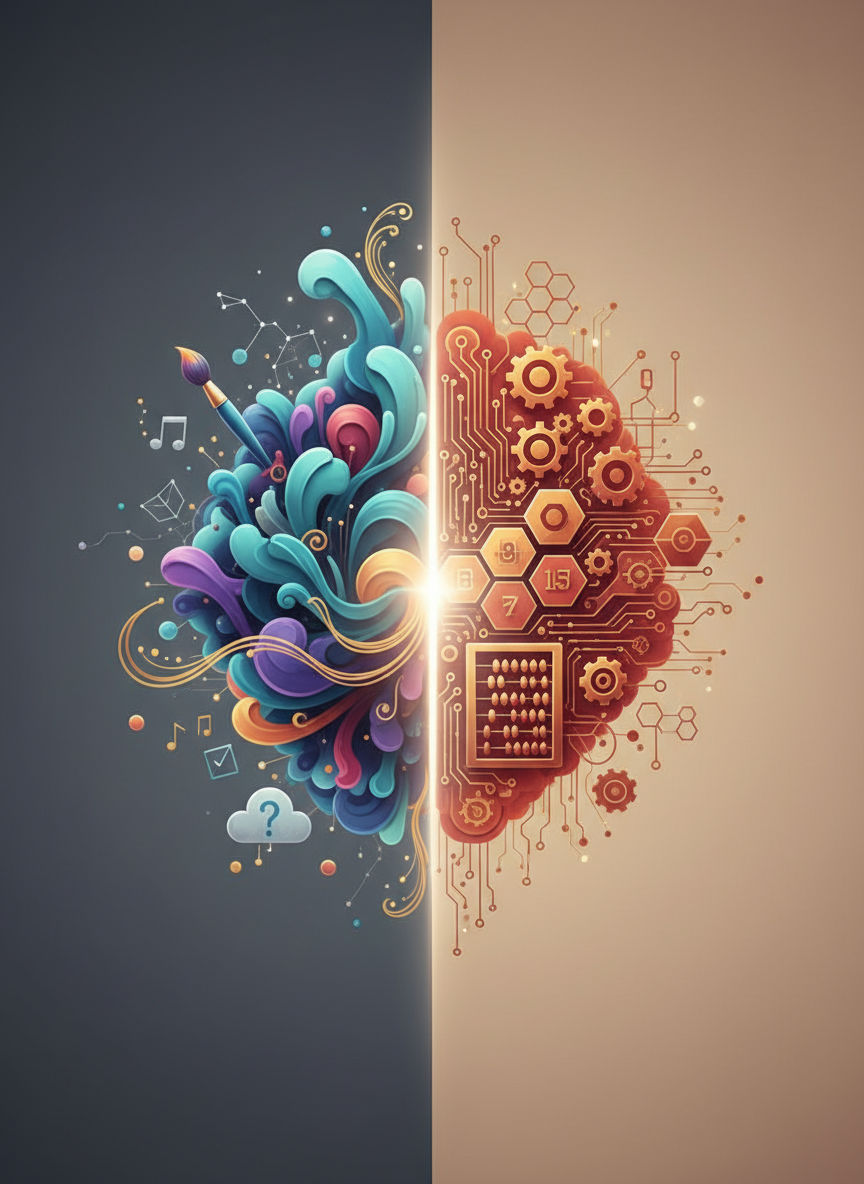
Are you really 'right-brained,' or is your personality a scientific fairy tale?
Prompted by A NerdSip Learner
Debunk the myth and understand how your whole brain works.
In the 1960s, neurobiologist Roger Sperry conducted famous "split-brain" experiments. He studied patients who had their corpus callosum—the bridge between the two halves of the brain—severed to treat severe epilepsy. Sperry discovered that the two sides *do* have different specialties. For example, the left side usually handles language, while the right side is better at spatial recognition.
However, the media and popular culture took these specific scientific findings and ran wild with them! They turned a discovery about lateralization into a personality test. Suddenly, the world was divided into "logical" left-brainers and "creative" right-brainers. It was a simple, catchy way to explain why humans are different, but it was a massive oversimplification.
In reality, while some functions are more concentrated on one side, they never work in total isolation in a healthy brain. Your brain is a highly collaborative team, not a set of roommates who never speak to each other. The myth survived because humans love to categorize themselves, but the science moved on long ago.
Key Takeaway
The myth originated from oversimplified media reports of 1960s split-brain research.
Test Your Knowledge
Why did the 'left-brain/right-brain' idea become so popular?
Meet the corpus callosum. This is a thick bundle of over 200 million nerve fibers that connects the left and right hemispheres of your brain. Think of it as a massive, high-speed fiber-optic cable that allows both sides of your brain to communicate instantly and constantly.
Because of this connection, your brain is a single integrated system. For almost every task you do, both sides are firing away in a coordinated dance. For instance, when you have a conversation, your left hemisphere might process the literal meaning of the words (grammar and vocabulary), but your right hemisphere is busy interpreting the tone of voice, sarcasm, and emotional context.
Even "simple" tasks like walking through a crowded room or catching a baseball require lightning-fast communication between both halves to coordinate your vision and your movement. Without that bridge, your perception of the world would literally be split in two. You don't have a 'dominant' side; you have a highly connected partnership.
Key Takeaway
The corpus callosum ensures that both brain hemispheres work together as one synchronized unit.
Test Your Knowledge
What is the primary function of the corpus callosum?
Let’s look at the two biggest stereotypes: "logical" math and "creative" art. Modern brain imaging, like fMRI scans, shows that a mathematician solving a complex equation has activity occurring across both hemispheres. Logic isn't just a left-brain task; it requires spatial visualization (often right-hemisphere) and symbolic processing (often left-hemisphere).
The same applies to creativity! Painting a masterpiece or writing a song isn't just a "right-brain explosion." Creative work requires planning, structure, focus, and technical skill—all of which heavily involve the left hemisphere. There is zero scientific evidence that one side is "stronger" or that your hobbies are determined by hemisphere dominance.
Researchers have analyzed the brain scans of thousands of people and found that everyone uses their entire brain for almost everything they do. You aren't a 'left-brain' or 'right-brain' person. You are a whole-brained person who uses a complex network of connections to be uniquely you!
Key Takeaway
Both 'logical' and 'creative' activities require synchronized activity across the entire brain.
Test Your Knowledge
What does modern brain imaging (fMRI) reveal about how we use our brains?
Track your progress, earn XP, and compete on leaderboards. Download NerdSip to start learning.